

SONO
Sonos Inc
Sonos past growth is... bad...
Is The Business Growing?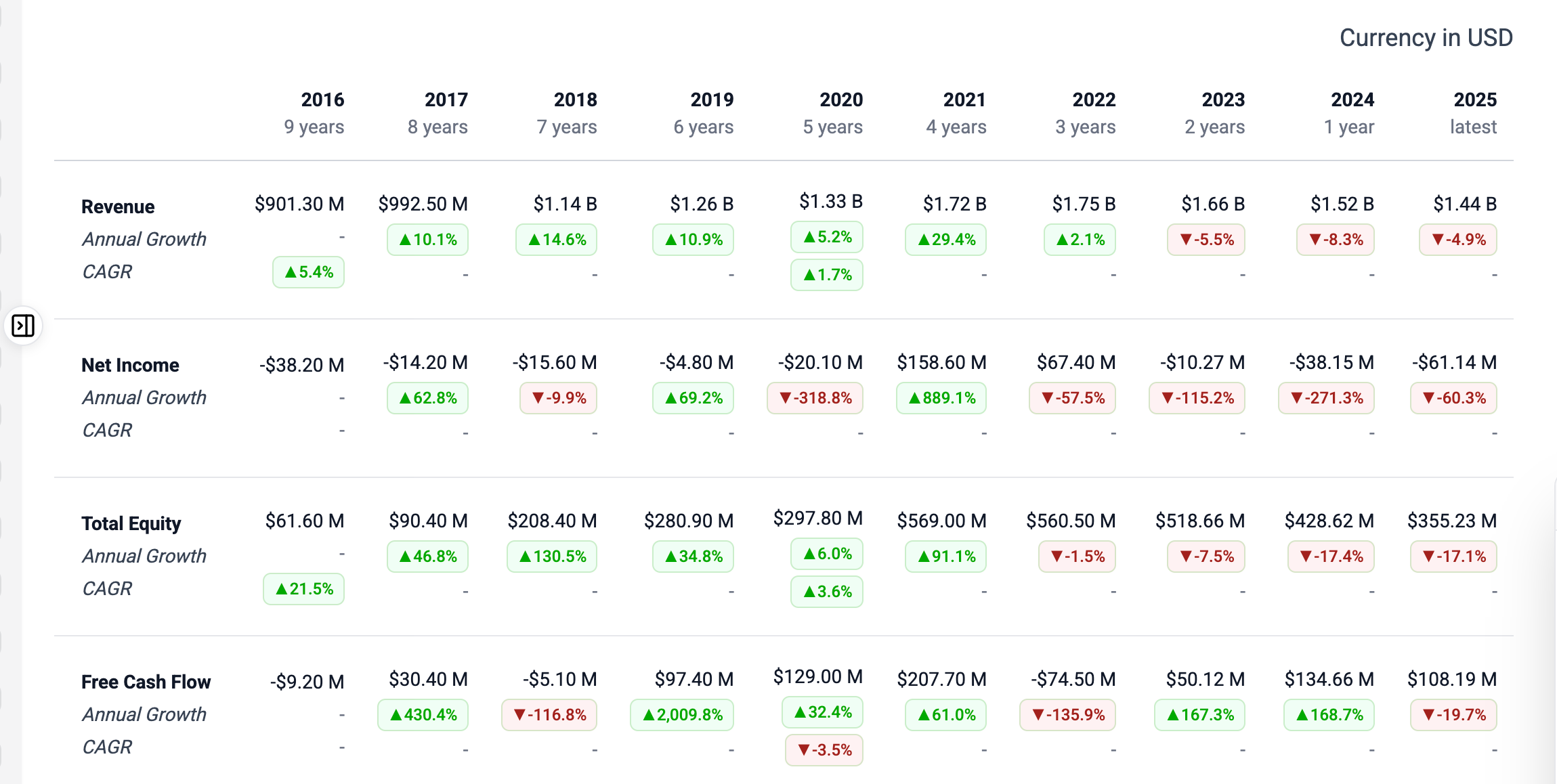
I pulled up the growth metrics for Sonos and three numbers jumped off the screen. Total equity is down 38% from its 2021 peak.
Net income has been red in seven of the last ten years.
Revenue has now declined three years in a row.
If you stopped there, you'd call it a dying business. I don't think that's the right read of the data after understanding the business model.
The red ink has a shape
Sonos is a hardware company with a 44-47% gross margin carrying the operating costs of a much bigger company. R&D alone runs near 20% of revenue. At that cost structure, the math only works above roughly $1.6 billion in sales - which they haven't hit in the past two years.
Fiscal 2021 proved the model works at scale: revenue jumped 29% to $1.72 billion and Sonos earned $158.6 million in GAAP net income.
Every year since, revenue has sat below that breakeven line while costs came down slowly. Poor management compounded the problem: the botched 2024 app redesign cost roughly $100 million in revenue plus another $20-30 million to fix.
Add three rounds of layoffs, $39 million of inventory write-downs, and new tariffs in fiscal 2025, and you get three straight years of losses.
The equity decline is mostly on purpose
Here's the one that fooled me for a second. Equity fell from $569 million to $355 million, and losses only explain about $110 million of that.
The bigger driver: Sonos has been buying back stock the whole way down. Roughly $350 million of repurchases since fiscal 2022, including $81 million last year at an average price of $14.23, with a fresh $150 million program authorized in February 2025.
Equity can shrink two ways: by bleeding, or by choice. Sonos is doing both at once. Buying back stock while posting GAAP losses usually makes me nervous.
Here it's funded by positive free cash flow and a debt-free balance sheet with about $200 million in cash, so I'd call it discipline, but only barely. If free cash flow flips negative, this exact behavior becomes desperation.
Why the cash flow line looks fine anyway
Free cash flow was positive all three loss years, and there are two reasons. Stock comp is a real cost but not a cash one, and it ran $75-90 million a year. And Sonos spent fiscal 2023-2025 draining the inventory mountain it built in 2022, which is exactly why FCF was negative $74.5 million that year. The cash is real, but part of it is a one-time unwind, not the business humming.
So, is it growing?
Management frames the model as two levers: households, and revenue per household. The first lever still works. The installed base grew 5% last year to 17.1 million households, devices per household ticked up to 3.13, and existing customers drove 45% of new product registrations. The second lever is broken. When your customer count grows 5% a year and revenue falls 5% a year, each household is buying meaningfully less.
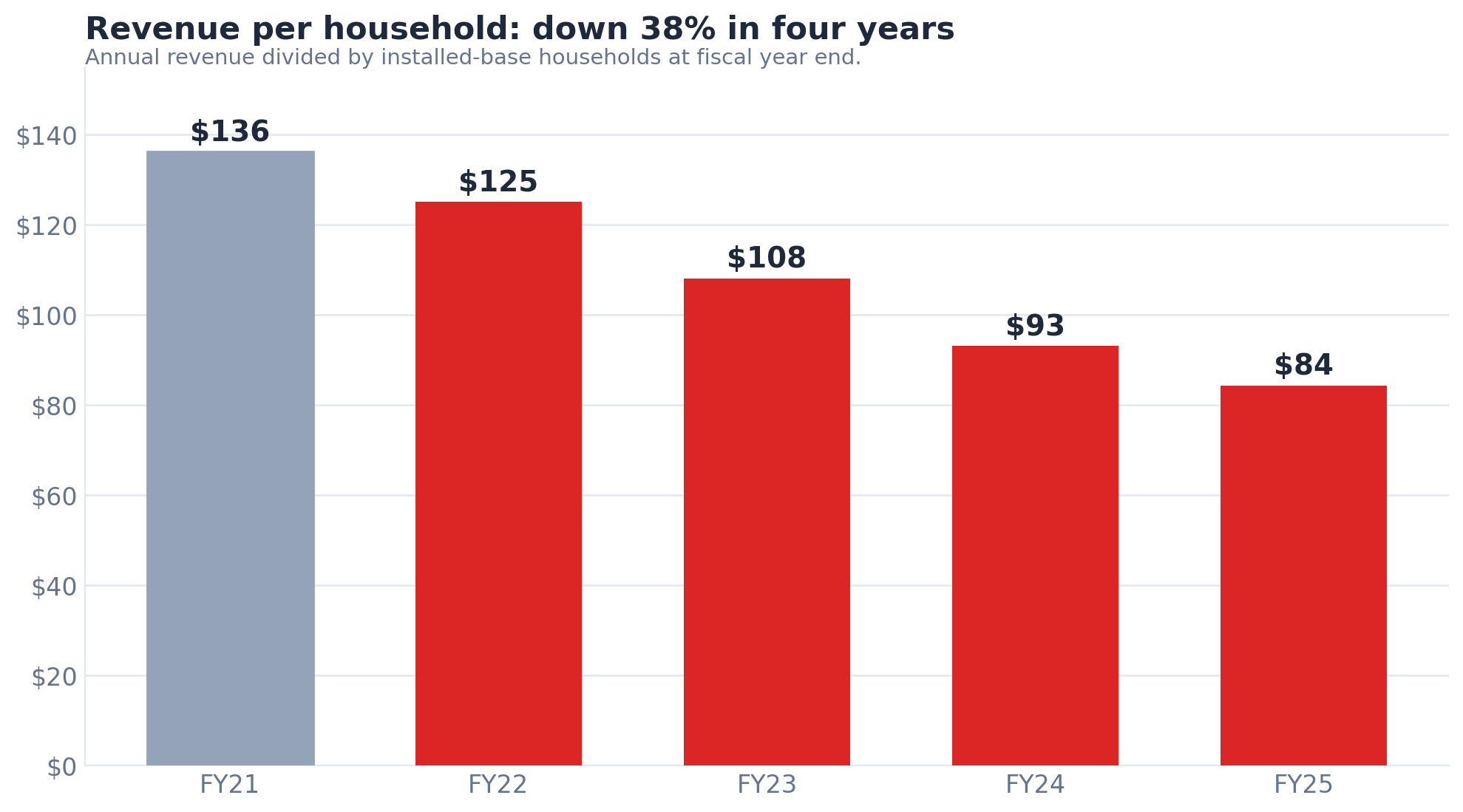
So my answer for this step: no, Sonos is not growing. It's stabilizing. The chart can't show it yet, but in the first half of fiscal 2026 revenue turned slightly positive and Sonos posted $64.9 million of GAAP net income. Look at how, though: they cut operating expenses 21% year over year. That's a cost-cutting profit, not demand coming back.
Final Thoughts
When growth goes negative, our job is to figure out whether the business is dying or resetting. For Sonos: the equity decline is mostly capital returns, the losses come from a cost base built for the $2 billion company management promised (they were targeting $2.5 billion in revenue for fiscal 2024, and actual came in at $1.52 billion), and the one thing still compounding is the installed base.
A loyal, growing customer base inside a shrinking income statement is a problem.
Sentiment: Neutral