

SONO
Sonos Inc
How does Sonos make money?
I originally published this as research, but we have a bug in our draft system on research posts, so while I can see it, it never posted to the feed (working on the bug)
Sonos sells speakers. Hardware is roughly 95% of revenue.
The interesting part is what happens after they sell you the first box.
Source: fiscal 2025 10-K
One product, three revenue lines
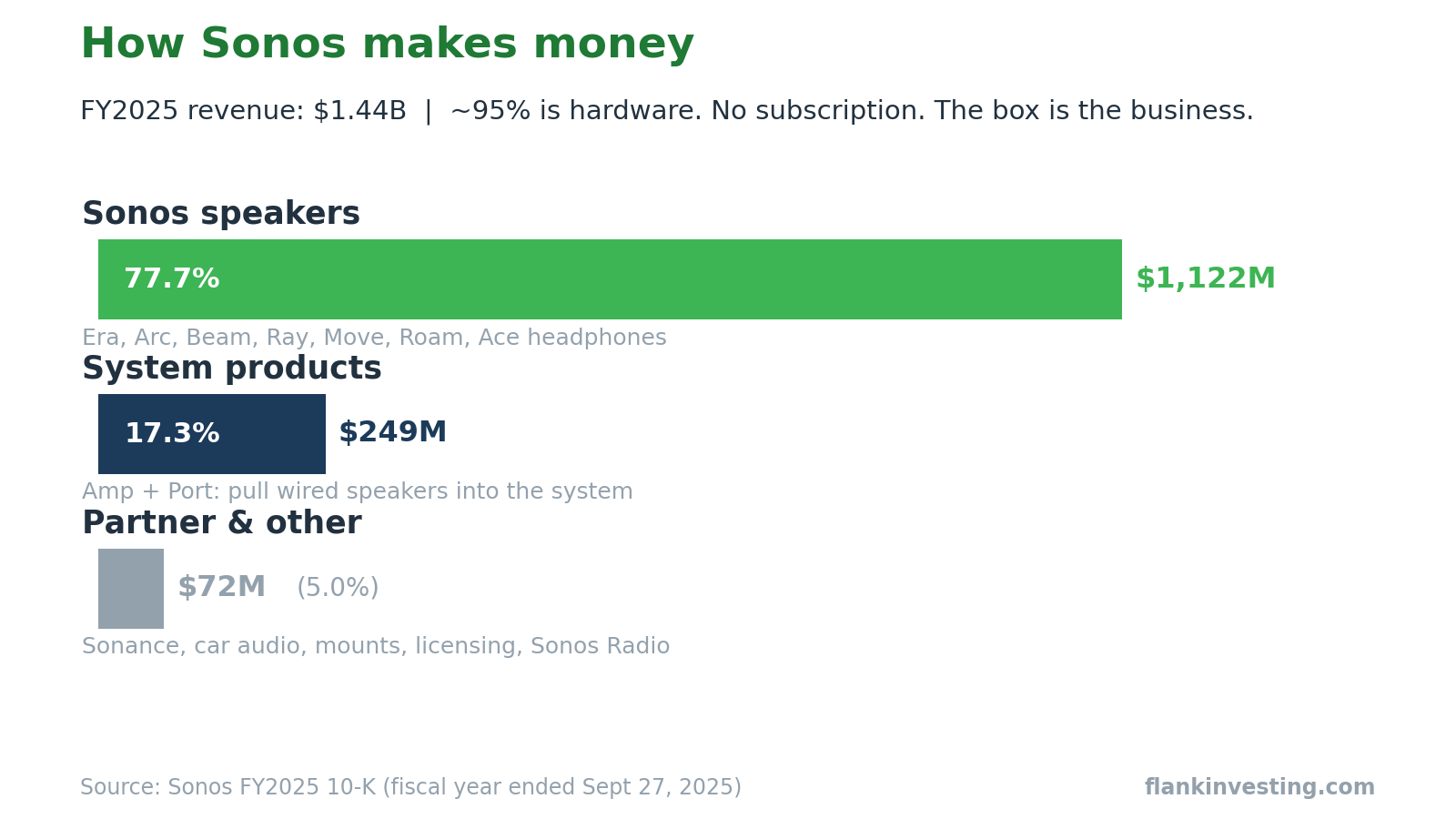
Sonos booked $1.44 billion of revenue in fiscal 2025 (their year ends in late September), reported in three business units.
Sonos speakers did $1.12 billion, 77.7% of the total. That bucket is everything with a driver in it: Era, Arc, Beam, the portables, and the Ace headphones.
System products did $249 million, 17.3%. That's the Amp and the Port, boxes that pull old wired speakers into the Sonos system.
Partner products and other did $72 million, just 5%. The scraps live there: Sonance architectural speakers, car audio, stands and mounts, licensing, and ads on Sonos Radio.
CEO Tom Conrad puts it more simply. "We really make just one product, which is a sound system for the home," he told TechRadar in March.
Every individual speaker is just a door into that system, or a way to deepen your attachment to it.
That framing is the entire business model.
The flywheel
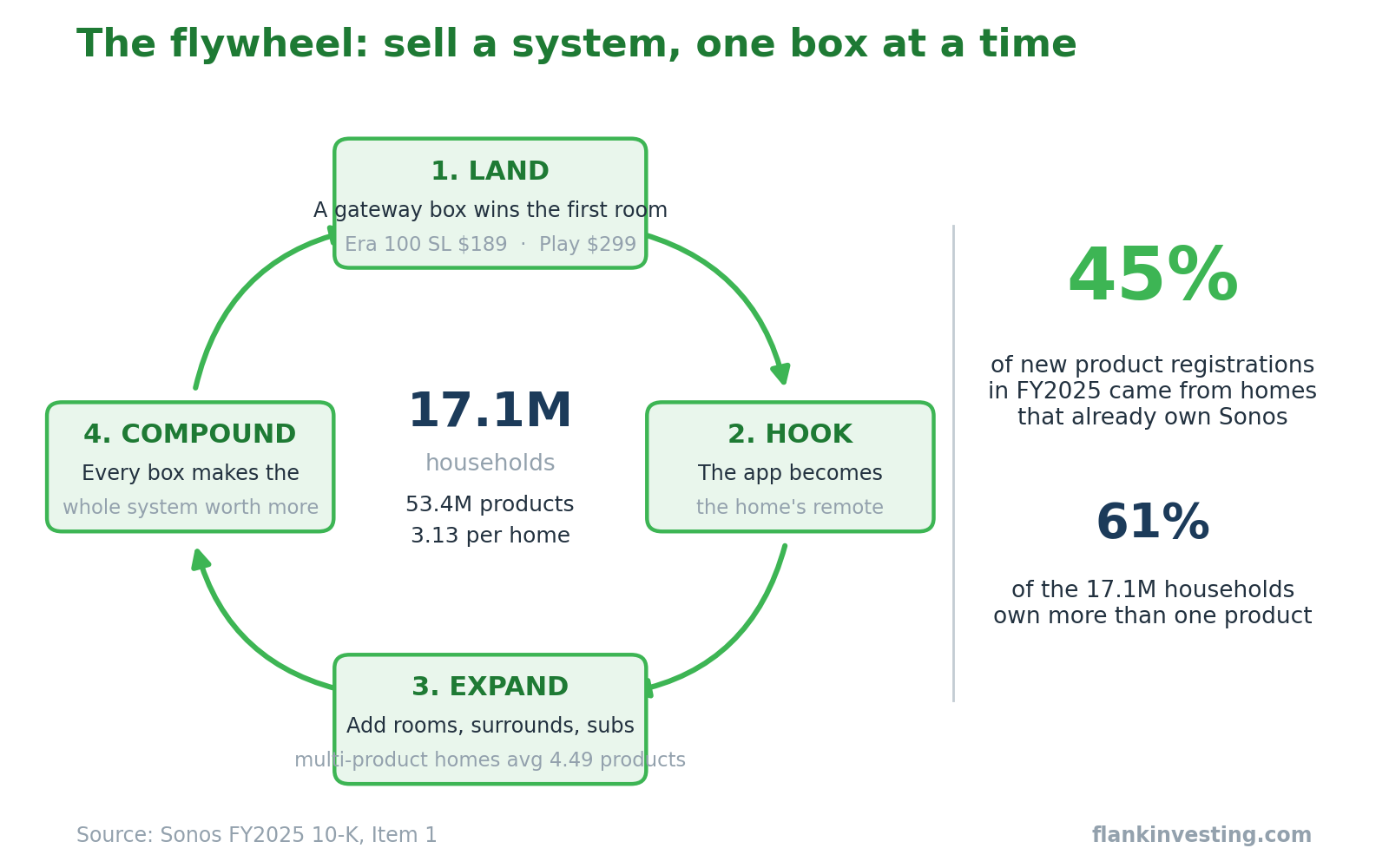
Here's what the system looks like in numbers. Sonos sits in 17.1 million households across 60+ countries, with 53.4 million products registered.
That's 3.13 products per home. 61% of households own more than one speakers, and those multi-product homes average 4.49 speakers, which they believe represents an opportunity.
"Lifetime value is more than just how many products a household owns; it also reflects the horizon over which they are investing in their Sonos systems. We aim for households to upgrade, expand and enjoy our products for years. To do this we will keep systems fresh and relevant through reliable software updates, delivering superior customer service, and bringing product innovations to market that inspire system upgrades." (pg 5 of the 2025 10-K)
And the number I keep coming back to: 45% of new product registrations in fiscal 2025 came from households that already own Sonos.
That's what I believe Sonos' flywheel is. They get you to buy a single unit, and because the appeal to have whole-home audio is so awesome (can confirm it's sick) - consumers keep buying speakers. I know because I'm one of the 61%... I counted 6 Sonos products in my house...
The unit math tells the same story. Sonos sold 4.6 million products in fiscal 2025, which works out to roughly $310 of revenue per box. Fewer units than last year (down 7.5%), propped up by premium pricing. GAAP gross margin ran 43.7%, fat for consumer hardware, because the system justifies the price tag. So the model in practice: retail wins the first room, then the software sells the next three from the couch, at full margin, with zero customer acquisition cost.
How the boxes get sold
Distribution is the part most people skip, and it matters here. Per the Q2 FY2025 slides, retail (Best Buy, Amazon, and friends) is about 60% of revenue. Direct through sonos.com is 27%, down from a peak of 32% in fiscal 2021. Custom installers are 13%, up from 8% in fiscal 2018, and that's the quiet push right now: the Era 100 Pro launched for that channel in January 2025, and the Amp Multi, an eight-channel amp for big residential installs, ships this fall.
On the supply side, contract manufacturers in Vietnam, Malaysia, and China build everything, and roughly 60% of sales come from the US. Remember those two facts. They come back in a minute.
When the flywheel broke
Now the part every Flanker should study, because it's a masterclass in how a business model fails from the inside.
In May 2024, Sonos shipped a ground-up rewrite of its app to pave the way for the Ace headphones launch. It went out missing alarms, sleep timers, queue management, and local music libraries. Loyal customers watched thousand-dollar systems turn unreliable overnight. Then-CEO Patrick Spence reportedly collected 30,000 complaint emails. The company budgeted $20 to $30 million just to fix it, delayed two products (Arc Ultra and Sub 4), and later admitted to roughly $100 million of lost revenue. Two rounds of layoffs followed, 6% and then another 12%. Spence was out by January 2025.
Zoom out and the damage is bigger than one bad year. Revenue peaked at $1.75 billion in fiscal 2022, then fell three straight years to $1.44 billion.
Here's the lesson. At most hardware companies, a bad app is an annoyance. At Sonos, the app is the checkout aisle. When 45% of your sales come from existing customers voluntarily adding boxes, breaking their remote doesn't just hurt satisfaction scores. It stalls the entire revenue engine.
The rebuild
Tom Conrad, a board member since 2017 and ex-Pandora CTO, took over in January 2025 and got the permanent job in July. He killed the long-rumored streaming box, flattened the org, and pointed everything back at the system. By November he was telling investors "we restored the quality of our software."
The numbers say the repair is working. In Q1 of fiscal 2026 (the holiday quarter), Sonos earned about $91 million of GAAP net income, up from $50 million a year earlier. For all of fiscal 2025 it lost $61 million. In Q2, revenue grew 8% to $281.5 million and the GAAP net loss narrowed from $70 million to $29 million. First-half revenue is up 2%, and Conrad says they've "changed the trajectory of the business."
The product strategy now reads like a flywheel repair manual. The new Play at $299 and Era 100 SL at $189, launched in March, are explicitly gateway products, the first new consumer hardware in over a year. Amp Multi feeds the installer channel. And a new Škoda partnership puts the system in cars, following Audi.
What could change the model from here
Four things I'm watching.
1. The $12 billion pitch. Conrad claims the existing customer base alone holds $12 billion of revenue opportunity: $5 billion from pushing households toward six devices, $7 billion from converting single-product homes. I treat big round TAM numbers with suspicion, and this one can't be falsified. But it explains every decision Sonos is making, from gateway pricing to the app obsession.
2. Tariffs. With production in Vietnam and Malaysia (tariffed around 20%) and 60% of sales in the US, tariffs were initially a $60 million headwind. Price increases in late September 2025 plus supplier cost-sharing neutralized most of it. There's even a wildcard: a duty refund claim worth up to $40 million.
3. Memory chips. The new margin villain. The AI datacenter buildout is inflating memory prices for everyone, and Sonos guided to a roughly 400 basis point gross margin headwind in Q3, with second-half margins expected below last year. A speaker company is paying part of the AI boom's grocery bill. Management's counter: nobody buys a speaker based on its memory config, so they can engineer around it.
4. The 5% bucket. Licensing and services are rounding errors today, but two live options sit there. Sonos' patent case against Google, once left for dead, was revived on appeal in August 2025. And while Conrad has told The Verge he won't paywall core features, a company with 17 million loyal households has obvious room to attach services someday. If a recurring layer ever sticks, this stops being a pure hardware story.
Sentiment: Neutral. I don't like that they don't really have a source of recurring revenue, but I like the "land and expand" model, and since they primarily target 'affluent' households - that core market may be more inclined to upgrade existing systems as new products release.