

SONO
Sonos Inc
Sonos Growth Strategy to get out of the rut their in
What's Their Growth Strategy?New CEO Tom Conrad's bet is that Sonos stopped selling what actually made it special (the system) and started selling gadgets, and that re-centering everything on "the system is the product" unlocks a $12 billion upsell opportunity inside the 17 million households it already owns. Everything else, the five "growth dimensions," the new CMO, the AI tease, hangs off that one idea.
First, his diagnosis (because the prescription only makes sense with it)
Conrad has been unusually candid about what broke. On the app: "We just changed too much too fast, and made a bunch of tactical errors along the way of rolling it out to our customers, and then paid a very dear price. As did our customers," he told TechRadar in an interview around the Play launch.
"For my first year at the company, we had to pour so much of our energy into righting the ship with respect to the software platform that underpins all of the system experiences, that we purposefully paused our new hardware introductions to get back to par on that front," he explains.
At the Morgan Stanley TMT conference on March 3, he laid out a three-chapter history: founder John MacFarlane's decade sold the whole-home system, Patrick Spence's decade turned Sonos into a hardware machine shipping two products a year, and the laser focus on becoming a hardware execution team had the unintended consequence of the company taking its eye off the system-level promise. By the time Conrad arrived, they had forgotten what it meant to sell Sonos as the product rather than a pair of headphones or a mid-tier soundbar. His two proof points are brutal and specific: the Ace headphones launched without deep Sonos integration (you couldn't move music from your speakers to your headphones), and the Era 300 still can't detect its own orientation in a home theater setup, so it dumbs itself down. His strategy, in his words: "A return to Sonos as a system for seamless entertainment in the home, powered by a best-in-the-world hardware execution engine."
The formal strategy statement landed on the Q4 FY25 call (Nov 5, 2025): "to unite every dimension of sound, through world-class hardware, software, and design, into one seamless platform for the home."
One more thing for this section, I was really impressed by how Tom Conrad working to get real feedback from the customer. In the tech radar post site above, he talks about going into customers' houses, watching them use the app, and seeing what their complaints are and what they wish it could do. I love that. He's also been on Reddit describing the changes and asking customers for their feedback.
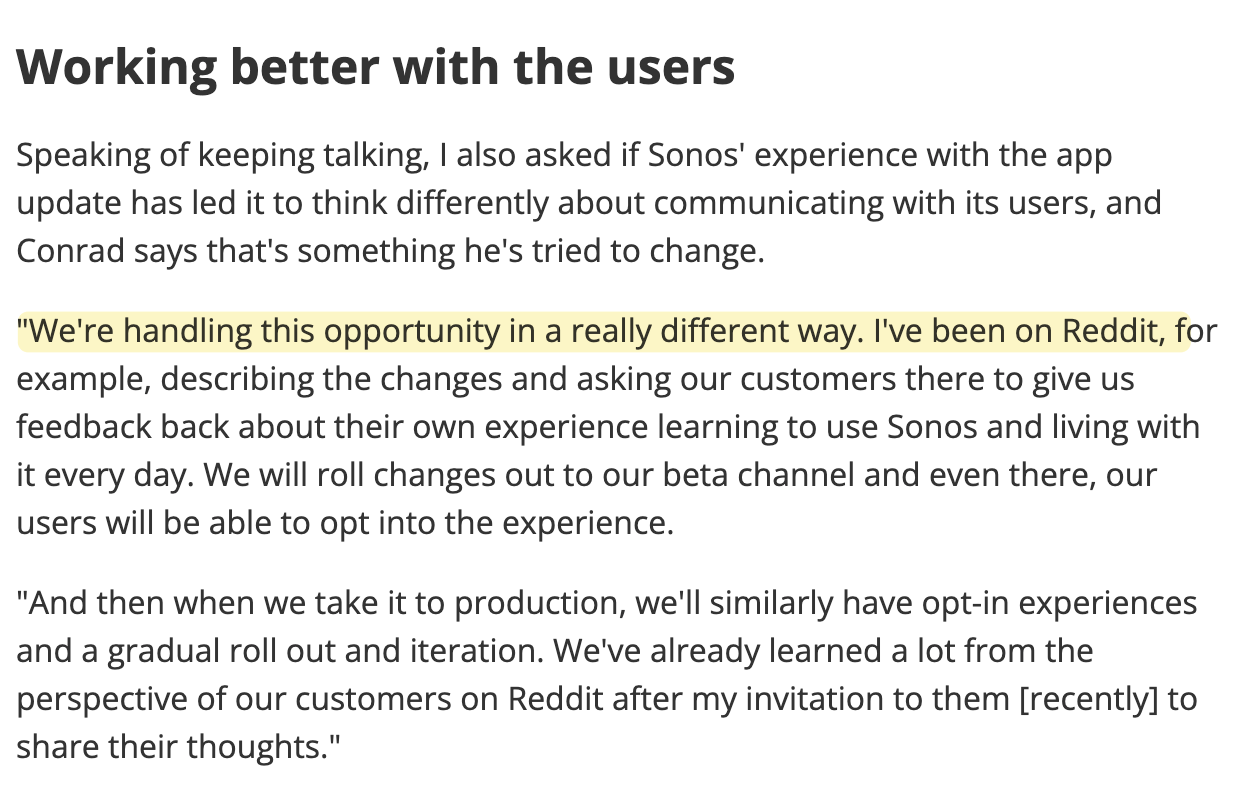
Great job, Mr. Conrad.
The five growth dimensions (the actual plan)
Conrad formalized these on the Q1 FY26 call (Feb 3, 2026), framing it with: "Sonos is not a collection of products. It's a system that gets more valuable as you add to it, use it across more rooms, and rely on it over time."
1. Product innovation, but system-first. After "an intentional pause in new hardware launches last year" to fix software, the pipeline restarted: Sonos Play at $299 and Era 100 SL at $189 launched March 31, with Conrad framing them as "a clear expression of what Sonos does best, creating products that feel simple on the surface, but are deeply powerful because of the system behind them." The press narrative is the tell they cite constantly: on the Q2 call Conrad rattled off Gizmodo calling it a comeback, the WSJ calling it the Goldilocks speaker, and Bloomberg saying "back on track." Then Amp Multi (announced Jan 27, shipping this fall) for the installer channel, which Conrad says can drive up to 768 speakers in a single home. More unannounced products are slated for this half.
2. Customer advocacy as a growth driver. "System reliability is not just a quality metric for us, it's a growth driver," because Sonos historically grew on word of mouth. At Morgan Stanley he claimed NPS, social sentiment, and customer satisfaction trends have all reversed since the repair work. Insider MonkeyInvesting.com
3. Marketing, rebuilt from scratch. Colleen DeCourcy, co-president and chief creative officer of Wieden+Kennedy for a decade, joined as CMO in January. The brief: full-funnel brand architecture around one sentence, "Sonos is the easiest way to build a sound system for the home, and it gets better as you add to it," and a shift away from "episodic spikes" tied to product launches toward a sustained marketing presence.
4. Geo expansion. The one dimension already producing undeniable numbers: in Q2, APAC grew 25% and EMEA 21% while the Americas grew 2% (constant currency: 18%, 9%, and 1% per the Q2 transcript).
5. Emerging trends, meaning conversational AI. This is the pillar Conrad calls "what I find most compelling": 17 million households and 53 million voice-enabled connected devices, "present room by room... as more people look for experiences that do not depend on pulling out their phone, that value only grows." When an analyst asked point-blank whether AI monetization means recurring revenue or advertising, Conrad said it was "premature to get into those details today" but teased: "We are building towards something larger here... there is considerably more to this story, and I look forward to sharing it with you in time." On the Q4 call he framed Sonos as a platform that "can now encompass hundreds of services, formats, and AI personalities."
The math Sonos puts behind the plan
This is the slide-one arithmetic they repeat everywhere. From the Q1 call: moving from roughly 4.5 devices per multi-product household to 6 represents about $5 billion in incremental revenue; converting single-product households to multi-product levels adds another $7 billion. Beyond the installed base, Sonos holds about 6% of the $24 billion global premium audio market. The proof of concept they lean on: cutting Era 100's price produced a third consecutive quarter of accelerating new-customer growth, up more than 40% year over year, and Era 100 SL at $189 extends that gateway logic. The installer channel is about 22% of the business and gets dedicated products (Era 100 Pro, Amp Multi).
And at Morgan Stanley, Conrad described how the lifetime-value model is now operational, with the sales org arming retail partners with data on household acquisition, initial receipt size, and repurchase behavior.
The competitive framing is the most interesting strategic statement he's made: "It's not that interesting to me that we compete with Samsung for soundbars or JBL for portable speakers or Sony and Bose for headphones. It's much more interesting who is trying to control the sound operating system in the home. Candidly, those competitors look much more like Amazon and Apple and Google." His claimed edge: Sonos is the only one delivering every dimension of sound (Alexa has about 4 SKUs, Apple 2), from a $139 entry speaker to whole-mansion installs. His three-year vision: a "segment of one," dramatically expanded brand awareness and country presence, and "conversational AI in every environment, and Sonos will be at the center of that."
What funds it, and the first crack in the story
The plan is financed by the transformation: more than $100 million in run-rate savings while, per CFO Saori Casey at Morgan Stanley, production moved to Vietnam and Malaysia before tariffs hit, pricing was used "surgically" to offset them, and capital allocation keeps a buffer for tuck-in M&A then pours "the rest into the buyback." They repurchased $65 million in H1 FY26 with $65M left authorized, sitting on $249 million net cash. A potential tariff refund "as large as $40 million" under IEEPA is pending. And they're still cutting: about 40 more UX/product/design roles on June 25, mid-"comeback."
The crack: DDR4 memory inflation from AI datacenter demand. It cost roughly 200 basis points of gross margin in Q2 (explains why I saw gross profit falling in the first step of my research), is guided as a 400 basis point year-over-year headwind in Q3, worsens in Q4, and Casey now expects FY26 gross margin "somewhat lower" than FY25's 43.5% GAAP. So the margin expansion story just inverted, exactly as the growth story got going.
The newest pillar extensions (last 30 days)
Two moves show where "system" goes beyond the home. On June 23, Sonos became the audio partner for the Škoda Peaq EV, its first car deal, with Conrad saying "As listening flows beyond the front door, this partnership enables us to imagine how the Sonos system can too."
Then on July 14, Bloomberg reported OpenAI is building a screen-free ChatGPT smart speaker (unveil 2026, ship 2027, Jony Ive's io designing), and SONO fell more than 10% in late trading before paring losses. So, the market treated OpenAI as a direct attack on pillar five, the one Conrad calls most compelling.
The Barchart writeup notes SONO dipped 9% on July 14 and sits about 24% below its 52-week high, with the stock now back around $15 (~$1.75B market cap). Meanwhile Bose just launched a Lifestyle line with Alexa+ built in. The AI land grab for the home is happening now, with or without Sonos.
Still, I can't help but think to myself: for <$2B, this seems like such an acquisition target to big tech.
Does the plan show up in the numbers yet?
Honest scoreboard. FY25 revenue fell about 5% (roughly $1.44B). Then: Q1 FY26 revenue of $546 million, down about 1%, Q2 up 8% to $282M, H1 up 2% with GAAP net income swinging $85 million to positive $65 million. Casey's line: "seventh consecutive quarter of executing against our commitments." Q3 guidance is $355-375 million, 3% to 9% growth, 6% at the midpoint, which is the first quarter where new products (Play, Era 100 SL) contribute fully.
Sentiment: Bullish. the more I'm reading about Tom Conrad, the more I'm liking him. Excited to get to the leadership step