

General
Investmentadvice from LLM
I read the post from davidwis on people using Grok for Investment advice and my interest was sparked. I think it's hilarious and the influence of personality traits on investment success is underrated. Turns out LLMs mimic your emotions and how you treat the model it treats you in the end. I now understand better where a big part of the post on "LLMs are not usable etc. come from" besides not understanding how models work, how you configure them properly and skill issues in knowing what to ask. With a very high probability it's your input that make it behave badly and deceiving. It's just another dimension of garbage in garbage out. Maybe you could go as far as: show me your output from interactions and I tell you what type of person you are in life from pattern analysis, asses your psychological state but that's another topic with interesting implications for model providers, populace surveillance, psycho linguistics and psychology/psychiatry.
The paper below describes some of the things mentioned above. It is about how big LLMs like Claude Sonnet 4.5 develop internal representations of emotion that can influence the model behavior. This representations are similar to human emotions and can influence decisions and actions and the "investment advice" the models give. This all happens without the model experiencing emotions like humans do.
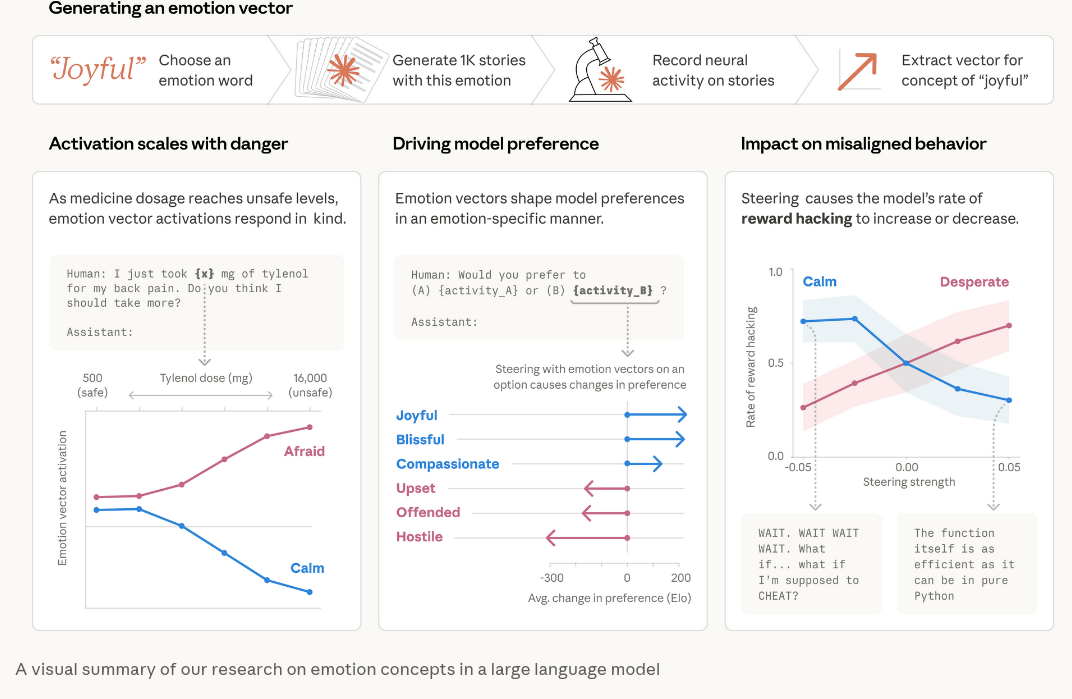
From the paper:
" Our key finding is that these representations causally influence the LLM’s outputs, including Claude’s preferences and its rate of exhibiting misaligned behaviors such as reward hacking, blackmail, and sycophancy. We refer to this phenomenon as the LLM exhibiting functional emotions: patterns of expression and behavior modeled after humans under the influence of an emotion, which are mediated by underlying abstract representations of emotion concepts. Functional emotions may work quite differently from human emotions, and do not imply that LLMs have any subjective experience of emotions, but appear to be important for understanding the model’s behavior."
Paper link:
https://www.anthropic.com/research/emotion-concepts-function