
VITL
Vital Farms Inc
Competitive Advantage?
Do They Have A Competitive Advantage?I like to define my terms to help me orient my thinking. So to start.
What is a Competitive Advantage?
A competitive advantage is why one company captures market share and will continue to hold or grow that market share going forward.
This was the simplest way i could think to define a competitive advantage.
Who is the competition?
To determine if Vital Farms has a competitive advantage we must first see whom it is they are competing with. They say themselves that they are not competing against the big egg distributors such as Cal-Maine Foods. They are positioned in the premium egg sector, making their competitors more premium brands such as Happy Egg and Pete & Gerry's. Within this niche of premium eggs, VITL is roughly the size of the next three specialty egg brands combined (Food Business News) and is in approximately 24,000 retail locations.
What are their unique strengths and assets?
To start, let's take a look at what they are reporting themselves.
Brand Equity:
From their own 2026 Q2 Earnings Call: "Even as retail egg prices across the total shell egg category fell more than 35% year-over-year amid historic industry-wide oversupply, we grew our dollar share of the category by more than 200 basis points, further extending our position as the nation's leading pasture-raised egg brand."
“(Pasture-raised) products have been on the shelf next to ours for over a decade, but what is much harder for them to copy is the trust we build with consumers and the transparency we bring. It’s really hard to be transparent about your millions of caged hens. Consumers are savvy to that. We’re a one trick pony. We just have this wonderful high level of animal welfare in our products.”
They are showing their ability to maintain brand equity even within a contracting macro economic environment.
Pricing Power:
As far as competition based solely on the lowest cost of eggs, Vital Farms said most of the shell egg industry is private label, so retailers use private label “to bring feet in the door, and we’ll continue to generate high margin, high revenue dollars on a consistent basis over time in the face of these deep discounted items,” said Peter Pappas, chief sales officer, Vital Farms. “Premium pricing does not impair performance. And that’s the power of the brand. We do not see switching. Our consumers stay with the brand. Our consumers are not interested in cheap eggs.”
They claim to have pricing power of their brand equity but there are cracks in this claim. Proven by Q2 2026. Discussed later.
Supply Chain
This is the core argument: the supply chain is the moat, and it can't be bought — only built, slowly.
Pasture-raised is land locked. 108 sq ft per hen. This means you can't scale by density; you must add land and farmers. To overcome this VITL uses a farm network partnership. That partnership grew from 300 farms in 2023 to 575 in 2025, with roughly 10 million laying hens.
The network is compounding via word-of-mouth among farmers(Iowa PBS).That took ~18 years of farmer recruitment, financing relationships, flock management training, and reputation among rural communities.
A competitor with capital can build a processing plant in two years. They cannot conjure 600 committed smallholder relationships.
The Counter
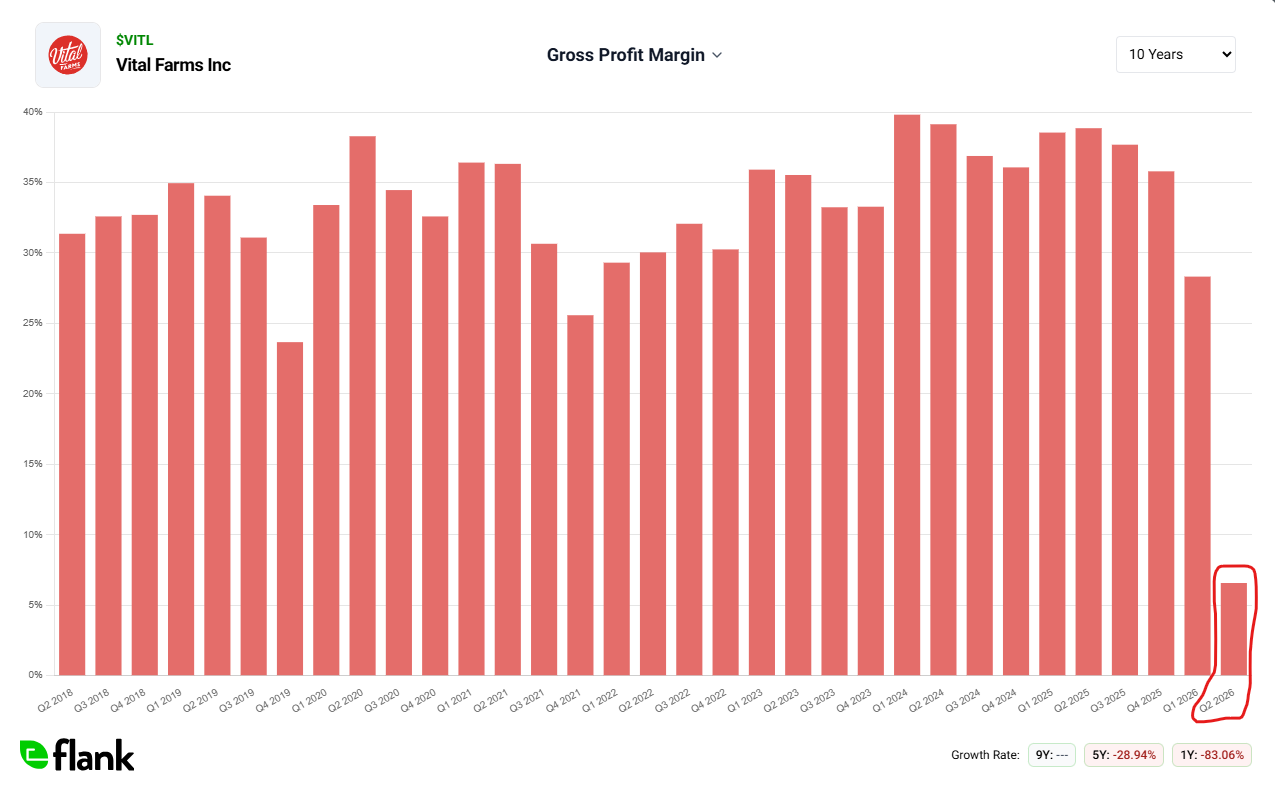
Q2 2026 Gross Margin: 6.5%. Why?
$10.9M of gross profit on $166.0M revenue = 6.6%, versus $71.8M on $184.8M = 38.9% a year earlier. Of the ~$60.9M gross-profit decline, roughly $28.1M is the "supply management and discrete expenses" bucket (breaker sales + butter exit + contract amortization) — the rest is the underlying volume decline and cost inflation hitting a smaller revenue base.
These are the cracks to their pricing power claims. They lost significant margin in Q2. Yes some one time expenses, but also they were affected by the industry wide over supply and could not move their inventory of eggs at the price and velocity they thought they could.
VITL had more eggs than retail shelves could absorb at retail prices, the surplus got diverted to "breaker" (liquid egg processing) and wholesale channels, which pay commodity-grade prices. Volume actually rose here — but price fell so far that the extra units contributed essentially nothing to revenue ($0.1M net) while carrying full production cost.
Retail channel net revenue itself fell from $176.1M to $158.0M on a $19.8M volume decline (the price-gap-driven demand softness we discussed).
Why this matters for the thesis: management is explicitly calling Q2 the trough and guiding to ~30% gross margin by Q4 exit, with the farmer contract amendments now live specifically to prevent this exact oversupply mechanism from recurring, and price gaps to branded competitors already narrowing ($2.51 → $2.36, against a $1–$2 target range). This reads as a supply-planning failure with a defined fix in motion, not a structural repricing of the business — but 30% would still be well below the 38.9% baseline, meaning even the "recovery" case implies gross margins settle at a permanently lower steady state than the 2025 HPAI-inflated peak.
Sentiment: Neutral to Slightly Bullish