

AMZN
Amazon.com Inc
The Everything Store's domination plan
What's Their Growth Strategy?Years ago I read The Everything Store by Brad Stone. It had a profound impact on how I view business, and led me to my first investment in Amazon back in the mid-10s
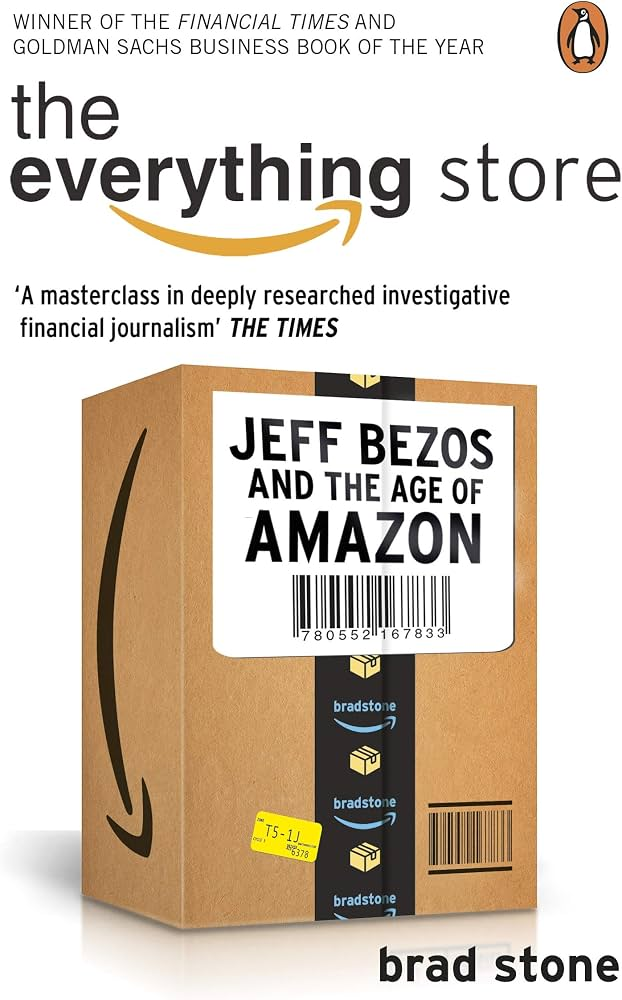
Here's what it taught me. Jeff Bezos broke into retail, arguably the most competitive industry on earth, with a wedge. He didn't try to sell everything. He sold books... Then he expanded beyond books. But the goal the entire time was tell sell everything, and that's what they did/are continuing to do.
Sometimes the cut-throat realities of retail expansion got ugly. In 2010 Amazon wanted Diapers.com. The founders said no. So Amazon cut diaper prices 30% and, according to Stone's reporting, threatened to drive prices to zero. Walmart offered more money. The founders took Amazon's $545 million offer anyway, "largely out of fear." Amazon shut the whole thing down seven years later.
But amongst this entire wave of cutthroat capitalism, one thing has persisted: Amazon's fearless growth strategy of doing everything they can to create the best experience possible for the customer, while maintaining and incredibly innovative dog-food-eating culture that builds things internally - and if they work, sells them externally.
My favorite example of this is the announcement of AWS back in 2016. Amazon rolled an 18-wheeler onto a conference stage. . Inside was a 45-foot shipping container packed with 100 petabytes of hard drives, built to physically haul a company's entire data center into the cloud. Jassy's line: "We're going to need a bigger box."
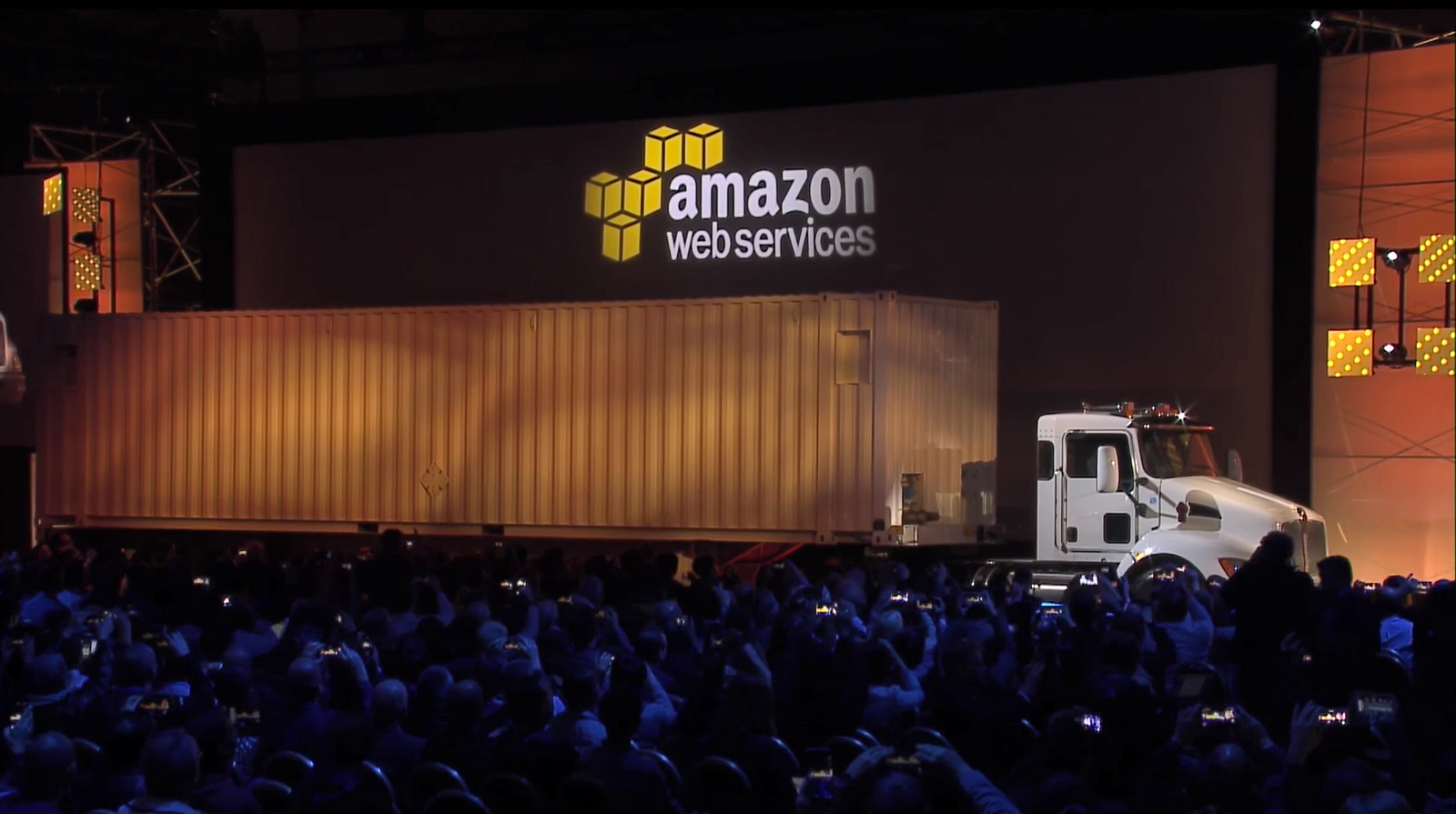
That truck, to me, is the whole company in one image. Amazon needed to move enormous amounts of data, built a ridiculous solution, then sold it to everyone else. And in 2024 they quietly killed it. One known customer, ever... but it was the seeds for their most profitable business unit (AWS, as my post on how amazon makes money showed), and arguably the most commercially SaaS platform ever (maybe Microsoft Office beats it...)
That's the execution record I love. Mostly excellent, with real misses, but the accept their failure and cut losses.
Some of the misses:
The Fire Phone cost them a $170 million write-down including $83 million of unsold inventory. The devices business lost over $25 billion between 2017 and 2021.
They killed the Astro home robot after spending more than $1 billion on it.
In January 2026 they shut down Amazon Go and Amazon Fresh physical stores entirely.
1. The Strategy
Based on following this company for years, if I had to boil the growth strategy down to one thing: it's customer centricity.
They do everything in their power to make sure customers have a great experience. And to make the unit economics work while still giving the customer the best value, they build out enormous scale. The scale isn't the goal. The scale is what makes the customer promise affordable.
The second thing I love about this culture: they eat their own dog food.
AWS started as internal plumbing. Amazon needed compute for itself, built it, then realized other people needed it too. It is now a $169 billion annualized business throwing off $45.6 billion of operating income in 2025. Fulfillment by Amazon followed the same path.
And it doesn't stop there. In the 2025 shareholder letter, Jassy wrote:
"There's so much demand for our chips that it's quite possible we'll sell racks of them to third parties in the future."
"Wherever we can leverage our scale and real-time feedback loop from so many robots in our fulfillment network to build robotics solutions for other industrial and consumer customers, we'll explore doing so."
I highly recommend reading the Annual report. It's exactly what we want to see as Flankers.
I wanted to know whether they can actually do this. On chips, yes, easily. Amazon's silicon arm is Annapurna Labs, acquired in 2015, and it's already one of the largest fabless chip companies in the world and a top-five TSMC customer.
Fabless means exactly what you'd guess: they design, TSMC manufactures. Same model as Nvidia. So selling racks externally isn't a factory problem. It's a sales and supply-allocation decision.
Robotics is a different story. They run over a million robots internally, but building and supporting hardware for outside customers at commercial scale is unproven. More on why that matters below.
When you operate at hyperscaler scale, your internal tools are worth tens or hundreds of billions. Jassy put a number on it: if the chip business sold externally the way standalone chipmakers do, the run rate would be roughly $50 billion instead of the $20 billion it books internally.
2. The Four Levers
I think of Amazon's growth as four levers, not one business.
A note on why four. Amazon reports three segments (North America, International, AWS) but seven revenue lines. So we get revenue detail on all four levers, but operating income on only one of them: AWS. Keep that in your head. It matters enormously when we get to valuation.
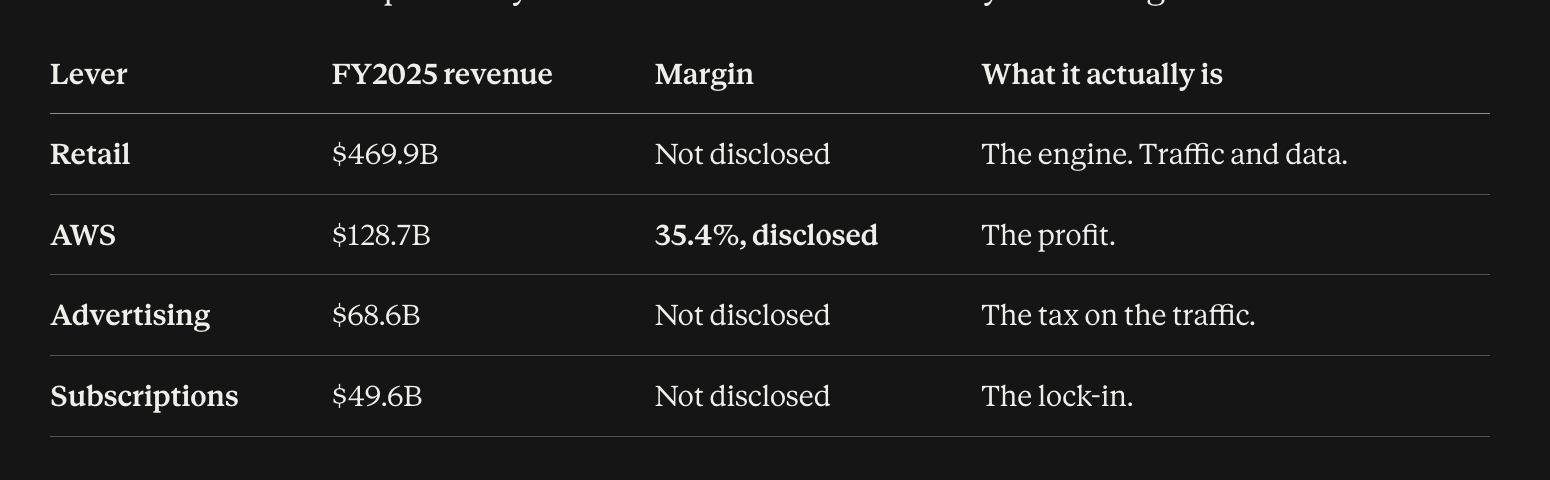
Retail did $469.9 billion in 2025. Margin not disclosed. This is the engine that generates the traffic and the purchase data everything else feeds on.
AWS did $128.7 billion at a 35.4% operating margin. That margin is the only one Amazon actually tells you, and AWS produced 57% of total company operating profit on 18% of revenue.
Advertising did $68.6 billion. Margin not disclosed. This is effectively a tax Amazon collects on its own traffic.
Subscriptions did $49.6 billion. Margin not disclosed. Prime is the lock-in - similiar to how Costco uses their subscriptions
So, current growth rates and the various growth rates I'm assigning to each lever:
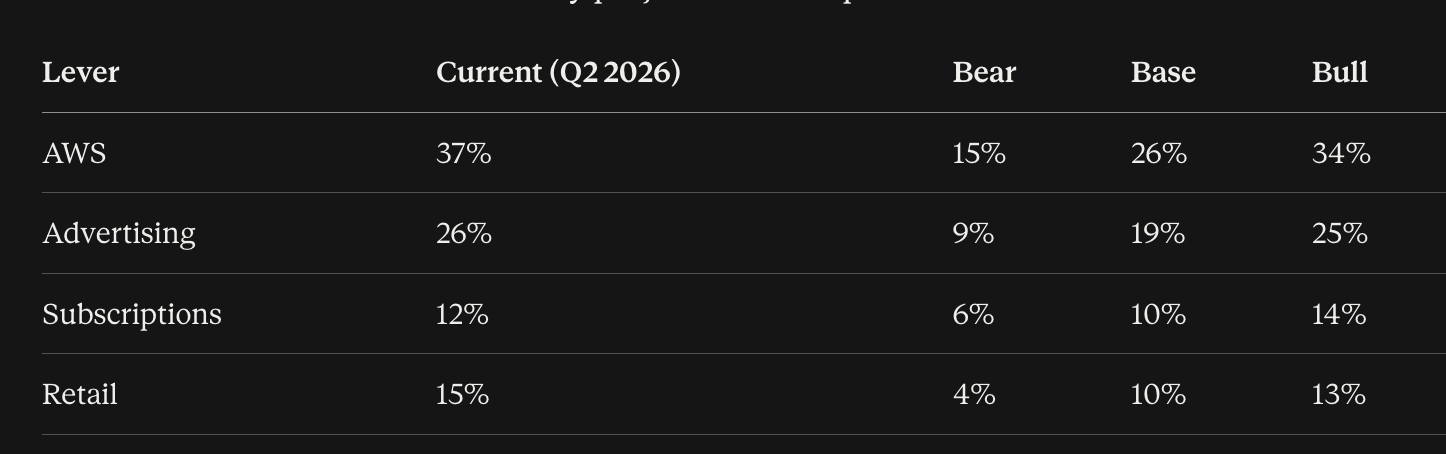
I'll put real growth ranges on these when we get to valuation, but roughly, through 2030: AWS somewhere between 15% and 34% annually with a base case around 26%. Advertising between 9% and 25%, base around 19%. Retail between 4% and 13%, base around 10%. Subscriptions between 6% and 14%, base around 10%.
That's a wide cone for a company this mature, and the width is the story. Three independent things could each break either way. Thank Buffett for Margin's of Safety.
3. AWS: Why It Actually Grew
AWS grew 36.7% in Q2 2026, its fastest in 18 quarters and its fifth straight quarter of acceleration, up from 17%.
Three reasons, and none of them is "AI is hot."
The backlog. Contracted work not yet delivered sits at $496 billion, up from $364 billion one quarter earlier. That's 3.3 times trailing revenue. Most of this growth was signed years ago and is only now showing up.
Capacity came online. Jassy says that even at $220 billion of capex they won't have enough capacity in 2026, expects the same in 2027, and called 2028 demand "striking." Growth here is supply-constrained, not demand-constrained. That's a very different problem to have.
The silicon.
Hold that last one for the next section, because I think it could be big.
The chips, in plain English
Amazon designs four families of chip, and the names are confusing until someone lays them out.
Nitro is the plumbing. It offloads networking, storage and security from the main processor. Every AWS server since 2015 runs on it. You'll never see it mentioned in a headline and it's arguably the most important of the four.
Graviton is the general-purpose CPU. It runs websites, databases, ordinary applications. It delivers 30 to 40% better price-performance than comparable Intel or AMD instances, and 98% of the top 1,000 AWS customers use it.
Inferentia runs inference, meaning it operates models that have already been trained.
Trainium trains the models. This is the direct Nvidia competitor.
Combined, they're at over $25 billion run rate, growing triple digits.
Who's buying? Anthropic and OpenAI have both made multi-year, multi-gigawatt Trainium commitments. Meta signed a multibillion-dollar Graviton deal. Uber and Pinterest are on Trainium. Two customers asked to buy Amazon's entire Graviton capacity for 2026 and were told no.
Trainium2 is sold out. Trainium3 is nearly fully subscribed. Trainium4 is 18 months from broad availability and already significantly reserved.
Jassy's claim on the economics: at scale, Trainium saves Amazon "tens of billions of capex dollars per year" and several hundred basis points of operating margin versus renting someone else's chips.
What Bedrock is
I skipped over this. Bedrock is AWS's model marketplace. Instead of picking one AI provider, you rent access to all of them through one API: Claude, GPT, Gemma, Grok, and dozens more, with enterprise security and governance wrapped around them.
The strategy is Switzerland neutrality. Amazon isn't betting on having the best model. It's betting on being the place you rent whichever model wins. Over 100,000 customers run Claude on Bedrock alone. Amazon says more customers joined in the last six months than in Bedrock's first two years, and that customers spent more in Q2 than in all prior quarters combined.
Why AWS is losing share
This is the question I wanted answered, so I dug in.
AWS is at roughly 28-30% of global cloud infrastructure, down from 32-34% in 2022-23. Meanwhile Google Cloud grew 82% last quarter and Azure grew 43%, both faster than AWS.
It is not churn. Enterprises are not ripping AWS out. Migration costs are brutal and multi-cloud adoption is now near 90%, so companies add a second provider rather than switch.
It's that the new AI dollar is landing disproportionately elsewhere. Azure has the OpenAI relationship pulling workloads in. Google has TPUs and prices AI workloads 5-10% below AWS and Azure. And Google Cloud is a fraction of AWS's size, so the same absolute dollar shows up as a much bigger percentage.
AWS is adding more revenue in dollars than anyone. It's just adding it to a bigger base while the challengers grow off small ones. Both things stay true for a while. They don't stay true forever.
What happens if the AI bubble pops
Honest answer: AWS gets hurt, but less than you'd think, and here's why.
The $496 billion backlog is contracted. Frontier labs are the concentration risk, and if OpenAI or Anthropic can't fund their commitments, that's a real hole. But Graviton is not an AI story. It runs ordinary computing for 98% of AWS's biggest customers, and that demand doesn't evaporate because model training slows.
The bigger risk isn't revenue. It's the asset. Which brings me to the part I want you to actually understand.
The Anthropic deal
This one is bigger than most people realize.
In April 2026, Amazon committed up to $25 billion to Anthropic, $5 billion immediately and $20 billion tied to milestones, on top of $8 billion already in. Total exposure north of $33 billion.
The money going the other direction matters more. Anthropic committed more than $100 billion to AWS over ten years and locked up as much as 5 gigawatts of Trainium capacity. They already run over a million Trainium2 chips through Project Rainier, a joint cluster that was the largest in the world when it launched.
So Amazon invests in a customer, the customer spends it back at Amazon, and Amazon books it as revenue. That's circular financing, and I've written about the pattern before. It doesn't make the revenue fake. It does mean you should weight it below a customer spending money it earned somewhere else.
It also produced the strangest number in Amazon's financials. Q2 net income was $62.6 billion, of which $53.4 billion was a non-operating paper gain from marking up the Anthropic stake. That is not earnings - we made a whole video and post on it :)
4. Advertising
Ads grew 26% to $19.8 billion in Q2, breaking out of four straight quarters at 22%. Amazon now takes over 75% of all US retail media spending.
Three expansions running at once. Up-funnel into Prime Video, Fire TV, Twitch and live sports. Off-site, where the DSP puts Amazon's purchase-intent data on third-party inventory including Netflix and Paramount+. And agentic, where Sponsored Prompts went live as a billable placement in March 2026.
That last one is the quiet one. If shopping moves to AI agents, the search ad box disappears. Amazon is building its replacement inside its own walls first, while blocking roughly 50 AI crawlers and suing Perplexity to keep everyone else's agents out.
5. Retail, and the Number Nobody Publishes
Online stores grew 15% in Q2. Third-party seller services grew 16%. Paid units grew 17%.
The strategic push is grocery. Amazon is now the second-largest grocer in America with over $150 billion in gross sales. Monthly active perishables customers grew over 50% since January. Same-day orders with perishables carry three times more units. Groceries drive frequency, and frequency drives everything else.
Amazon discloses operating income for three segments. It has never disclosed a margin for retail, for advertising, or for subscriptions.
So let's do the arithmetic ourselves.
FY2025 total operating income: $80.0 billion. AWS is disclosed at $45.6 billion. That leaves $34.4 billion for everything else.
Advertising did $68.6 billion in revenue. The most-cited outside estimate puts the ad margin around 40%. That's $27.5 billion of operating income.
Subscriptions did $49.6 billion. Call it 20%. That's $9.9 billion.
$34.4B minus $27.5B minus $9.9B leaves negative $3.0 billion. On $469.9 billion of retail revenue.
Run the ad margin at 30% instead and retail makes about $6.3 billion, a 1.3% margin. Run it at 50%, which some industry insiders claim is achievable, and retail loses roughly $10 billion a year.
I want to be careful here, because this is an estimate stacked on an estimate. But the conclusion holds across the whole range: Amazon's retail business, the thing everybody thinks Amazon is, either barely breaks even or loses money. It exists to acquire customers and generate data for the businesses that actually earn.
The automation layer
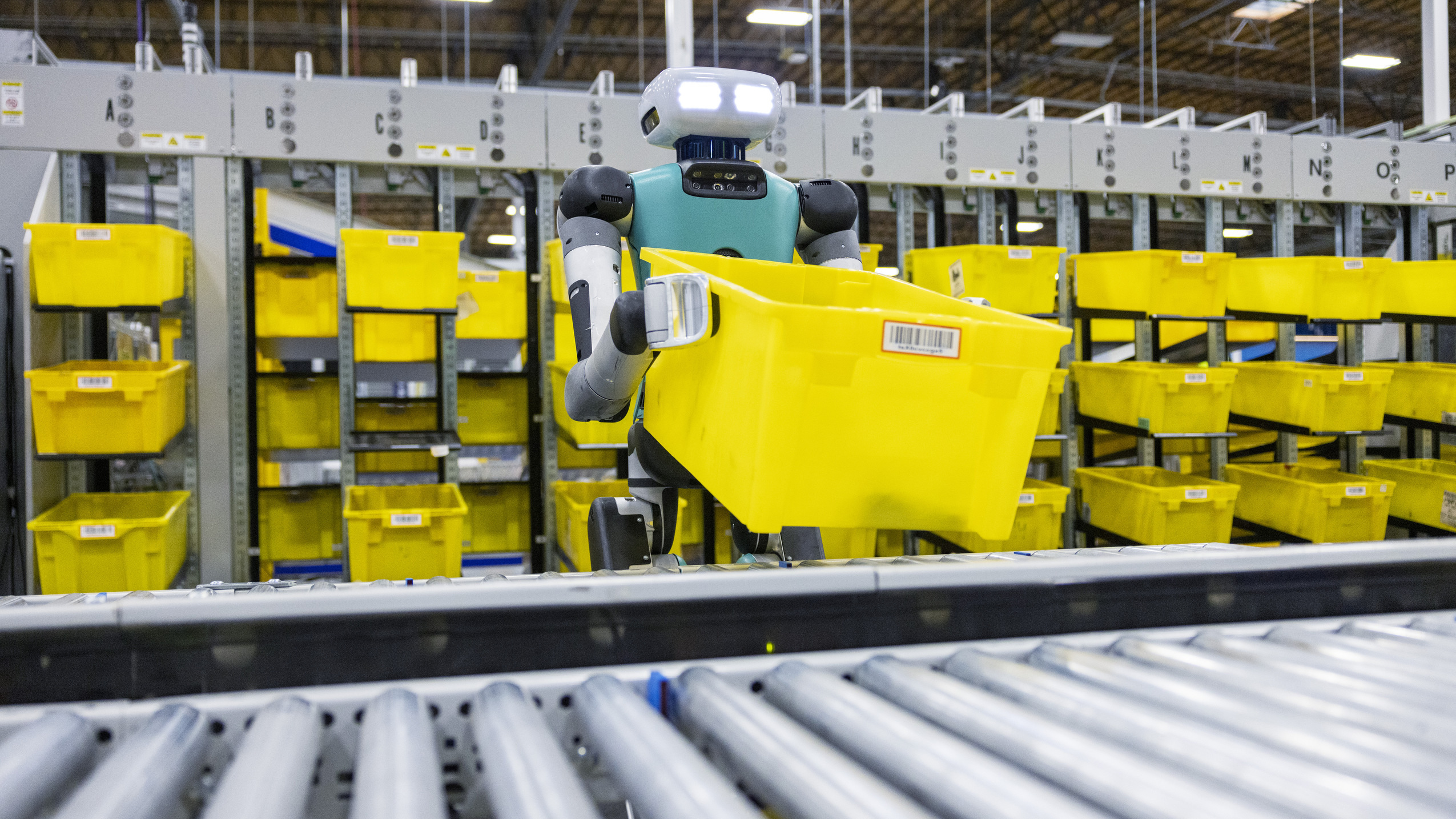
This is why the robots matter so much.
Leaked internal documents reported by the New York Times in October 2025 lay out a plan to automate roughly 75% of operations by 2033, avoiding more than 600,000 US hires, at a saving of about 30 cents per item picked, packed and delivered. The Shreveport template facility already runs with 25% fewer people.
Amazon doesn't disclose unit volume, but back-solving from third-party seller fees puts it around 20 billion units a year. Thirty cents on a growing share of that gets you roughly half a percentage point of retail operating margin by 2030.
That sounds small. On a business running at negative 0.6%, half a point is the difference between losing money and making money. It is not the thing that turns retail into a high-margin business.
And I'd temper the robot enthusiasm three ways:
The hardware is hard. Amazon announced Blue Jay in October 2025 as the centerpiece of next-generation fulfillment, then quietly stopped using it in February 2026 over cost and integration problems. Project Eluna, the software half, survived. Software scales. Robots break.
The savings are being offset. Q2 shipping costs grew 19% against 17% unit growth. Olsavsky blamed fuel and driver capacity on line haul. Robots inside a warehouse do nothing about the truck between warehouses.
But the leverage is real and already visible. Q2 2026: units up 17%, headcount up 3%. That gap is the whole thesis, and it's in the filing right now.
6. The Moonshots
Funded by AWS and ads. Mostly pre-revenue. Each one a candidate to become the next AWS.
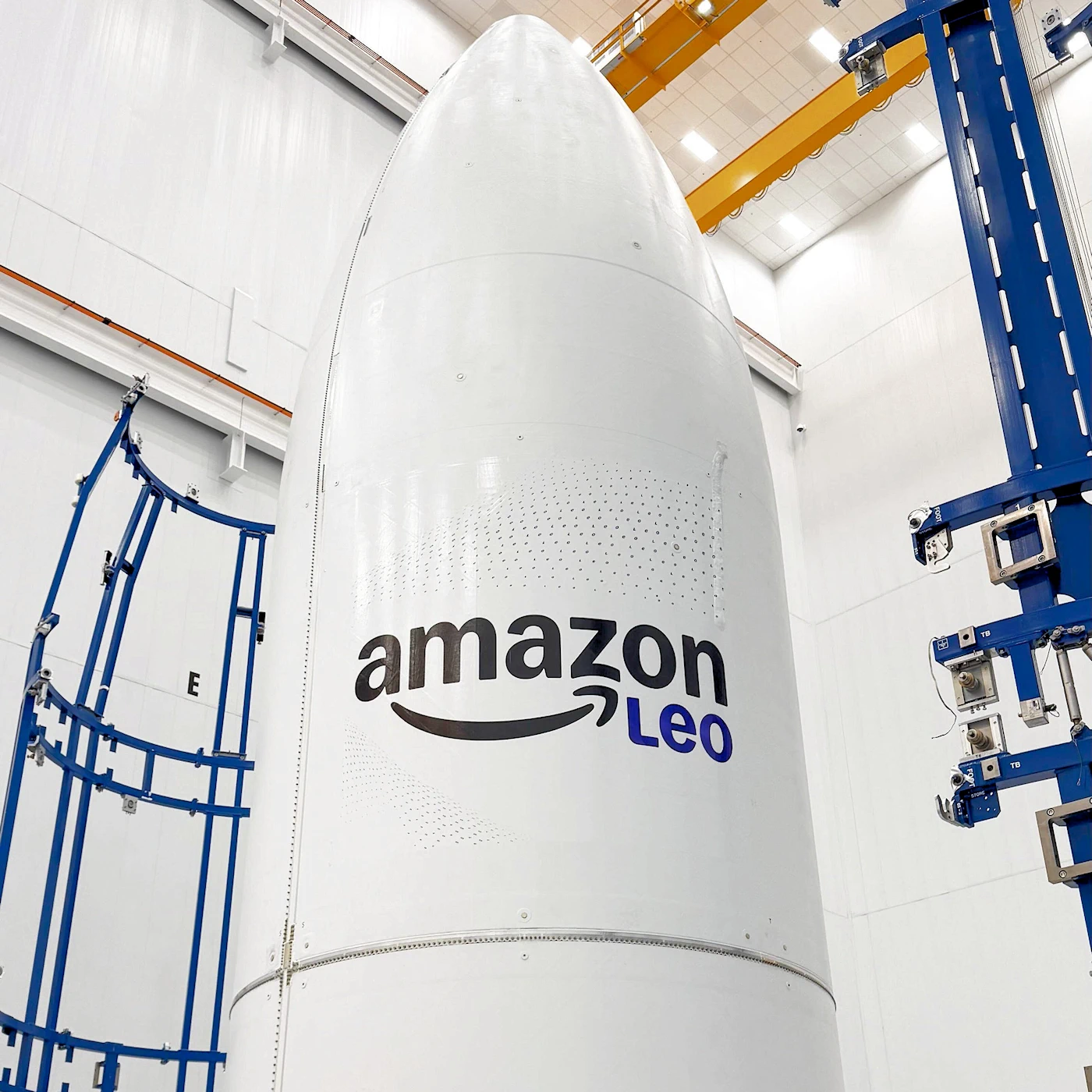
Amazon Leo (satellite internet). About 400 satellites in orbit against an FCC requirement of 1,618 by July 2026, with an extension requested. Customers already signed: Verizon, AT&T, Vodafone, JetBlue, Delta, NASA. Amazon has floated a $20 billion revenue ambition by 2030. I'd haircut that hard given the launch shortfall and Starlink's head start.
Zoox (robotaxis). Won its NHTSA exemption on July 30, 2026, the first purpose-built robotaxi cleared to charge for rides. Context on scale: Waymo does over 500,000 paid rides a week. Zoox has served 500,000 riders total, all free.
Chips as a product. Already fabless, already a top-five TSMC customer. The capability exists today. This is a decision, not a build.
Robotics as a product. Over a million robots deployed internally. But see Blue Jay.
Healthcare. Pharmacy new customers doubled in the first half of 2026, same-day prescriptions up nearly 5x. Buried inside a $5.9 billion "Other" line, so you can't size it yet.
Supply Chain Services. Launched in Q2 2026 with P&G, 3M, Lands' End and American Eagle as first customers. FBA for companies that don't sell on Amazon.
7. The Depreciation Wall, Explained
I kept using this phrase without defining it. Let me fix that, because it's one of the single most important thing to understand about Amazon right now.
When Amazon buys a server, the cost does not hit the income statement that year. It goes on the balance sheet as an asset, then gets expensed a slice at a time across the years it's expected to last. Servers run 5 to 6 years. Data center buildings run 30-plus.
So when Amazon spends $220 billion this year, you don't see $220 billion of expense this year. You see roughly a fifth of the server portion, then another fifth next year, and so on. This is the whole idea of depreciation, checkout our course for the balance sheet for more info!
The spending is happening now. The earnings hit arrives in 2027, 2028 and 2029. And it arrives whether or not the AI revenue shows up.
It's building. Amazon's property and equipment went from $357.0 billion at the end of 2025 to $446.0 billion six months later. Across the hyperscalers, trailing depreciation is running at about a third of trailing capex. The other two thirds are queued up.
That's the wall. Not a crash. A bill that's already been rung up and hasn't been presented.
The transparency point I really like:
Here's something that made me trust management more, not less.
Between 2022 and 2024, Microsoft, Google, Meta and Oracle all extended the assumed useful life of their servers from about four years to five or six. Stretch the life, and the annual depreciation slice gets smaller, and reported profit gets bigger. Same asset, better-looking earnings.
In February 2025, Amazon went the other way. It shortened a subset of servers from six years back to five, citing the pace of AI development.
Under identical underlying technology, one company moved toward conservatism while four moved away from it. That makes Amazon's reported margins the most conservative of the group, and it means Amazon is telling you something true about how fast this hardware goes obsolete. Companies rarely volunteer a number that makes their earnings look worse. When they do, I pay attention.
What I'm Watching
Amazon's growth strategy is a wedge, then a lever, then a lever, then a lever. Books to everything. Internal tool to external product. Retail traffic to cloud, ads and subscriptions.
The strategy is not in doubt. The execution record is strong. What's genuinely unresolved is timing: whether $496 billion of backlog converts before the depreciation bill lands, and whether retail ever earns its keep or stays a permanent customer acquisition cost.
Three things I'll be checking each quarter:
Units versus headcount. Both are disclosed. That spread is the automation thesis, unfiltered.
AWS margin against a rising asset base. If it holds near 37% while property and equipment keeps compounding, the Trainium cost advantage is real.
The first quarter free cash flow turns positive again. That's when the build stops and the harvest starts.
Sentiment: Very Bullish