

AMZN
Amazon.com Inc
Jeff Bezos just filed to sell $4 billion in Amazon
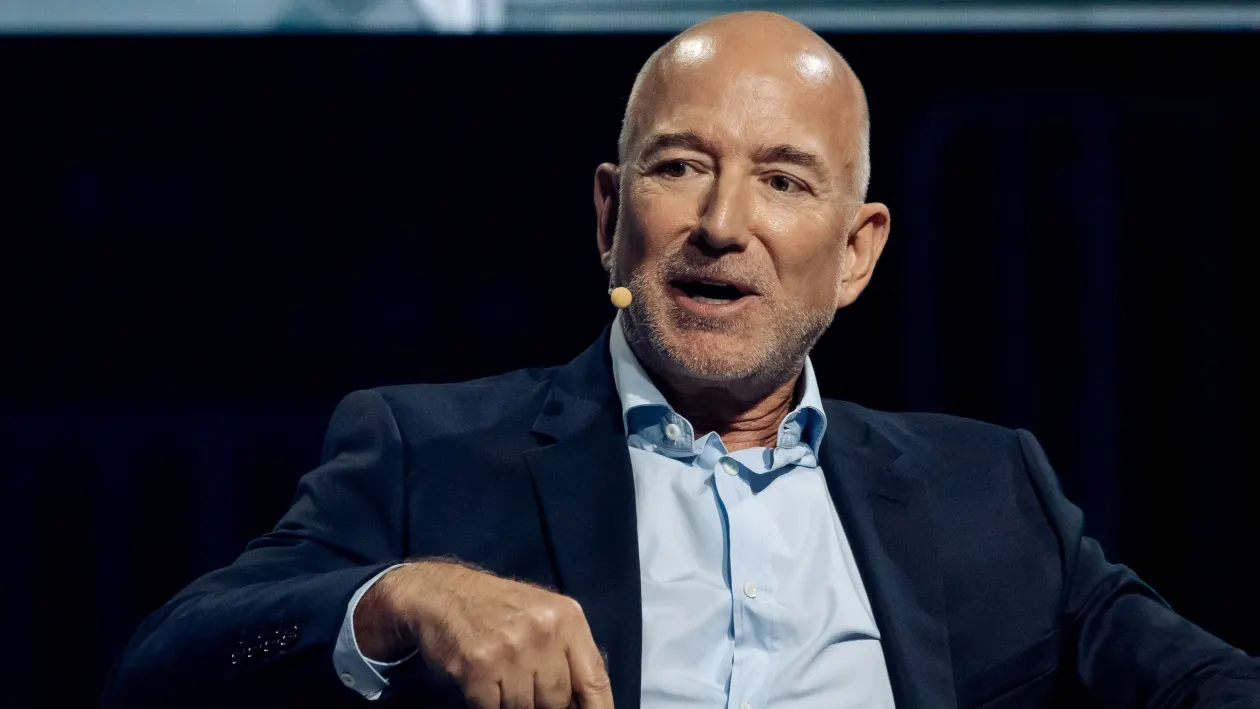
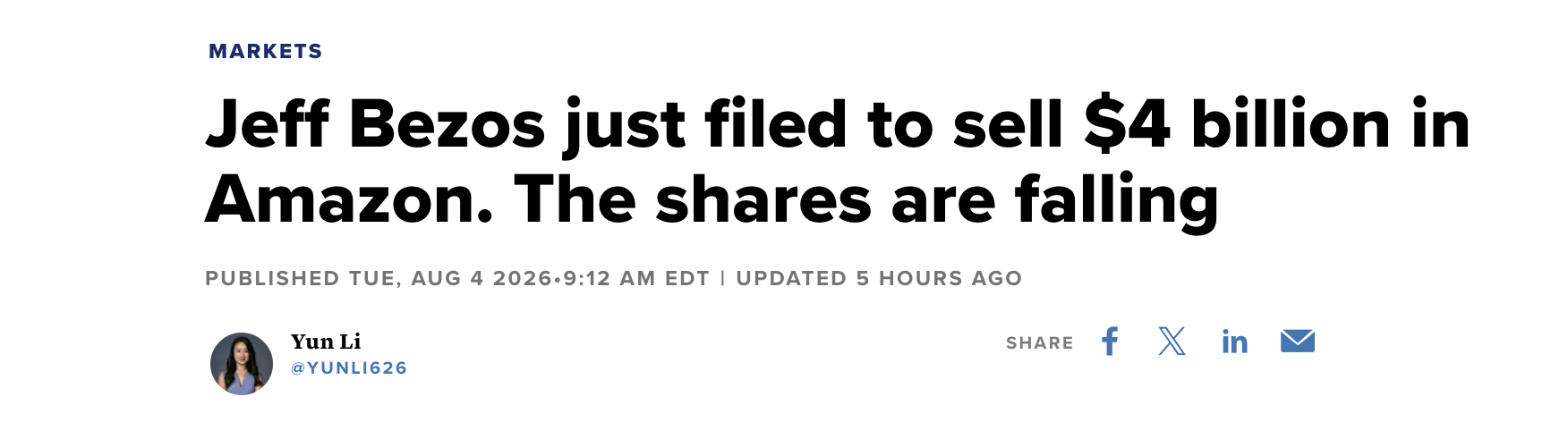
Jeff Bezos just filed to sell 15 million Amazon shares worth roughly $4.1 billion.
This comes after Amazon reported an AMAZING second quarter (EPS beat 216%, revenue beat 2%... according to google at least).
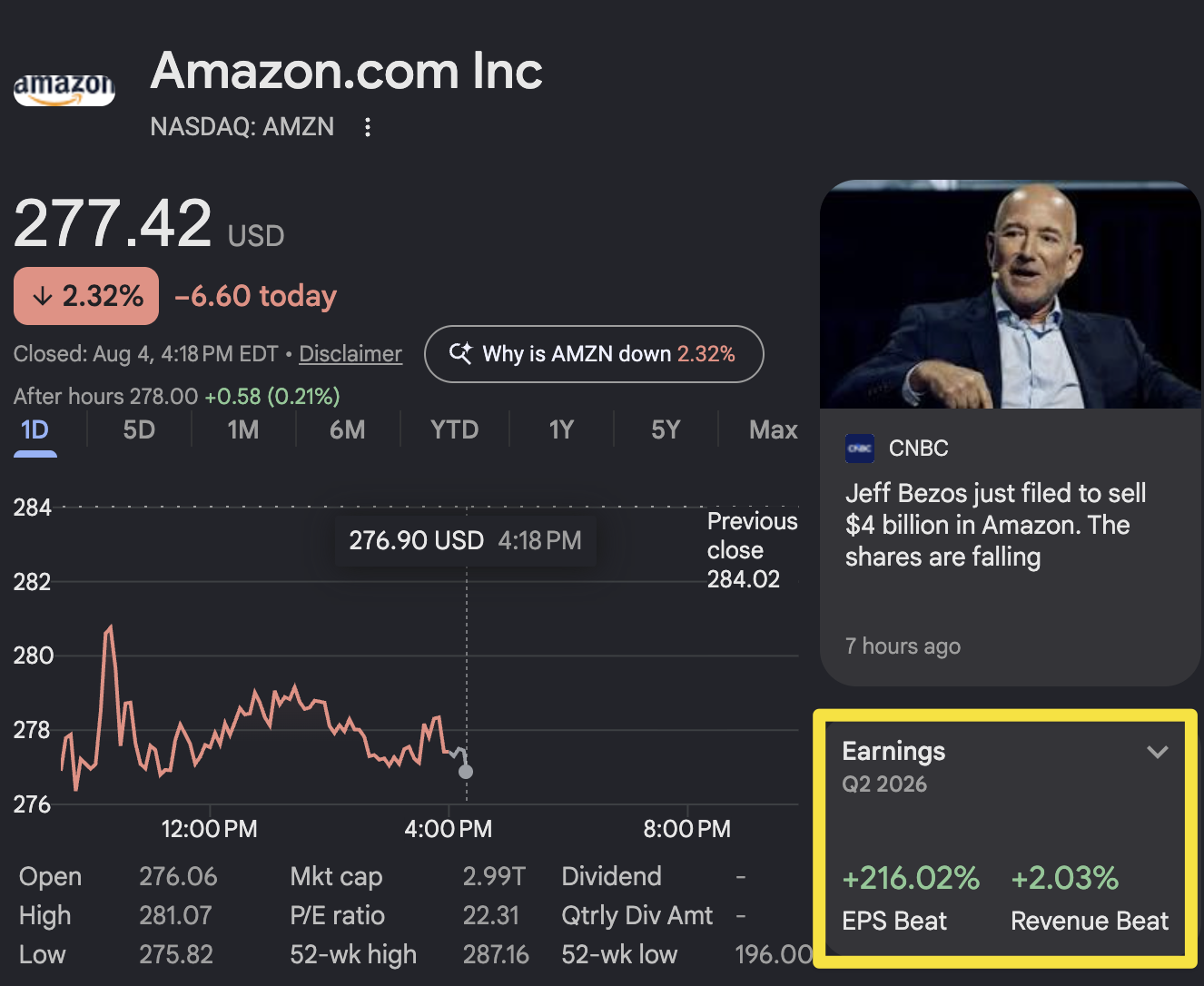
However!! And a big HOWEVER that no one else is reporting...
Amazon reported diluted EPS of $5.75 vs $1.68 a year early - BUT! This includes non-operating pre-tax other income of $53.4B - primarily from it's Anthropic investment.
This is a mark-to-market gain on a private equity stake. NOT INCOME.
Because of this, the stock is doing weird things. For the first time in my life, I've now see a forward PE ratio be higher than the trailing PE ratio on a growing company. (Amazon's trailing PE is ~21.9, while their forward PE is 32.1)... This is because of the Anthropic mark! It inflated trailing EPS, which deflated the trailing multiple, which makes Amazon screen as "cheap" to those just running a screener. Luckily for you, dear reader, you are an intelligent investor.
The real EPS beat is more along the lines of an 8% beat - which is nothing to blush at, but still... it's very important to distinguish the two.
They still did have a wonderful quarter, here are some of the highlights:
Net sales is up 20% to $200B (damn)
Operating income exploded from $19.2B in the prior year, now at $27.5B (a 43% growth)
Operating margin expanded from 11.4% to 13.7% (great sign)
AWS revenue is up +36.7%
AWS operating margin grew from 32.9% last year to 39.4%
Advertising is up 26% to $19.8B
FCF went negative to $7.6B (due to AI data-center buildouts)
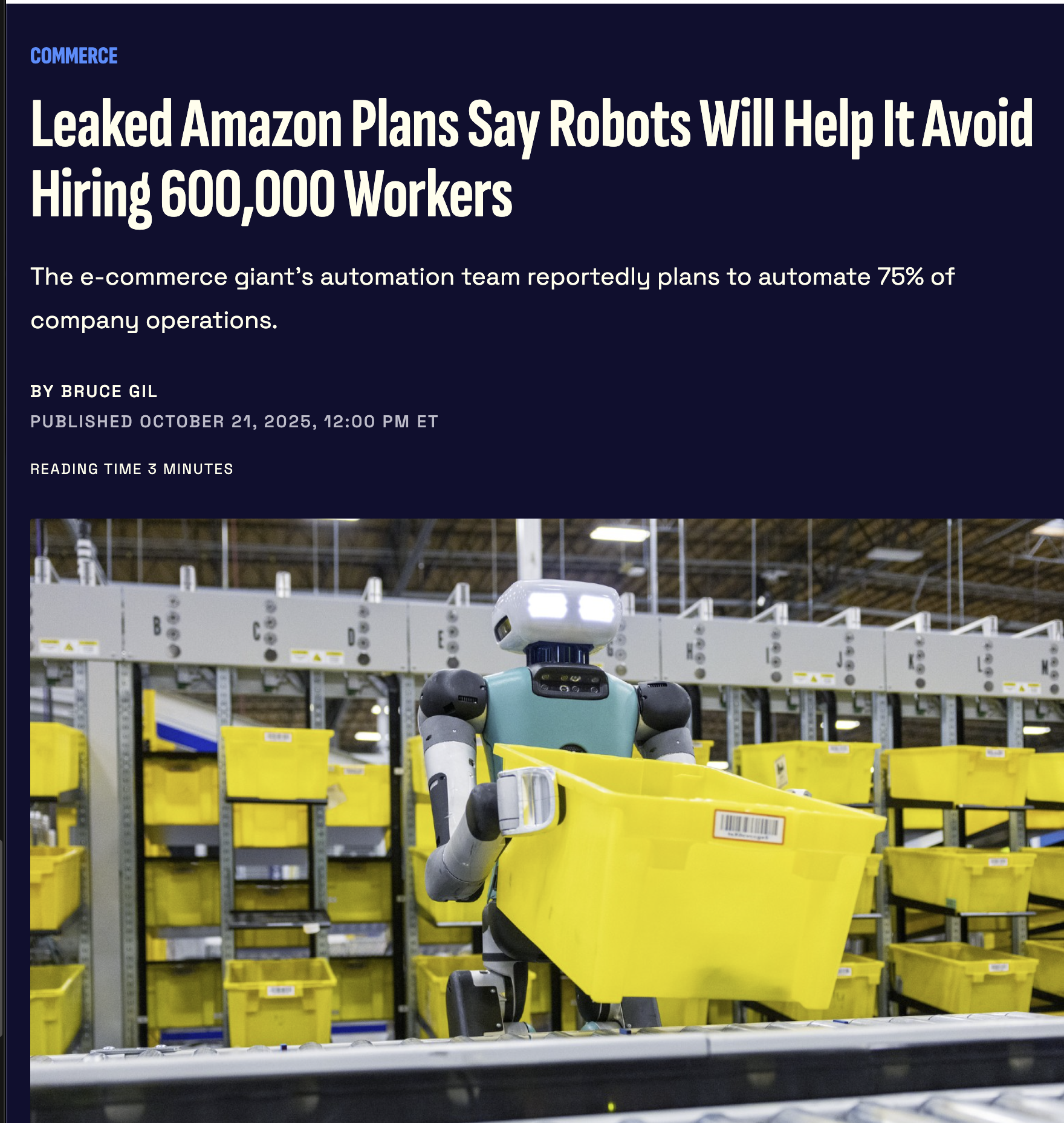
An important item about how Amazon is making money today... AWS supplied only 21% of Q2 revenue, but is responsible 60% of operating income. AWS is the powerhouse of Amazon. (that is, until robotics/automation make Amazon retail more profitable - a leaked internal memo has said that Amazon retail could double unit sales while keeping headcount steady by 2033... huge if true, and is making me want to research Amazon more)
So why is Bezos selling?
Here's the thing that took me about four minutes to find, and that almost nobody writing about this bothered to check.
He filed the sale under a Rule 10b5-1 trading plan that he adopted on November 14, 2025.
Nine months before this quarter existed.
He didn't see the earnings and decide to sell. He couldn't have. The whole point of a 10b5-1 plan is that you lock in the price, timing, and quantity ahead of time, and then it fires automatically whether you like it or not. Since the SEC's 2022 rule changes, executives even have to sit through a 90 to 120 day cooling-off period before the first trade can happen.
So this is a nothing burger.
There is one number that gave me pause. In the six months before this filing, Amazon insiders traded on the open market 66 times. Sixty-six sales. Zero purchases. Jassy's personal record over five years is 27 transactions, 0 buys.
So does insider selling mean anything at all?
Peter Lynch said it best: "Insiders might sell their shares for any number of reasons, but they buy them for only one: they think the price will rise."
But I don't want you taking my word for it, or Lynch's. The academics have beaten this to death.
Lakonishok and Lee studied every insider trade on the NYSE, AMEX, and Nasdaq from 1975 to 1995. Their conclusion: the information comes from purchases, while insider selling appears to have no predictive ability. Their own summary is worth reading twice: "Insiders have many reasons to sell shares but the main reason to buy shares is to make money."
Then Cohen, Malloy and Pomorski did something smarter in the Journal of Finance. They split insiders into two buckets: "routine" traders who sell on a predictable calendar, and "opportunistic" traders who don't. The opportunistic trades produced abnormal returns of 82 basis points a month. The routine trades produced essentially zero. And routine trades were over half of all insider trading.
A founder selling on a nine-month-old prearranged schedule for the twentieth time is the dictionary definition of routine.
The bear case of Amazon
I'm not going to pretend this is a clean story. Here's what genuinely worries me.
1. The cash is gone. Free cash flow swung from a positive $18.2 billion to an outflow of $7.6 billion, driven by $66.1 billion more in property and equipment purchases year over year. And Amazon didn't just miss on cash, they missed the bearish estimate, which was negative $3.81 billion.
2. The depreciation question, which is the strongest bear argument out there. This one is technical, so stay with me, because it matters.
When Amazon buys a server, it doesn't expense the whole thing at once. It spreads the cost over the server's "useful life," typically four to six years. Stretch that estimate and your reported profit goes up without anything real changing.
Michael Burry (yes, that one) argues hyperscalers are stretching it, and pegs the gap at roughly $176 billion of understated depreciation across the industry from 2026 to 2028. Here's how absurd it gets: Meta extended its server lives to 5.5 years and booked a $2.9 billion reduction in depreciation expense. Same Nvidia chips. Opposite accounting conclusions.
Amazon's defense on the call was that data centers have 30-plus year lives and servers break even in under three. Mayyyybee... But this is an assumption, not a fact, and it flows straight into the earnings number you're valuing.
3. Circular financing. Amazon owns a piece of Anthropic. Anthropic signed a $100 billion, ten-year commitment to run on Amazon's chips. So Amazon books an investment gain on Anthropic AND revenue from Anthropic. Bernstein's Stacy Rasgon said these structures "clearly fuel 'circular' concerns." If that gives you a funny feeling, it should. It's the same shape as Nortel and Lucent lending customers the money to buy Nortel and Lucent gear in 1999.
4. That $53.4 billion gain can go the other way. The Anthropic stake was carried at $74.2 billion at the end of Q1 before this revaluation. Private marks that go up on one funding round come down on the next one. The exact line that made this quarter will unmake a future quarter, and the headlines will be just as confused in that direction.
5. Capex keeps climbing, for reasons Amazon doesn't control. They raised 2026 guidance to $220 billion and blamed memory prices. Amazon has no say in what memory costs.
6. Guidance was soft. Q3 guided to $197B to $202B against a $204.1B consensus. They blame Prime Day timing, and say growth would be nearly 400 basis points higher without it. Probably true.
The bull case of Amazon
Now the other side, and it's genuinely strong.
1. The backlog is the entire argument, and it's enormous. Jassy on the call: "Our backlog stands at $496 billion, growing triple digits year-over-year. AWS is now a $169 billion annualized revenue run rate business, which, for perspective, would place it 24th on the Fortune 500 list if it was a standalone company."
Backlog is signed contracts not yet delivered. It went from $364 billion to $496 billion in one quarter.
This is the direct answer to every capex bear, including me a few paragraphs ago. Amazon is not building on a hunch. They're building against contracts already signed. The backlog is nearly three times AWS's annual revenue.
2. It's accelerating, not decelerating. AWS growth of 36.7% was the fifth straight quarter of acceleration, the fastest in 18 quarters, back when AWS was less than half its current size. They added $4.6 billion in revenue quarter over quarter, about 80% more than their largest increase ever.
Big businesses aren't supposed to be able to do that.
3. Margins expanded WHILE spending exploded. AWS operating margin hit 39.4%, up 650 basis points year over year. That combination is the whole reason the stock jumped 15%. As Forbes put it, investors bought because Amazon showed it could grow AWS revenue faster than capex.
4. They literally cannot build fast enough. Jassy: "But even at that amount, we will still not have enough capacity to meet all the demand we have in 2026, and I believe this dynamic will also be true in 2027 too. In fact, the demand we already have for 2028 is striking."
That's a supply problem. This type of supply problems are the good kind.
5. The chip business is real money now. Amazon's AI business and its custom silicon business each cleared $25 billion in annual run rate, both growing triple digits, with multi-gigawatt commitments from both Anthropic and OpenAI. Jassy floated that AWS could eventually be a $1 trillion revenue business.
6. And the boring old retail business is quietly working. Grocery is now number two in the US. Same-day perishables in 2,300 cities. Perishable customers up 50% since January. Paid units are up 17%.
Wall Street's response was a Strong Buy consensus with an average target of $323.29, and more than a dozen banks raised targets after the print.
My Conclusion
There's a lot here. I honestly don't know where I stand on Amazon right now. I think I would need to do a lot more research. With everything they're doing with AI infrastructure spend, as soon as the narrative changes on that, I feel like there might be an opportunity to buy it at a discounted price
but in order to buy it at a discounted price, I need to know what it's worth, so I'm going to start researching