

ORCL
Oracle Corp
Will Oracle be ground zero for an AI crash?

I got this DM asking me to take a look at Oracle. Let's take a look!
Disclosure: I used to be an employee at Oracle and have held Oracle stock in the past
The Debt
Let's answer the DM question first: is Oracle's debt unmanageable?
Not today. Oracle owes about $130 billion in bonds and loans, and if you count the data center leases it has already signed and moved into, the number is $167 billion. That is a big number. It was $109 billion a year ago. But Oracle can pay the bill. Interest last year was $4.6 billion against $20.6 billion of operating income, so the business earns about four and a half times what it owes in interest.
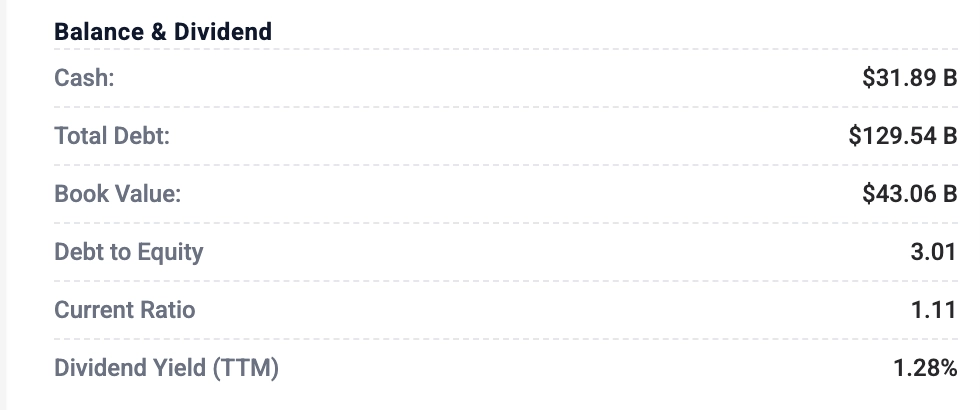
And here is the part most people miss: not one dollar of the $43 billion Oracle borrowed last year comes due before 2029. The bond market is nervous, S&P cut Oracle's credit rating to one notch above junk in July, but nervous is not the same as defaulting.
So if the question is "can Oracle service its debt," the answer is yes, comfortably. That is the boring answer, but I think there's a better question.
The better question is whether Oracle can pay for its own growth.
What I'm concerned with
First, the insane capex spending:
Free cash flow was -$23.7 billion on $67.4 billion in revenue. That means 83 cents of every revenue dollar went to CapEx. And look at what the spending bought. Revenue went from $57.4 billion to $67.4 billion, up $10 billion.
To get there, Oracle borrowed $43 billion in new bonds and sold $5 billion of preferred stock. $48 billion spent, $10B of new sales out. Some of that pays for revenue in future years, that's how building works. But it tells you the size of the bet.
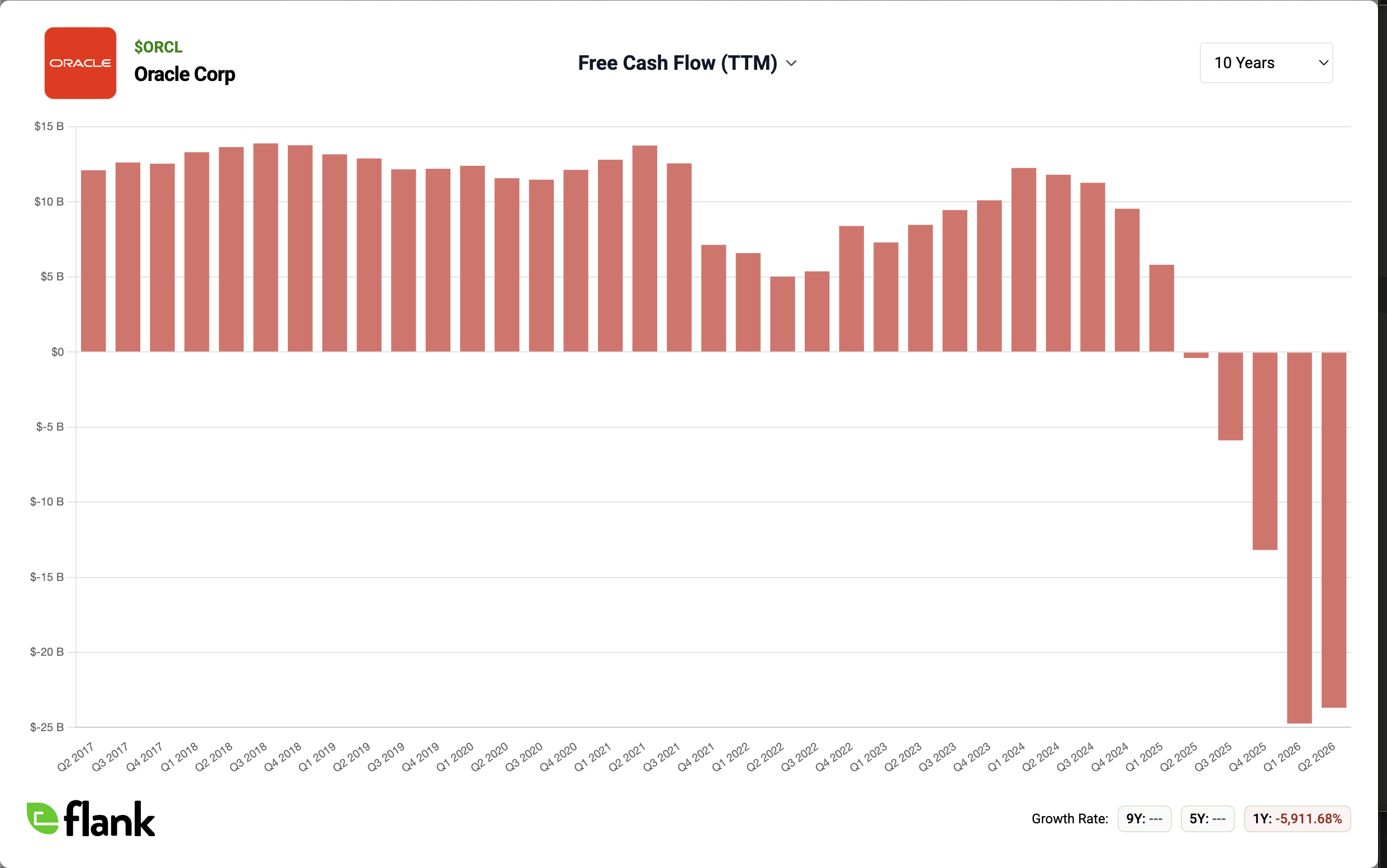
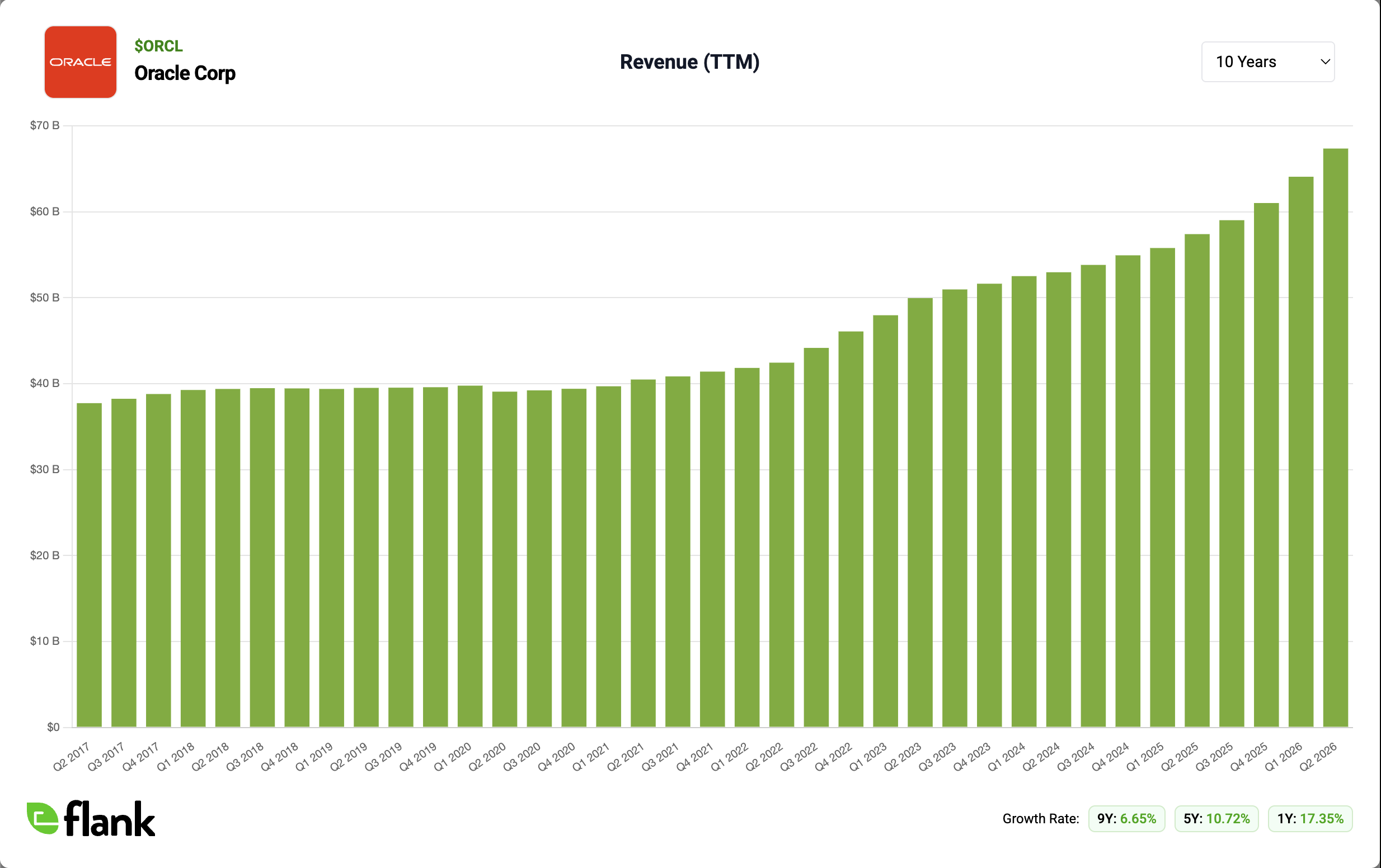
Holy guacamole. Look at that plummet. Reminder, FCF = Operating Cash Flow - CapEx.
So what are they buying?
Obviously, data centers. Enormous ones, and a lot of them. Oracle's capex went from $21 billion two years ago to $55.7 billion last year, and management says it will be $90 to $95 billion this year. That is more than Oracle's entire revenue.
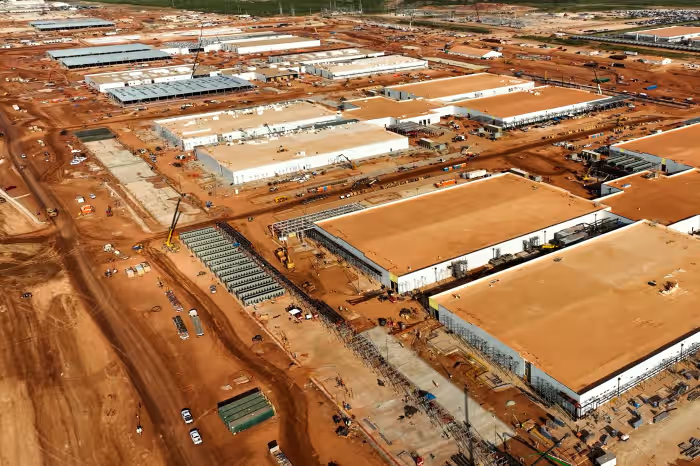
Oracle's Stargate data centers
I want to be more specific than just "data centers". The money goes to three things.
First, chips. The bulk of the spend is Nvidia GPUs, the processors that train and run AI models. Oracle has said its GPU business is the fastest growing thing it has ever had, and every one of those chips costs tens of thousands of dollars and is obsolete in about five years.
Second, buildings. Oracle added 1.2 gigawatts of data center capacity last year, with another gigawatt coming this quarter, at sites in Abilene, Texas (the flagship, built for OpenAI), Shackleford, Texas, Doña Ana, New Mexico, Saline, Michigan, and Port Washington, Wisconsin. For scale, one gigawatt is roughly the output of a nuclear reactor.
Third, power. Oracle signed $13.3 billion of unconditional purchase commitments, mostly electricity, plus a deal with Bloom Energy for on-site fuel cells because the grid can't deliver what these buildings need.
And here's the thing about buildings: last year's CAPEX of $55.7 billion is only what Oracle has paid for so far. It has also signed leases on $260 billion more data center space that hasn't been built yet. None of which shows up in that debt number above. We'll come back to that.
One more number so you feel the weight of all this buildout. Depreciation, the accounting charge for all this equipment wearing out, nearly doubled last year to $7.6 billion. That is the cost of the buildout starting to hit the income statement, and it is early. Every GPU bought this year is a bill for the next five.
Customer Concentration is troubling, too
Now for the part that actually worries me.
Oracle's growth story is a number called remaining performance obligations (RPO), which is a fancy way of saying signed contracts it hasn't delivered yet. It's essentially the Order Book.
It sits at $638 billion, up 363% in a year. That is the number Wall Street points to when it says the debt is fine. Look at all that contracted revenue!
Here's the problem. About half of that order book is one customer. S&P estimates OpenAI is roughly half of the $638 billion, and that concentration is the reason it downgraded Oracle.
The headline deal is $300 billion over five years, starting in 2027. That is $60 billion a year. OpenAI's total revenue right now is about $25 to $30 billion a year, and it expects to burn $25 billion in cash this year.
Wait, what?! The customer's entire revenue is smaller than its bill to this one vendor.
OpenAI can only pay Oracle if it keeps raising money from investors, year after year, for five years... or they get a lot more money coming in.
Oracle won't tell you the exact number. Microsoft, which has the same customer, disclosed that 45% of its backlog is OpenAI, and its stock dropped 12% that day. Oracle chose silence. In my opinion, silence on a number like that is a choice.
And you can already watch the wire between them. When the Wall Street Journal reported in April that OpenAI missed its revenue targets, Oracle fell 4% that day. OpenAI sneezes, Oracle catches it.
One last thing on this. Remember those $260 billion in leases? They run 15 to 19 years. The OpenAI contract runs five. Twenty-year buildings, five-year tenant. If the tenant leaves, Oracle still owns the building and the mortgage. Risky.
The Money Goes in a Circle
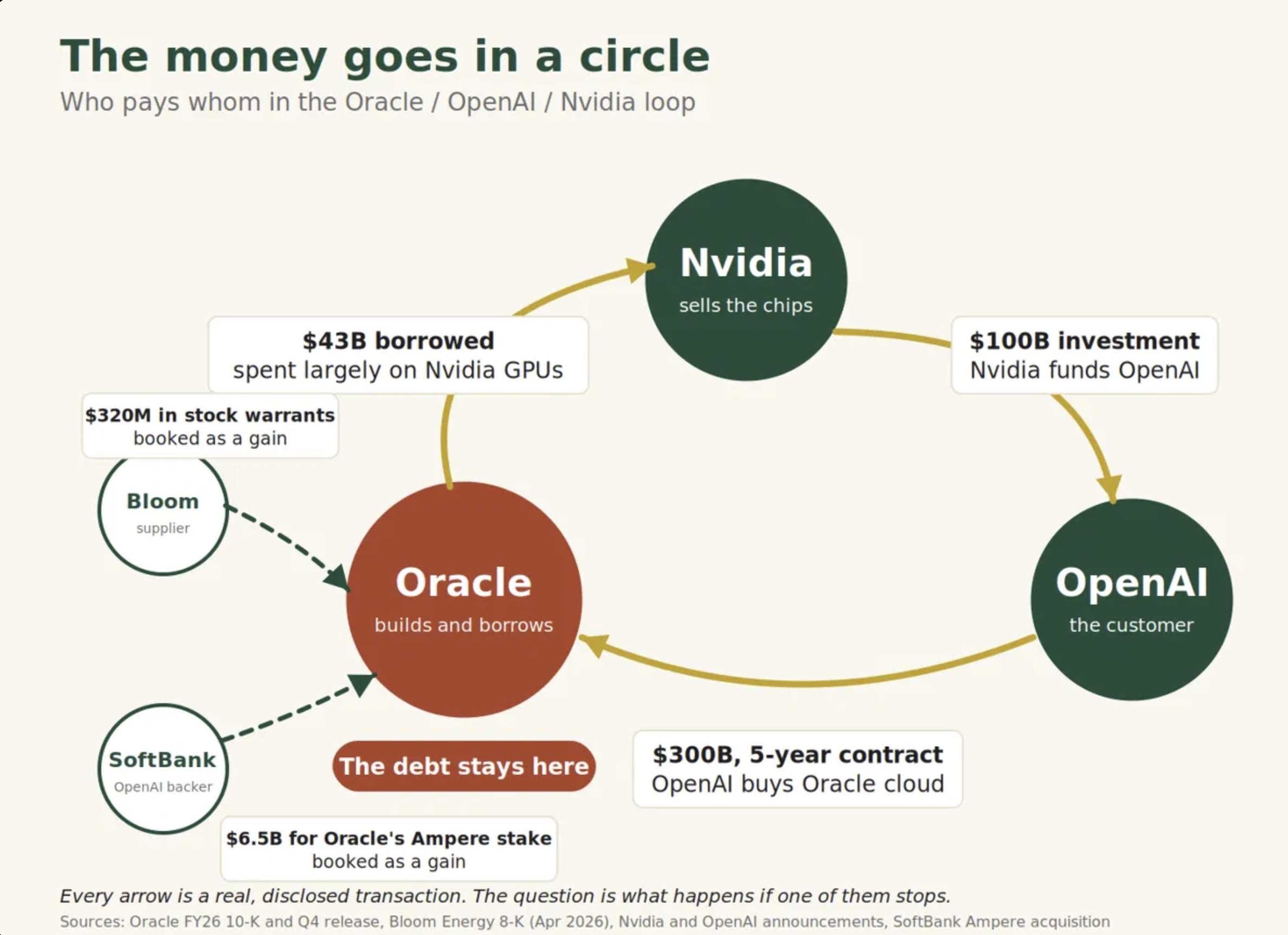
Now here's the part that made me want to write this post, because I wanted to study this question further: is Oracle ground zero?
In the late 1990s, telecom equipment makers like Lucent lent money to their own customers so the customers could buy Lucent's gear. Lucent's revenue looked incredible, right up until the customers went bankrupt and the loans went to zero. The revenue had never really been there. (That story deserves its own post)
Today's version has more players, but the same shape. Three facts:
Oracle's biggest customer is funded by Oracle's biggest supplier. Nvidia committed up to $100 billion to OpenAI. OpenAI committed $300 billion to Oracle. Oracle borrowed $43 billion and spent most of it on Nvidia chips. Nvidia's money leaves as an investment and comes home as revenue. The debt from the round trip stays with Oracle.
Oracle's record earnings were partly paid for by its customer's backer. Oracle sold its stake in a company called Ampere to SoftBank, which is OpenAI's largest investor and Oracle's partner in the OpenAI data centers, for $6.5 billion. That gain is most of the reason Oracle's earnings per share grew 27% last year instead of the 13% its own footnote admits to without it. (seen this story before, amirite?)
Oracle's suppliers pay it in stock. Bloom Energy, which sells Oracle those fuel cells, handed Oracle warrants worth about $320 million along with the power deal. Oracle booked the gain as income.
None of this is illegal. Most of it isn't even unusual on its own. The problem is that everyone in this circle is paying everyone else with paper whose value depends on the circle continuing. If one link stops paying, all three unwind at once. And Oracle is the link holding the debt.
The Canary Already Sang
During the GFC, Bear Stearns didn't fail in a day. In June 2007, two of its hedge funds blew up. The CEO said it wasn't that big of a deal. The stock recovered. Nine months later the firm went under, which many cite as the kickoff to the GFC. Bear wasn't the biggest bank and it didn't cause the crisis. It was the first to go because it was the most concentrated, the most levered, and the most dependent on other people staying confident.
Oracle's canaries: the worst week since 2001 in June, on a quarter that beat estimates. A credit downgrade in July. Bondholders suing over what Oracle told them in its bond documents. The stock down 59% from its peak while 41 of 51 analysts still rate it a Buy. To me, that last one is a Bear Stearns parallel. Everyone is sure it isn't a big deal until it is.

And if you want this cycle's hedge fund, look at CoreWeave. Same business as Oracle's cloud, a fraction of the size, $35.6 billion of debt on $4.8 billion of equity, borrowing at 11%, losing money every quarter, three customers making up 72% of revenue. If the AI build stumbles, CoreWeave goes first.
Oracle could go second, and Oracle is the second largest corporate borrower in the entire US bond market outside the banks. If/When CoreWeave breaks it's a headline. If/When Oracle breaks it's will be heard by the entire bond market (gulp)
The Bull Case
Let me steelman this, because the bulls have real points.
The racks are full. Oracle reports 97.5% utilization and 98% of capacity under contract. The dot-com telecoms built fiber nobody used; Oracle is selling out what it builds.
The growth is real, cloud infrastructure revenue growth went 49%, 52%, 55%, 68%, then 93% last quarter. Customers have put up $75 billion of prepayments and their own hardware, so Oracle borrows less than the headline suggests.
The debt is termed out to 2029 and beyond with $32 billion of cash in the bank. Underneath the AI story is a database and applications business that earned $17 billion last year.... And the stock has already been cut in half, so a lot of this is priced in. Citi thinks shares can double.
Every one of those points is true. And every one of them assumes OpenAI pays. Full racks, accelerating growth, and customer funding are the same fact wearing three different hats.
So, is Oracle ground zero?
It depends what we mean.
If you mean "will Oracle go bankrupt," no. The database business and the 2029 maturities mean Oracle survives an AI bust as a much smaller stock, not as a Chapter 11 filing. Today, it doesn't really look like Lucent or Lehman.
If you mean "where will an AI slowdown show up first and hit hardest," then yes, I think so.
Oracle is the most levered public balance sheet pointed at a single private, money-losing counterparty.
It has signed twenty years of leases against five years of contracts. It funds the build with customer confidence and stock sales. That is the Bear Stearns profile. Not the cause of the crash. The first casualty of it.
What I'm watching: Oracle reports its first quarter in the second week of September. Two things to look for. Did they start selling the $20 billion of stock they authorized, and at what price? And did free cash flow get worse than negative $23.7 billion? If both answers are yes, the canary is singing louder.
Sentiment: Bearish