

General
Mostly passive investor tech worker nervous about being over-indexed on tech & AI
Hey folks! Found this website after watching David's videos!
TL;DR: Long rant on current AI bubble and tech overall. Passive investor nervous that passive investments and AI bubble go hand in hand and 401k/IRA are at a higher risk than I feel comfortable with. Looking for help on what to do!
I'm not an intelligent investor, in fact, I'm barely an investor. I've basically put most of my money in my 401k/IRA + I get stocks as I work at a tech company. However, like a lot of people in the US, I've been feeling a bit more nervous about the future/have some thoughts. I'm hoping that folks here can help me understand what the hell is going on/what I should do to help my financial future.
I've been thinking about the current state of affairs with tech and the economy a lot lately. Particularly concerning AI, big bets, and who we have at the wheel right now driving things. As a lot of American's feel, something doesn't feel 'right' in the economy and the market - the vibes are off. Which is fitting since we are moving towards an vibe-centered economy if AI thoughts-leaders I see on X(the everything app) are to be believed. We will have vibe coders, artists, and movie makers, so I'll take this chance to become a vibe-based economist.
My vibe is that I have a growing concern that we may be over-indexed on tech as main driver of economic growth/market growth, and that passive investing is at risk here as well.
I'm going to try to break down my thoughts into a few different sections:
Productivity & Tech:
"Microsoft’s mission is to empower every person and every organization on the planet to achieve more" - Microsoft mission statement.
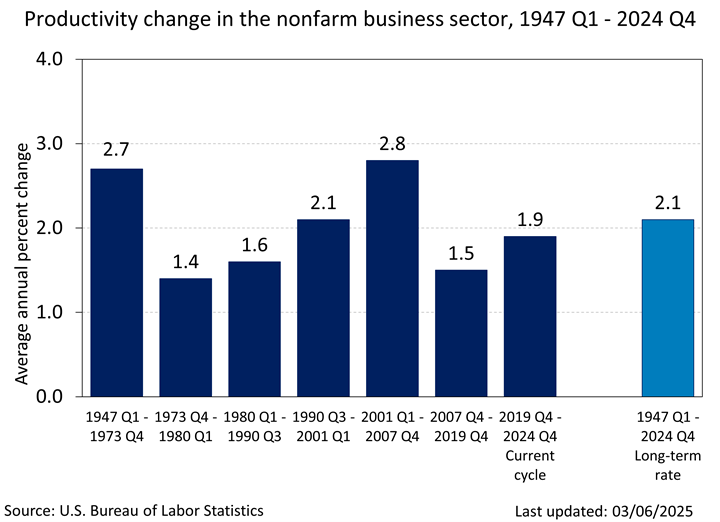
How do we measure productivity? From an economic standpoint, it is calculated as a ratio of GDP to hours worked. The amount of units of a product produced relative to labor hours or measuring net sales relative to labor hours. The world has radically changed since the introduction of Microsoft - and with the introduction of tech as a major sector of the economy. The introduction of the smart phone, the boom of the internet, and the deliveries of technology have made major impacts in our way of life. Life is radically different in the 21st century than it was in the 20th century, we deal with new problems that we haven't really had to deal with before at the scale we have now (our politics have changed pretty radically, social structure has changed, how we interact or don't interact with our neighbors has changed, our eating habits, we have a new gig economy, etc...). But with these new changes in technology - our productivity must have changed radically as well, or at least I thought it did. See the chart below[1]:
Huh.
This was an interesting graph for me to look at and think about my prior assumptions. The iPhone was introduced to the world in 2007 - and average annual percentage change in US productivity dropped from an increase of 2.8 to 1.5. This chart just shows the annual percentage change per year, and shouldn't be taken as a we've become 'less productive', just more that we have slowed down the increases in production, but I'd believe that most people's worlds have felt more radically different from 2007 onwards. Major caveat here is that this is our age group's change into adulthood, so could just be that - but I do believe that most people have felt the change more radically in the late 2000s because it was not just a change in the way we looked, but the way we interacted with the world around us. The thing I'm trying to get at here is that there seems to be a disconnect between the amount of change economically and the amount of change systematically with regard to the introduction of 'modern' technology.
The thing that we have definitely seen though the these years though is more of a disparaging gap between wages and productivity. Like I said, productivity increases have slowed down, but the still increased, but what has not increased are the wages. Well, sort of. Below you'll see a chart you are more than likely familiar with[2]:
What's interesting though with this chart, is that this chart does not include the PMC (professional managerial class) and does not include total compensation packages (i.e. only takes salary not stock bonuses, etc..) If you include the PMC & stock bonuses and get rid of those pesky subhumans (part time workers [this is a joke!]), you'll see a different chart[2]:
Hey that looks a lot better! But those are strange vibes, right? With this in mind, it would make me think that the people who introduce the most amount of production into economy would be the PMCs then? So although we did not see a major jump in productivity with the introduction of smart technology, we've seen that those who have been awarded the most with their wages corresponding to the correct amount when compared to product output was the PMC.
That is an interesting statement, and as a PM at a tech company I will not say anything about my productivity (KPIs are looking good boss!)
With terms of economic output though, we have been seeing some interesting trends in Q4 of 2024 and Q1/Q2 of 2025, that we may be entering another boom era for productivity[3]. The model used here gives about a 40% chance of another high production era, similar to the increases in productivity that we've seen in the early 2000s, late 90s. Which is a strange way to say a 60% chance of that not happening, but maybe it's a glass-half full thing. The article that I took this model from puts some of its belief in entering a high production era on the growing field of AI.
AI: It could be your angle... or yuor devil
Not only is the private sector taking huge bets on AI, but the United State's government is placing a huge bet on it as well, with the $500 billion project stargate[4], although this effort has been slow down quite a bit from how tech and government works, I believe only about $30 billion dollars have been acted upon[5], with the Pentagon also investing $800 million in AI[6] (dope that MechaHitler grok is included in this investment list), this is just part of their $4.9 billion dollar budget for AI technology investments, which is 65% of all of their tech investment now. Note: please send a copy of the book "Who moved my cheese?" to CEOs of Lockheed Martin & Northrop - this is a joke they are fine and doing great. NVIDIA, Microsoft, Apple, Amazon, Meta, Broadcom, Alphabet, Telsa (1-9 on the S&P 500) all have major investments in AI.
Plus, the amount of money VCs are throwing at this is wild as well - with AI startups taking 53% of VC funding[7]. Or roughly, around $131 billion globally in 2024 [8]. I'd like to compare that to the last craze of
VC money we saw, crypto [9]:
The peak of which was roughly $12 billion in 2022. Now, I'm not trying to compare the productivity gains that could be realized from AI with those that were very clearly not there from the get-go with crypto, there is a difference there. I'm more trying to scale this for my own head the amount of money that is being put into AI currently. With this amount of money flowing in here, the invisible hand of the market moves production towards AI and AI related services. With AI startups crowding VC funding, that means less money for those who do not have AI-enabled startups, or it means that non-AI startups have to change their product to fit the AI market in hopes of broadening their appeal to VCs. Furthermore, there have been complications due to the supply chain issues with construction of these huge data centers that has affected other business areas. I was listening to the Odd Lots podcast where they had a guy who did coffee shop drive thrus talking about how he was not able to build as many as he wanted to this year because of supply issues due to data centers driving most of the need their way. I don't need more coffee shop drive thru's so I don't care, but I've been trying to look more into it and there is some other cases of this happening to other industries.
As I see it, with AI there are three cases:
Increases Productivity:
So we've made an AI that increases workers productivity - yay! What does that mean for us? Well, it so depends on what it is capable of doing. Let's throw out some assumptions:
1. It can automate/enhance clerical tasks (planning, organization, email updates, book keeping)
2. It can automate/enhance financial tasks (trades faster, can perform better forecasting, can predict markets better)
3. It can automate/enhance logistical tasks (driving, shipping and handling)
4. It can automate/enhance developer tasks (performs at mid-level dev)
5. It can automate/enhance service tasks (kiosks, mid-level IT tasks, customer service)
6. It can automate/enhance medical tasks (medical clerical tasks, basic counseling, first pass medical screenings)
What does working in these conditions look like? In these conditions, I'd predict that an increasing AI makes it a lot harder to find an entry level job, since an AI can replace most of the services a new worker can do, so why would a company hire a person when an AI agent can automate your job? What happens to the truck drivers if we automate truck driving? What are the carry on effects in this scenario, what happens to the diners between major city to major city, where truck drivers stop for grub? What happens to the wonderful backbone of this nation's economy, the lot-lizard!? Why won't anyone consider the humble lot-lizard!
But seriously, what is gained in this scenario? We are able to automate jobs, increase productivity for companies and save costs. So we can hopefully assume there is a carry on effect that means since most of this work is automated, we could lower the costs of the goods. I'd harken back to the graph that shows productivity increases and wage increases. I'm making a little bit of a jump here, but if companies are able to push out even more of the professional managerial class with AI replacing white collar jobs while maintaining and increasing productivity, do you think they would treat us better than they treated the part timers/non-PMC people?
Would we see UBI so that we can keep a consumer market afloat? Will learn how to code be transformed into learn how to weld instead? Or other blue collar jobs that can't be as easily automated? Does that not just lead to final rift between the mega-rich and the rest of us?
It doesn't increase productivity:
Welp! You win some you lose some. The bubble bursts. What happens? With major tech companies making up roughly ~30% of the S&P500 and ~40% of the NASDAQ, plus all of the money that's being pushed into AI, if that pops, uh, ow? This seems like it would be worse than the dot.com bubble. We've had bubbles before, but this is an insane one. Any average Joe with a 401k or really anyone in the market is heavily leveraged on the tech economy. If we don't see an increase in major productivity from AI, and we continue to slowly increase production, or worse, lower production, what do we head towards then?
Passive Investment Feeding the AI Bubble
With most American's not having a retire plan outside a 401k/IRA, I saw an article stating that passive strategies have overtaken active investment management. I think that helps explain why the market is so weird, that even with the tariffs and fear about a bubble, we keep seeing all time highs. I'm asleep at the wheel, not looking for market inefficiencies, thus I don't look to move my money around. I've stated in my long rant above though that the market seems really inefficient right now, and that it won't pan out in a good way. So a large majority of investors feed market inefficiencies (AI bubble that doesn't seem like it will pan out, over-indexing on tech that may not pan out), and thus the valuation of companies can keep going up and up.
So I guess my question is here at the end of a long rant:
I'm not going to exit my 401k or IRA, I do think in the long run it'll be fine and I'm still young-ish. I am over-indexed I feel on tech stock rewards though I feel. Does it make sense to shift those stock rewards into safer investments, or am I seeing smoke when there is none?
sources:
1: https://www.bls.gov/productivity/images/pfei.png
4: https://www.axios.com/2025/05/30/ai-race-us-tech-space
5: https://qz.com/openai-500-billion-stargate-ai-project-faces-setbacks
7: https://www.axios.com/2025/07/03/ai-startups-vc-investments
9: https://www.galaxy.com/insights/research/crypto-venture-capital-q1-2025