

OBDC
Blue Owl Capital Corp
Private Credit is the dog that hasn't barked yet
Words in the title are chosen specifically. IYKYK.
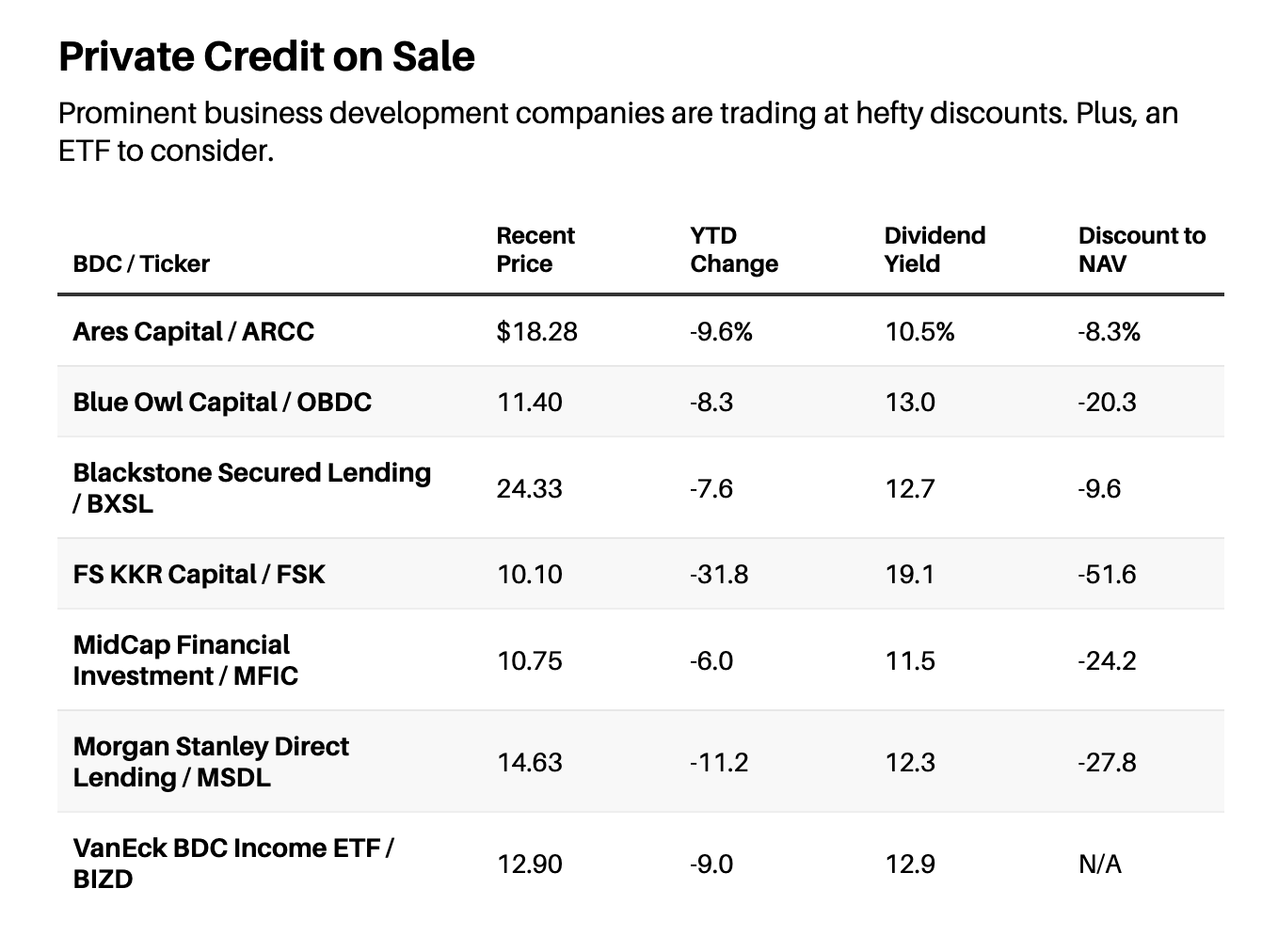
Private-credit funds face investor exits and market skepticism, with publicly traded BDCs down 10% and trading at a 25% average discount to their portfolio values.
Why should you care? Private credit is a $1T+ market. It's a big deal.
Not sure what a BDC is (it's okay, I didn't either).... BDCs are Business Development Companies. They are publicly traded vehicles that lend money to private companies.
These are the largest BDCs that are showing cracks:
Ares Capital (ARCC) → the largest BDC (~$13B+ market cap)
Blue Owl Capital (OBDC) → one of the fastest-growing direct lenders
Blackstone Secured Lending (BXSL) → tied directly to Blackstone’s credit machine
FS KKR Capital (FSK) → huge PE-linked loan book, already showing stress
Golub Capital BDC (GBDC) → major middle-market lender
Main Street Capital (MAIN) → retail favorite, trades at premium historically
Hercules Capital (HTGC) → venture/growth lending exposure
Why were investors attracted to this industry?
That's an easy answer: The funds make junk-grade loans with yields of close to 10% to private companies.
Now, fears that private-credit funds have big batches of bad loans have rocked the business.
Wtf is private credit?
Sorry, I may have been getting ahead of myself. Let's cover what Private credit is first.
As you most likely know, there are two ways that a business can raise money: through raising debt or selling equity. When a company raises debt, the vehicle they use for that are called bonds, and when equity is sold, it's a stock!
Private credit is basically loans that don’t come from banks.
Instead of going to JPMorgan or Bank of America, a company borrows money from private funds (think Apollo, Blackstone, Ares). These funds raise capital from institutions and investors, then lend it directly to businesses.
Why does it exist?
After 2008, banks got hit with heavy regulations and stopped making a lot of risky or mid-sized corporate loans (ruh roh)
That gap didn’t disappear.
Private funds stepped in and said: we’ll do it, but at a higher rate, but with just as much leverage
Where are we today?
While the number of defaults has been low, investors are lining up to exit these funds. But the funds aren't allowing exits. Specifically:
Blue Owl – OBDC II (private, not the public ticker)
Stopped allowing normal withdrawals entirely
Replaced redemptions with forced “return of capital” over time
Basically: you don’t get to choose when you exit anymore
Morgan Stanley – North Haven Private Income Fund
~$7.6B fund
Redemption requests ~11%
Allowed only ~5%
BlackRock / Blackstone / Blue Owl (broader ecosystem)
Multiple funds limiting or prorating withdrawals
Industry only fulfilling ~70% of requests overall
It’s a problem of the industry’s own making. Private credit was initially an investment mainly for institutions. The industry, however, made a big bet on retail investors. There now are about $180 billion of assets in BDCs and another $350 billion of private semiliquid funds, which have limits on how much can be withdrawn in a quarter.
What I'm doing?
This is an easy one... stay far, far away from these funds.
Far, far, far away.
Paying full price for illiquid, opaque assets with limited exit options doesn’t make sense.
Am I missing an opportunity? I don't care. These are highly levered funds that are showing the same cracks that we saw in the Great financial crisis. I want no part in this.
I'm not expecting a crash though immediately though. Private credit doesn’t blow up overnight. It’s slow, opaque, and heavily managed. Problems can sit under the surface for a long time before they show up in defaults.
How will we know when teh crash is happening?
If BDCs start cutting dividends or reporting more troubled loans, that’s when this becomes real.
In the eternal words of Mark Twain, "How did you go bankrupt? Two ways. Gradually, then suddenly.”
Sentiment: bearish, and hopeful of a market crash