

KO
Coca-Cola Co
Coke's highly-leveraged business model
How Do They Make Money?Did you know that by the time a bottle of Coke Classic is sitting on a shelf at 7-Eleven, that Coke has already been paid?
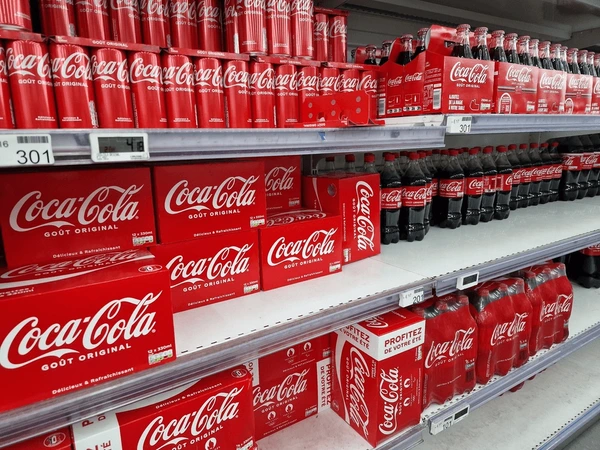
It wasn't even 7-Eleven that paid the Coca-Cola Company. They got paid weeks or months earlier... by the bottler.
You see, Coke produces the concentrate (which is a closely guarded secret for Coke Classic), and then sells it to bottlers mix it with still or sparkling water and sweeteners to produce finished beverages.
The finished beverages are packaged in authorized containers, bearing trademarks owned by Coca-Cola. Brilliant.
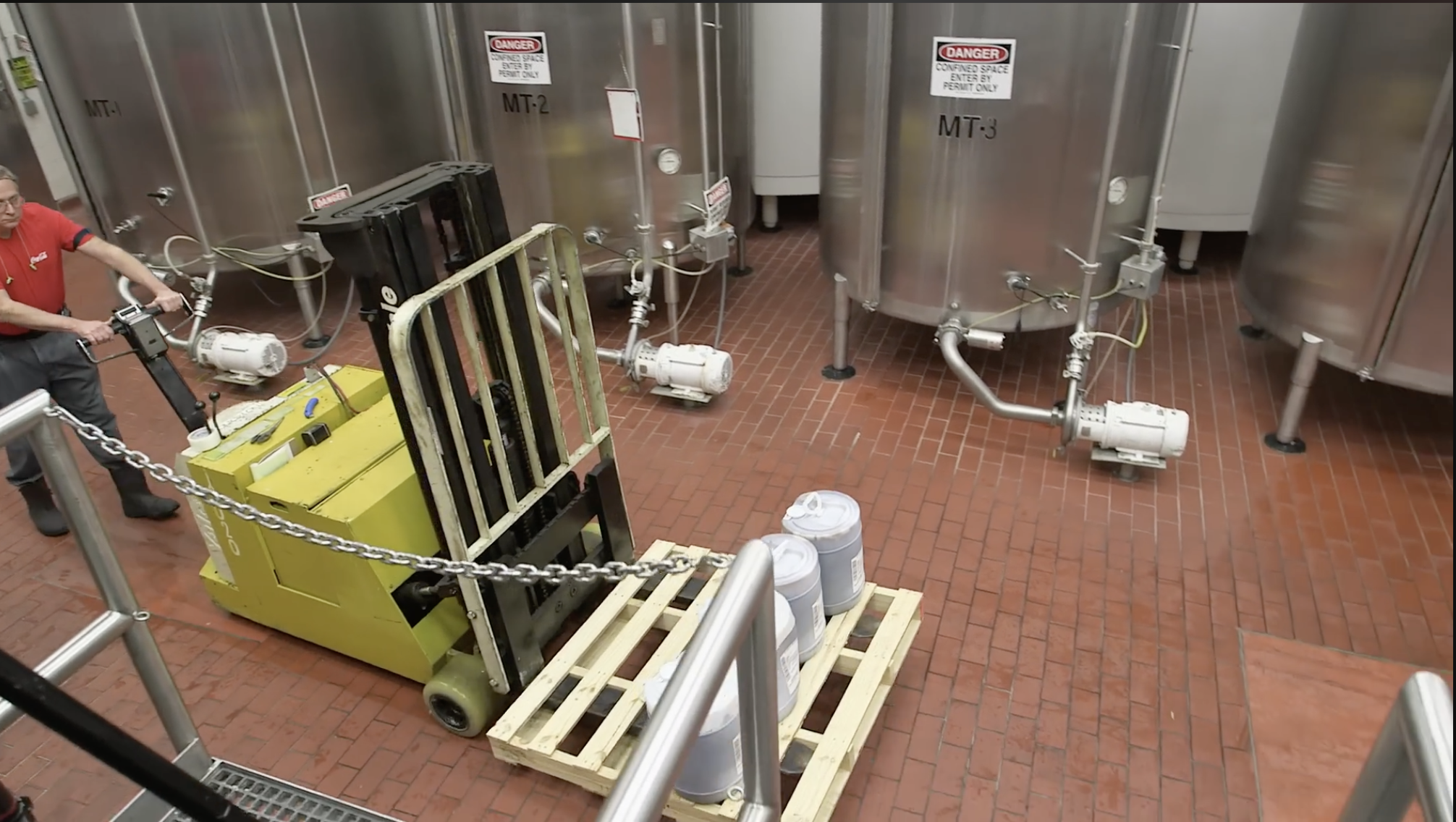
Coke syrup being prepared for bottling at the bottling partner
Why do they do this? Coke flags in plain English in the annual report that "finished product operations generate higher net operating revenues but lower gross profit margins than concentrate operations." When Coke sells syrup, the margin is great. When Coke makes the finished can, the margin gets worse. The whole strategy of the last decade has been to do less of the second and more of the first.
This is why Coke's operating margin runs at ~31%, whereas their major comparable Pepsi only has a ~12% operating margin.
The Business
Coke breaks itself into two lines of business in the annual report:
Concentrate operations
Finished product operations
Coke groups its brands into five buckets.
Trademark Coca-Cola (Coca-Cola, Diet Coke / Coca-Cola Light, Coca-Cola Zero Sugar and all variations).
Sparkling flavors (Sprite, Fanta, Fresca, Schweppes, Thums Up)
Water, sports, coffee, and tea (Dasani, smartwater, vitaminwater, Topo Chico, Powerade, BODYARMOR, Costa, Georgia, Gold Peak, Fuze Tea, Aquarius, Ayataka).
Juice, value-added dairy, and plant-based (Minute Maid, Simply, fairlife, Core Power, innocent, Del Valle, Maaza, Santa Clara).
And emerging beverages, which is mostly the alcohol push: Jack Daniel's & Coca-Cola, Lemon-Dou, Topo Chico Hard Seltzer.
The concentration is wild. Sparkling soft drinks are 69% of worldwide unit case volume. (Unit Case Volume is an important KPI Coke tracks)
Trademark Coca-Cola alone, meaning Coke and its zero/diet variants, is 47% of worldwide volume. Nearly half of everything Coke sells on earth is Coke itself. The 200-plus brand portfolio is real, but the engine is still the original recipe.
Going deep on Bottlers & Distribution
So... does Coke own the distribution?
Nope - it's almost entirely ran by the bottlers.
The bottler's agreements authorize bottlers to "prepare, package, distribute and sell Company Trademark Beverages in authorized containers in an identified territory." Coke ships concentrate. The bottler mixes it with water and sweetener, packages it in cans and bottles, drives the trucks, stocks the coolers, and sells to retailers either directly or through wholesalers.
There are a few exceptions worth noting:
Fountain syrup in the US is the exception. In the United States, bottlers generally are not authorized to manufacture fountain syrups. Coke makes the fountain syrup itself and sells it directly to fountain wholesalers or fountain retailers (think McDonald's, movie theaters, gas stations with the soda machine). Those fountain syrup sales sit in Coke's North America segment. Outside the US, bottlers typically do make fountain syrup themselves.
Costa retail stores are direct-to-consumer. Coke owns Costa Coffee outright and sells coffee directly to consumers through Costa retail stores. That's the one place Coke is literally handing a finished beverage to a customer over a counter. Those sales go through the EMEA segment regardless of where the store is.
The Bottling Investments segment is Coke doing it themselves. When Coke owns a bottler outright, usually in an underperforming market they're trying to fix before reselling, those operations sit in this segment. That's the "finished product operations" side of the business they keep trying to shrink. It was 52% of revenue in 2015, 13% in 2024, headed to about 5% after the Africa sale closes.
The alcohol business is third-party. For Jack Daniel's & Coca-Cola and the other RTD alcohol products in the US, Coke set up a firewalled subsidiary that uses third-party manufacturers and third-party distributors. Coke doesn't touch the actual product. They license the trademark, collect a fee, and let other people do everything.
They also help distribute Monster. Certain Coca-Cola system bottlers distribute Monster Energy in designated territories under a distribution coordination agreement between Coke and Monster. So Coke's bottling network also moves a competitor-ish brand it doesn't own, and Coke earns fees on that.
The bottler concentration is more than I thought. Just 5 bottlers represented 44% of global case volume
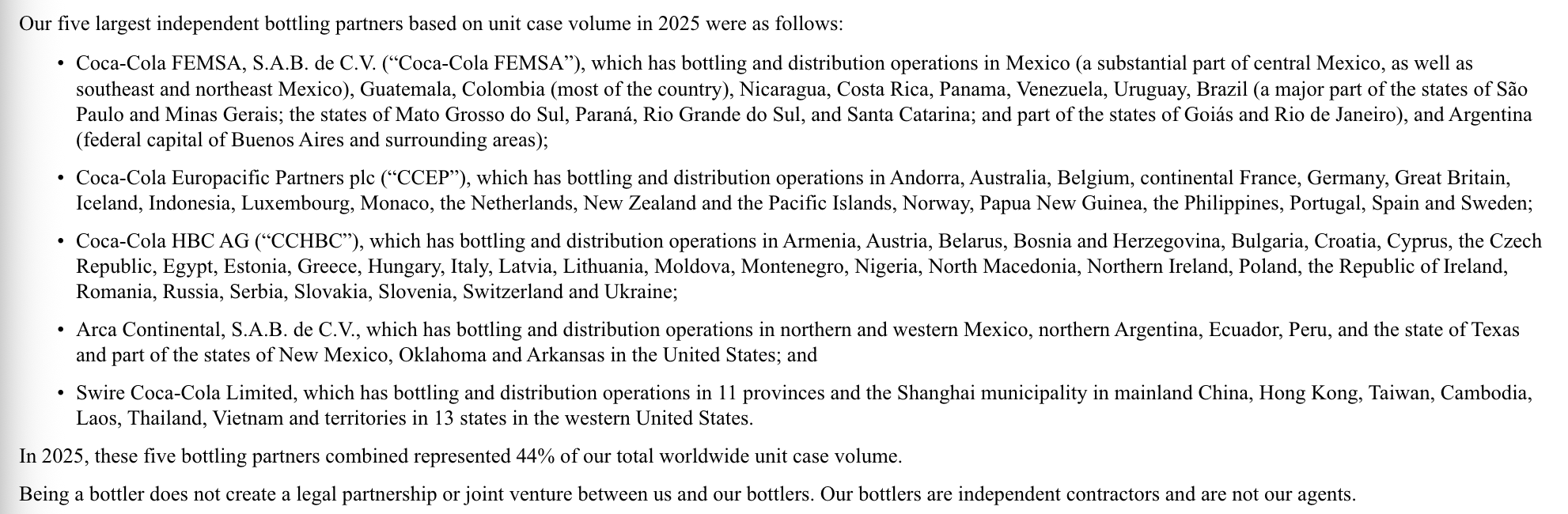
So the picture is: Coke owns the brand, the IP, the recipe, the marketing, and the concentrate factory. The bottlers own the trucks, the warehouses, the canning lines, the cooler placements, the route reps. The exceptions (US fountain, Costa, owned bottlers) are small and getting smaller. The direction of the company for 15 years has been "do less of the physical work, do more of the brand and IP work." That's the entire refranchising story.
Global Footprint
Here's something most people get wrong about Coke. They think of it as an American business with international exposure. It's the opposite.
Only 16% of worldwide unit case volume happens in the United States. Eighty-four percent of cases get sold somewhere else. In dollar terms, Coke pulled $28.8 billion of net operating revenues from outside the US in 2025, out of $47.9 billion total. About 60% of the top line is international.
The four biggest non-US markets are Mexico, China, Brazil, and India. Together, those four countries make up 33% of worldwide unit case volume.
Mexico alone is bigger than most people realize. Per-capita Coke consumption in Mexico is roughly twice the US rate, and Mexicans drink more Coca-Cola products per person than anyone else on earth. That's why Coca-Cola FEMSA, the Mexican bottler, is Coke's single largest bottling partner by volume.
The mix outside the US looks different too. 70% of non-US volume is sparkling soft drinks, versus 61% in the US. Trademark Coca-Cola is 48% of non-US volume versus 42% in the US.
Internationally, Coke is more concentrated in soda, and more concentrated in the original brand. The US is actually where Coke's portfolio is the most diversified, because that's where fairlife, smartwater, BODYARMOR, and the rest of the still beverage portfolio have the biggest footprint.
The "so what" on this is huge.
When the dollar strengthens, Coke's reported revenue gets crushed even if underlying volume is fine. That's why Coke reports "organic revenue" separately - to strip the FX noise out. When you see headlines about Coke missing on revenue, the first place to look is the FX line.
When emerging markets struggle, Coke struggles.
And the long-term growth story isn't about selling more Coke in Ohio. It's about per-capita consumption in markets like India, Indonesia, and Nigeria catching up to Mexico or even the US over time. If you're analyzing KO and not paying attention to emerging markets, you're missing a lot.
Conclusion
This is an incredible business model. It makes sense why Buffett has owned it since the 1980s and has never sold a share. I'm excited to keep studying it!
Oh and by the way... they've increased their dividend every year for the past 60+ years.
Sentiment: Very bullish