

KHC
Kraft Heinz Co
Kraft Heinz is Splitting Into Two Companies
Can you... can you guess what the two companies are?
Take a guess.
Did you guess it was Kraft and Heinz?
Well, if you did. Congratulations! After a decade of marriage, ketchup is breaking up with hot dogs.
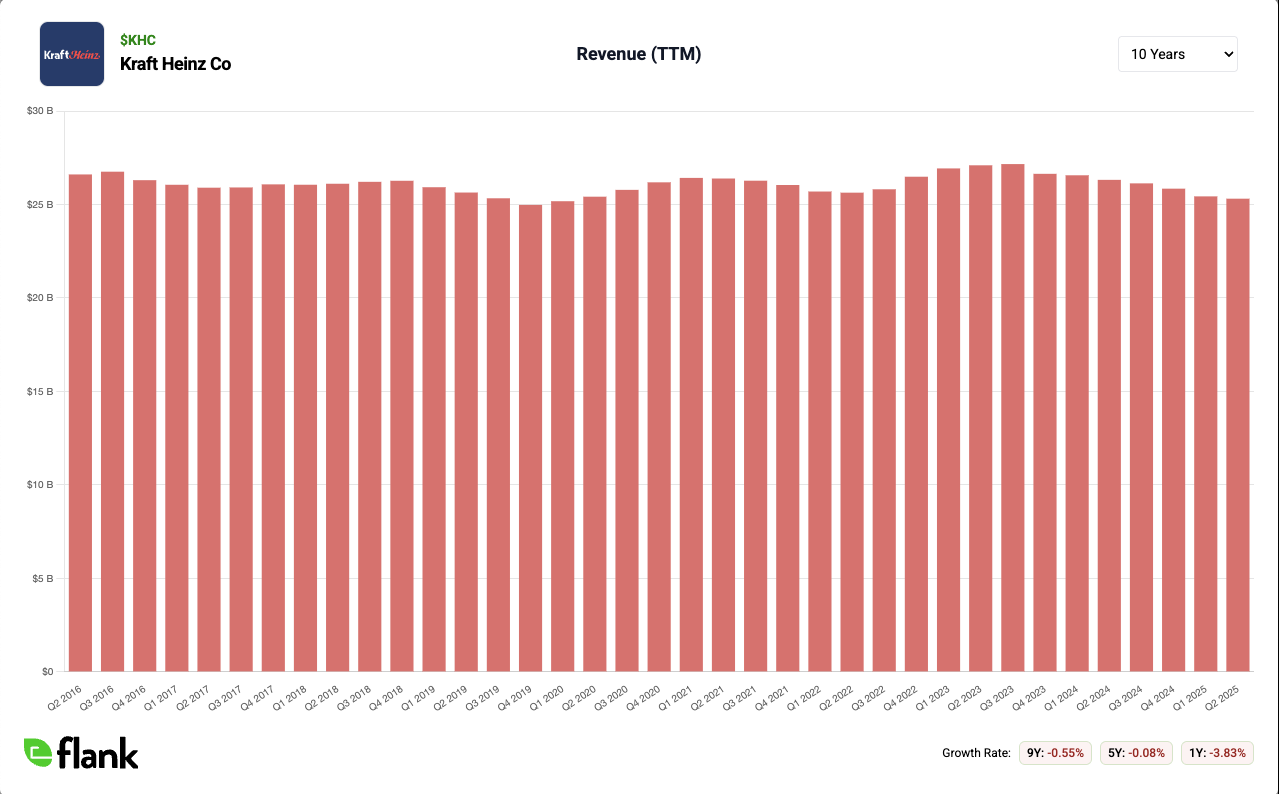
It makes sense when you look at KHC's revenue for the past 10 years... it's flatter than a Kraft single.
This coupled with shrinking margins (-3% GPM over the past year) and mixed bottom line results, necessitated a change.
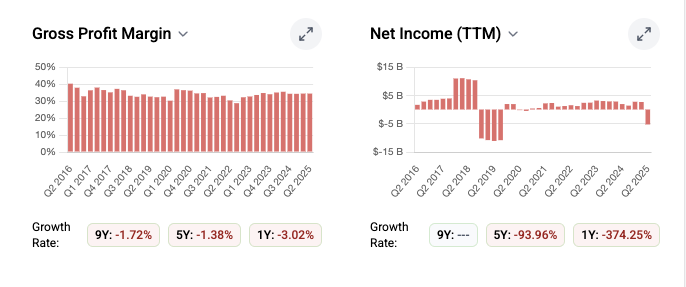
The food giant said it plans to split its business into two companies, unwinding an industry megamerger that married two packaged-food behemoths.
One company will focus on sauces, spreads, and seasonings. That's Heinz ketchup and Philadelphia cream cheese.
The other will stick to North America staples like Oscar Mayer hot dogs, Kraft Singles, and Lunchables. CEO Carlos Abrams-Rivera will head the $10 billion grocery arm, while the global “taste elevation” business will rake in around $15 billion annually.
Why the split? Complexity. Kraft Heinz has nearly 200 brands across 55 categories in 150 countries. That’s a recipe for dilution. Management says two leaner, more focused businesses can allocate resources better and actually grow.
CEO Carlos Abrams-Rivera, who will lead the $10 billion North American grocery arm, said scale only works when paired with focus. That unit will house brands like Oscar Mayer, Kraft Singles, and Lunchables. The global business, with about $15 billion in annual sales, will center on “taste elevation” products, including Heinz ketchup, Philadelphia cream cheese, and Kraft Mac & Cheese.
The move unwinds much of the 2015 Kraft-Heinz merger orchestrated by Warren Buffett and 3G Capital, a deal widely criticized since (even by WEB himself). It also follows a trend of corporate breakups in food and beverage: Kellogg split into Kellanova and WK Kellogg in 2023, while Keurig Dr Pepper is reversing a past merger.
Kraft Heinz has faced slowing demand for staples like Lunchables, Capri Sun, macaroni and cheese, and mayonnaise. In July, it posted a quarterly loss after a $9.3 billion impairment charge tied to its declining share price. Its stock has fallen about 21% in the past year, underperforming both the S&P packaged food index and the broader S&P 500.
To revive growth, the company has launched value products like family-sized mac and cheese under $2 and upgraded ingredients in Lunchables. Still, costs are expected to rise 5–7% this year, with only part of that passed on to shoppers.
Abrams-Rivera said Kraft Heinz’s sprawl—nearly 200 brands in 55 categories across 150 countries—made it hard to invest properly in each. By splitting, the North America unit can concentrate on its market and expand into underused channels like convenience stores. Executive chair Miguel Patricio said the separation will allow brands to get the focus and resources they need.
Analysts caution the split won’t be simple. Kraft Heinz has built company-wide systems and partnerships with Microsoft and Google, while years of facility closures and distribution consolidation will complicate the process. Still, analysts like Robert Moskow argue that focused portfolios often succeed more than sprawling conglomerates.
The company expects the breakup to be completed in the second half of 2026, with no changes to its Pittsburgh and Chicago headquarters.