

SPCX
Space Exploration Technologies Corp
SpaceX Told You It Made $3.5 Billion. It Lost $541 Million.
SpaceX just reported its first quarter as a public company.
The headline number was $3.5 billion of profit.
The actual number was a $541 million loss.
Both are in the same press release, three lines apart. That gap is $4 billion wide and it is the most important thing in this report.
First, the good news, because there is a lot of it
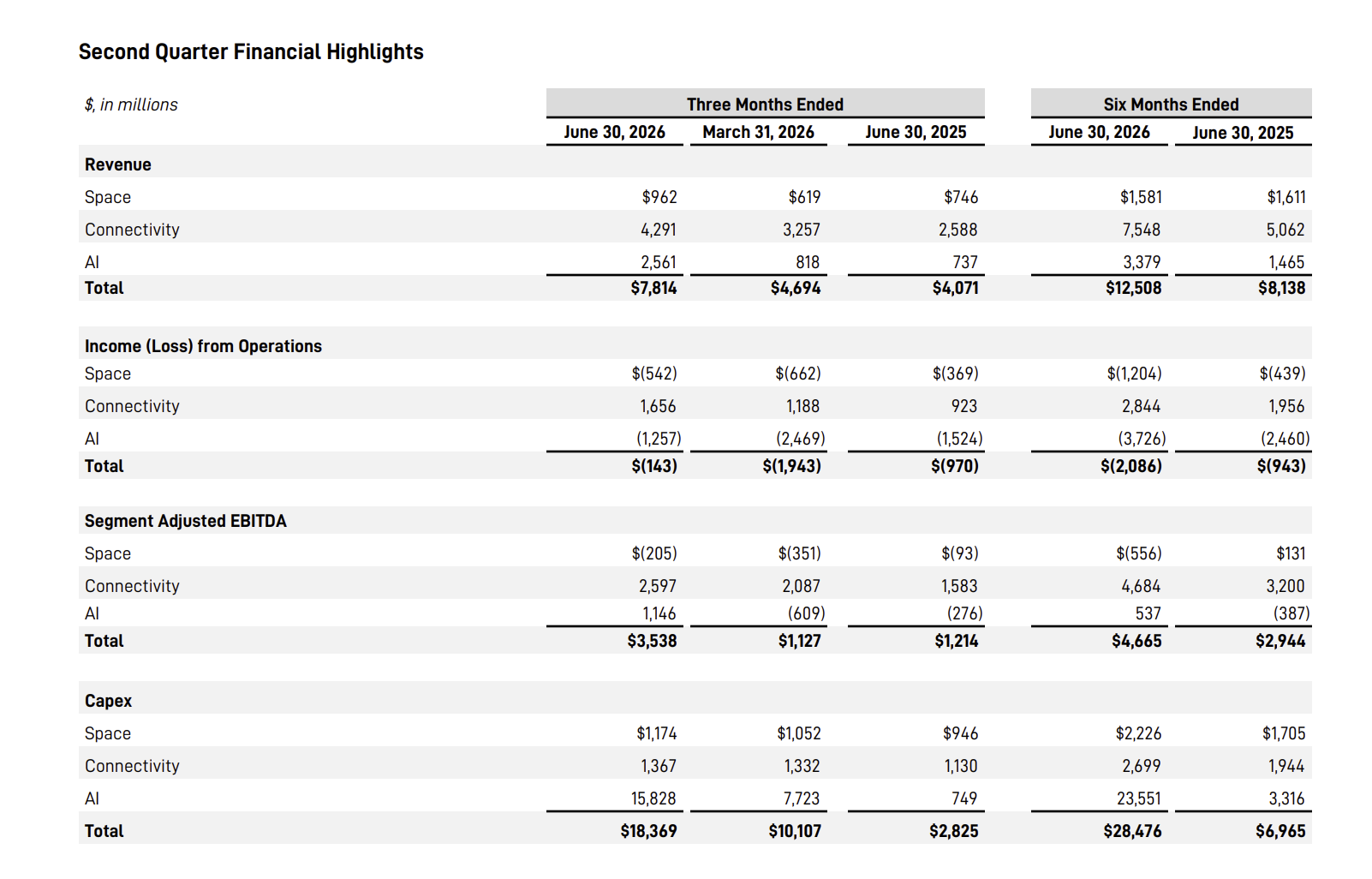
Revenue came in at $7.81 billion, up 92% from a year ago. Wall Street was looking for about $6.9 billion and a 23 cent loss per share. SpaceX did $7.81 billion and a 9 cent loss. That is a real beat on both lines.
Every segment grew. Starlink doubled its subscriber base. The AI business more than tripled. They closed a $25 billion bond deal, ended the quarter with $100 billion in cash, and are sitting on $47.5 billion of backlog.
The stock is trading around $117 as I write this, below its $135 debut price and roughly half its 52-week high of $225.64.
So this is not a story about a bad business. It is a story an extremely overvalued company.
Also, I just have to say they knew. SpaceX knew they would be reporting second-quarter results right after their IPO. When a company goes public, they want to make sure they beat that first quarter, so they make sure they bring in as much revenue as they can for that quarter. It's a simple human heuristic. I'm not surprised that they beat, but I am surprised by how much they are inflating the numbers and how forgiving Wall Street is over it.
But then again, the stock is getting beaten up pretty badly in the after hours.
The number they want you to look at
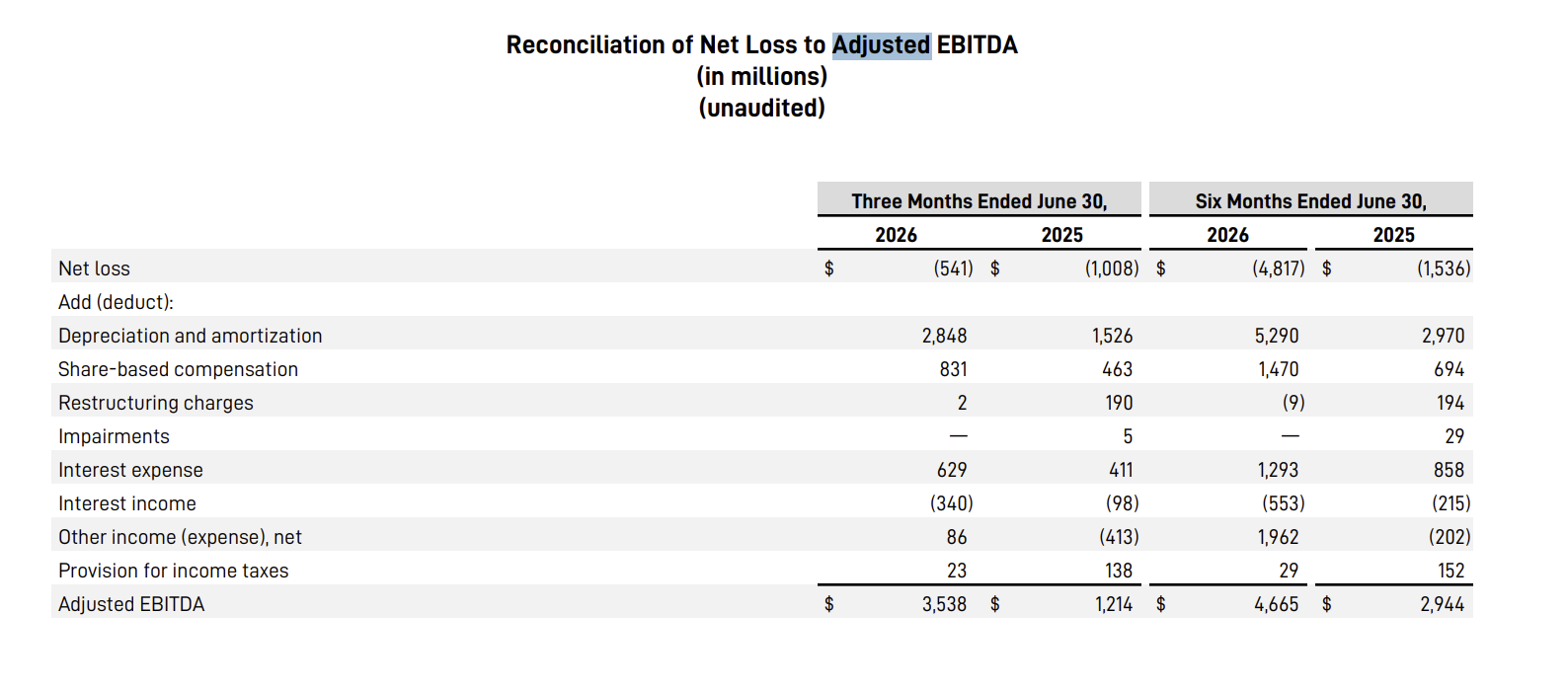
That $3.5 billion is what SpaceX calls "Adjusted EBITDA." To get there from the real $541 million net loss, they add back $2.85 billion of depreciation and amortization, $831 million of stock based compensation, $629 million of interest expense, and a handful of smaller items.
Here is the part that matters.
In the exact same quarter that SpaceX erased $2.85 billion of depreciation from its results, it spent $18.4 billion on capital expenditures.
Capex was 6.4 times the depreciation charge they just added back.
Depreciation is not a fake expense. It is the delayed invoice for the satellites, the rockets, and the GPUs. Adding it back does not make the cost disappear. It moves it to a future quarter. And when you are buying assets six times faster than you are writing them off, that future depreciation number is going to be enormous.
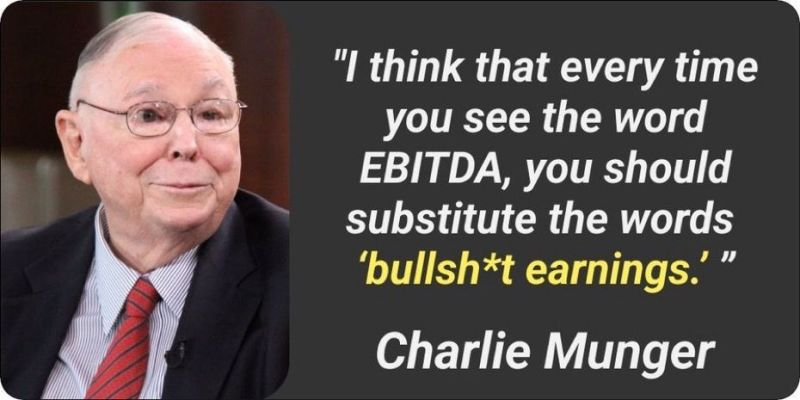
Charlie Munger had a famous line about this metric, and it was not a compliment.
Look at the cash instead. Over the first six months of 2026, SpaceX generated $3.47 billion from operations and spent $28.5 billion on capex. That is roughly $25 billion of cash going out the door.
This is not a rocket company anymore
The Space segment did $962 million of the $7.81 billion in revenue. That is 12% of the business. It lost $542 million.
For the first six months of the year, Space revenue was $1.58 billion versus $1.61 billion last year. It went down.
So did the launches. 78 versus 84 a year ago. Mass to orbit fell from 1,102 metric tons to 1,041. Customer launches dropped from 21 to 17.
And 61 of those 78 launches were internal, meaning SpaceX launching SpaceX's own Starlink satellites.
The rockets are becoming a logistics division for the satellite business.
That is not a criticism of the engineering. Starship Flight 12 launched in May and Flight 13 in July deployed 20 production V3 satellites and relit a Raptor engine in space. That is genuinely hard. It is also why Space segment R&D jumped to $1.08 billion in the quarter from $693 million.
If Starship gets to full reusability, everything changes. Right now it is a very expensive science project attached to a profitable ISP.
Starlink is the actual company
The Connectivity segment did $4.29 billion in revenue, up 66%, and $1.66 billion in operating income, up 79%. That is a 38.6% operating margin.
It is the only segment that makes money. It funds everything else at SpaceX... well, actually I suppose irrational exuberance is what really funds SpaceX (too cynical?)
Subscribers hit 12 million, double last year. Enterprise and government revenue grew 108%, with new deals at American Airlines, Southwest, Virgin Atlantic, Iberia, and Aer Lingus, plus mobile partnerships with SoftBank and NTT Docomo. They also picked up more than $6 billion of multi-year Starshield contracts from the US government.
Here is the line nobody is quoting: average revenue per user fell from $85 to $66. Down 22%.
Subscribers doubled. Consumer revenue only grew 44%. The growth is coming from cheaper customers.
That is probably deliberate as they push into more price sensitive markets, and 12 million subscribers at $66 still beats 6 million at $85. But if your model has Starlink compounding at $85 per user, it's time to update your model lol
The AI segment is where all the money is going
SpaceX spent $15.8 billion on AI capex in one quarter. A year ago that number was $749 million. 21x growth in capex in a year is pretty insane.
AI revenue was $2.56 billion, up 247%. But $2.19 billion of that came from selling compute and infrastructure, driven by $14.1 billion of newly signed Cloud Services Agreements. The release does not say who signed them.
On a GAAP basis the segment still lost $1.26 billion.
And here is what got buried. Advertising revenue fell. $367 million versus $426 million a year ago, down 14%. Down 18% across the six months. X's ad business is shrinking inside the segment everyone is calling the growth engine.
They also announced a $60 billion acquisition of Cursor, the AI coding tool, expected to close this quarter. That is roughly 4% of the entire market cap for one product.
The balance sheet
They have the money. That part is not in question.
$100 billion in cash and marketable securities, built from $85.7 billion of IPO proceeds and a $25 billion bond issuance at a 5.855% weighted average rate, all raised within about two weeks in June.
Total debt and finance leases sit at $39.4 billion. Of that, $13.3 billion is owed to a related party, and related party interest expense alone was $327 million in the quarter.
Accumulated deficit: $41.9 billion.
Final Thoughts
At roughly $1.5 trillion, we are paying about 78 times trailing revenue for a company with exactly one profitable segment. Even Morningstar, which likes the business, notes the valuation implies decades of waiting for earnings to catch up.
Starlink is excellent. The launch business is the best in the world at what it does and currently exists to serve Starlink. The AI business is a capex furnace with a customer list nobody has seen.
None of that makes this a bad company. It makes it a company where the headline number and the real number are $4 billion apart, and where the entire gap is depreciation on assets they are still aggressively buying.
Two questions I want answered before I get excited:
Who signed the $14.1 billion of Cloud Services Agreements?
Who is the related party lending them $13.3 billion?
Neither is in this release. I am not alleging anything. I am saying I would want to know, and so should you.
Sentiment: bearish