

PARA
Banzai International Inc
What's Their Growth Strategy?
What's Their Growth Strategy?Get acquired by Sundance Media lol.
But on that, let's explore that deal in greater detail...
This is what their 10-k said about the Sundance merger:
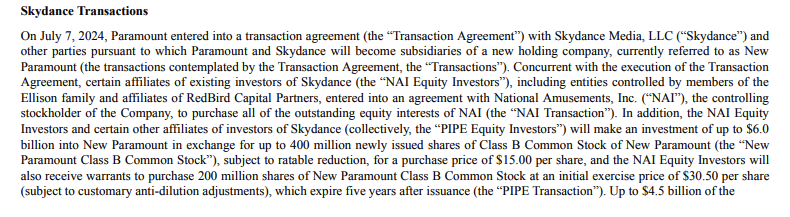
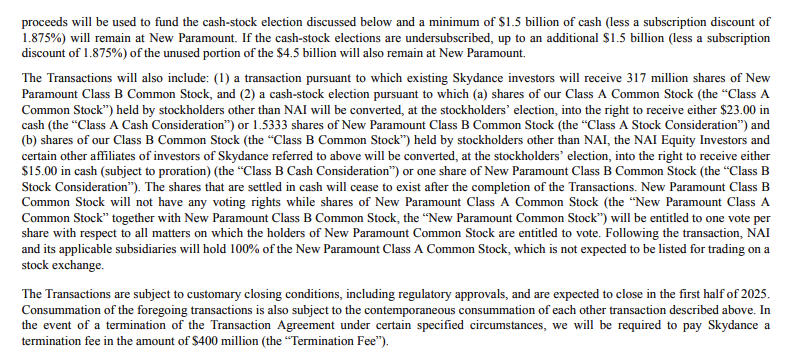
This is a bit confusing and legalese, so let's break it down.
1. Creating “New Paramount”
Paramount and Skydance will both become subsidiaries (owned by) a new parent company, temporarily called “New Paramount.”
The new parent company will control both Paramount and Skydance, forming a combined media company.
2. Buying Out National Amusements (NAI)
National Amusements, Inc. (NAI) currently controls Paramount. NAI is basically the family holding company led by Shari Redstone, controlling Paramount’s voting power.
Investors connected to Skydance (Ellison family and RedBird Capital) are buying all of National Amusements.
After this purchase, NAI will become part of this new group, effectively shifting control of Paramount from the Redstone family to the Ellison family (David Ellison is CEO of Skydance).
3. Raising Money (“PIPE Investment”)
Investors (including the Ellison family and RedBird Capital) are investing up to $6 billion into the newly formed New Paramount company.
In return, these investors receive:
Up to 400 million shares of New Paramount Class B Common Stock at $15 each.
Warrants (options) to buy an additional 200 million shares at $30.50 each within the next five years.
What happens with the $6 billion:
$4.5 billion will go to Paramount shareholders who choose to receive cash (see next section).
At least $1.5 billion stays with the new company as cash (minus a small discount of 1.875%).
If fewer shareholders take cash, more money stays in New Paramount (up to an additional $1.5 billion).
4. What Paramount Shareholders Can Do
Current Paramount shareholders (excluding National Amusements) have choices for what happens to their shares when the deal closes. They can choose either cash or new shares, depending on what type of Paramount stock they hold:
Class A Paramount Shares (voting shares-- we can't buy these)
Choose $23 in cash per share, OR
Receive 1.5333 shares of New Paramount Class B stock for each Paramount Class A share you own.
Class B Paramount Shares (common, non-voting shares)
Choose $15 in cash per share (might be adjusted/prorated depending on demand), OR
Receive 1 share of New Paramount Class B stock per Paramount Class B share.
Shares that are cashed out disappear after the deal.
5. Who Gets Voting Power After the Deal?
New Paramount Class A shares: Have voting rights (1 vote per share), but will only be owned by National Amusements (now owned by Skydance investors).
New Paramount Class B shares: Do not have any voting rights. These shares will be the publicly traded shares.
In simple terms, investors (public shareholders) getting New Paramount shares after this deal will own non-voting shares, while Skydance-affiliated investors gain all the voting control.
So.... what could happen to shareholders?
Scenario 1:
You Hold Paramount Class A Shares (Voting)
This really isn't an option for us normies, so we'll ignore it.
Scenario 2:
You Hold Paramount Class B Shares (Non-voting common shares)
Option A: Take $15 cash per share (could be prorated if many shareholders want cash). You get immediate cash, but shares disappear.
Option B: Exchange your shares 1-for-1 into New Paramount shares. You continue to own non-voting shares in the new, larger company.
Scenario 3:
Too Many Shareholders Want Cash
If more shareholders choose cash than the available $4.5 billion allows, cash payouts will be prorated. Shareholders might get partly cash and partly shares.
Scenario 4:
Few Shareholders Want Cash
If fewer shareholders than expected choose cash, extra cash (up to $1.5 billion) stays inside the new company. The new company will have more money to invest or reduce debt, potentially benefiting all shareholders who choose stock.