

HOOD
Robinhood Markets Inc
I'm Betting Robinhood CEO Vlad Tenev $100,000 that His New Fund Underperforms
In May, Robinhood CEO Vlad Tenev stood on a stage and described Robinhood Ventures as a publicly traded VC firm with "no accreditation requirements and no carry."
One of the shining pieces of Robinhood Ventures Fund I (RVI) was there would be no carry. Carry, in case you're unfamiliar, is the % that fund managers take of profits.
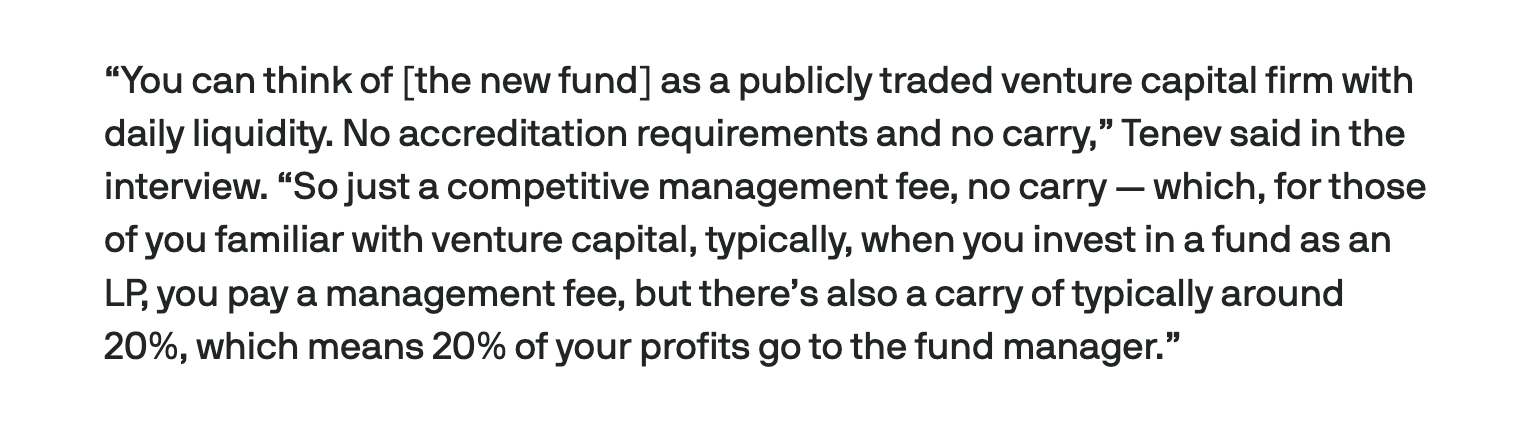
Wow! that's cool. Except, h̶e̶ ̶l̶i̶e̶d̶ three months later, he changed his mind.
In August, Robinhood launched Ventures Fund II (RVII). It charges 20% carry, on top of a 2% management fee AND other fees (more on that later).
Whoops.
Here's why I think you should stay FAR AWAY from this fund, and to put my money where my mouth is, I'd like to formally invite Mr. Tenev to a $100,000 charity bet: in ten years, RVII will underperform the SP500 either by list price or NAV (probably both).
What RVII actually is
RVII listed on the NYSE last Thursday. It's a business development company, a legal wrapper Congress created in 1980 that lets a publicly traded fund hold private startups and sell shares to anyone with a brokerage account. This vehicle is what supposedly allows the "entire democratization machine" where investors aren't required to have accreditation or minimum. Wow... a law from 46 years ago. So innovative.
RVII raised $225.5 million to hold roughly 80 seed-stage Y Combinator startups. It opened at $22.50, ten percent below its $25 IPO price.
Its older sibling, RVI, launched in March holding ten late-stage names like OpenAI, Stripe, and Databricks. RVI charges 2% and no performance fee, which I was more in support of and that's why I haven't called out Robinhood Ventures yet. RVII is a whole other ballpark.
Retail loved RVI. The shares ran from $25 to $57.02 by late May, a 90% premium to what the holdings were actually worth. Then SpaceX went public, the scarcity story died, and RVI round-tripped to $24.81 by end of July.
Here's a scary stat I found while researching: In RVI's first audited report, covering March 6 to March 31, the fund's net asset value fell 3.80% while its share price rose 6.16%. The assets went down. The price went up. This means the delta was pure sentiment. And that negative NAV number is after Robinhood reimbursed the fund almost $3 million of offering costs. Without the subsidy it was worse.
These things trade on hype to retail investors, not on "fueling innovation".
Why Fund II is worse
RVII took everything questionable about RVI and bolted a performance fee onto it. We are being asked to pay 2% a year on net assets plus 20% of realized gains to a Robinhood subsidiary formed in August 2025 that has never run a BDC. Total estimated annual expenses: around 4.18%.
That's the visible layer. But it gets worse. Some holdings sit inside SPVs, middleman vehicles run by outside managers who charge their own management fee and their own carry before a dollar reaches investors in the fund. The prospectus says shareholders bear both fee layers. It also says the fund may owe an SPV manager a performance fee on a winning position even if that SPV's overall return is negative.
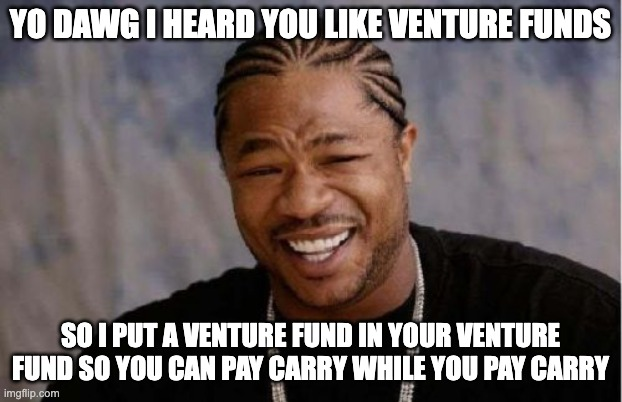
Fees on fees on carry on carry. Pardon my French (I'm a sailor, so cursing is my native tongue): But this is fucking ridiculous.
We're still not done! It gets worse: The adviser is also the fund's valuation designee, meaning it marks the value of 80 illiquid startups itself, and its 2% fee is calculated on the marks it produces. Right now there's almost nothing to mark.
The fund raised roughly $200 million on top of a seed book of about $25 million, so by my math close to ninety cents of every dollar you own is sitting in a money market fund earning cash yields while paying venture capital fees. That's not a hypothetical drag. RVI was still 53% in money markets seven months in.
And in case there's confusion about who's winning: Robinhood Markets sold 400,000 of its own shares into the RVII IPO, through its own app, to its own customers. Last quarter, $129 million of Robinhood's $573 million in net income came from marking its leftover RVI stake to RVI's market price, per its own 10-Q. So the premium retail paid above what the assets were worth became the parent company's reported earnings.
Robinhood's own legal footer says the quiet part out loud: it earns more money from affiliated funds like RVII than from unaffiliated ones.
Can it beat the market?
Short answer: If I had to bet on a snowball's chances of surviving the fires of Hell, or RVII beating the market, I'd choose the snowball 10 times out of 10.
But let's have some fun. The whole pitch rests on venture returns being big enough to justify the toll. So let's look Venture Capital as a whole for the record.
Cambridge Associates tracks 2,816 US venture funds, and their index is already net of management fees and carry. Their finding: the VC benchmark has been struggling to keep up with the large-cap S&P 500. That's the entire professional venture industry, after its own fees, failing to clear the index. RVII has to beat that, then pay 2-and-20 again on top of it.
"But RVII is picking almost exclusively from YC-backed companies"... ok, let's look there then:
The YC-specific data is worse, and it comes from a YC believer. Rebel Fund, which invests exclusively in YC companies, found that 6% of them become unicorns and drive 90% of all value created. Their simulation work concluded that a large, diversified YC portfolio picked without special skill lands at returns "similar to public equities." Before fees.
And YC itself buys in at $125,000 for 7% of a company. That's essentially the founding price. RVII buys later, through SAFEs and SPVs, at whatever the market charges. It does not inherit YC's entry price, only YC's brand.
So do the arithmetic. At 4.18% a year, before the SPV layer, RVII's startups need to beat the S&P 500 by more than four points annually for a decade just for shareholders to break even against an index fund.
The Steelman Argument
Let me give the other side its best shot, because it's real.
Eighty diversified YC seed positions is genuinely something no individual could assemble alone. That's fair enough.
Robinhood uses the idea of "power law" logic to define their prospectus. The power-law logic in Robinhood's own prospectus is intellectually honest - and that's how VC has historically operated. Here's what they say in the prospectus:
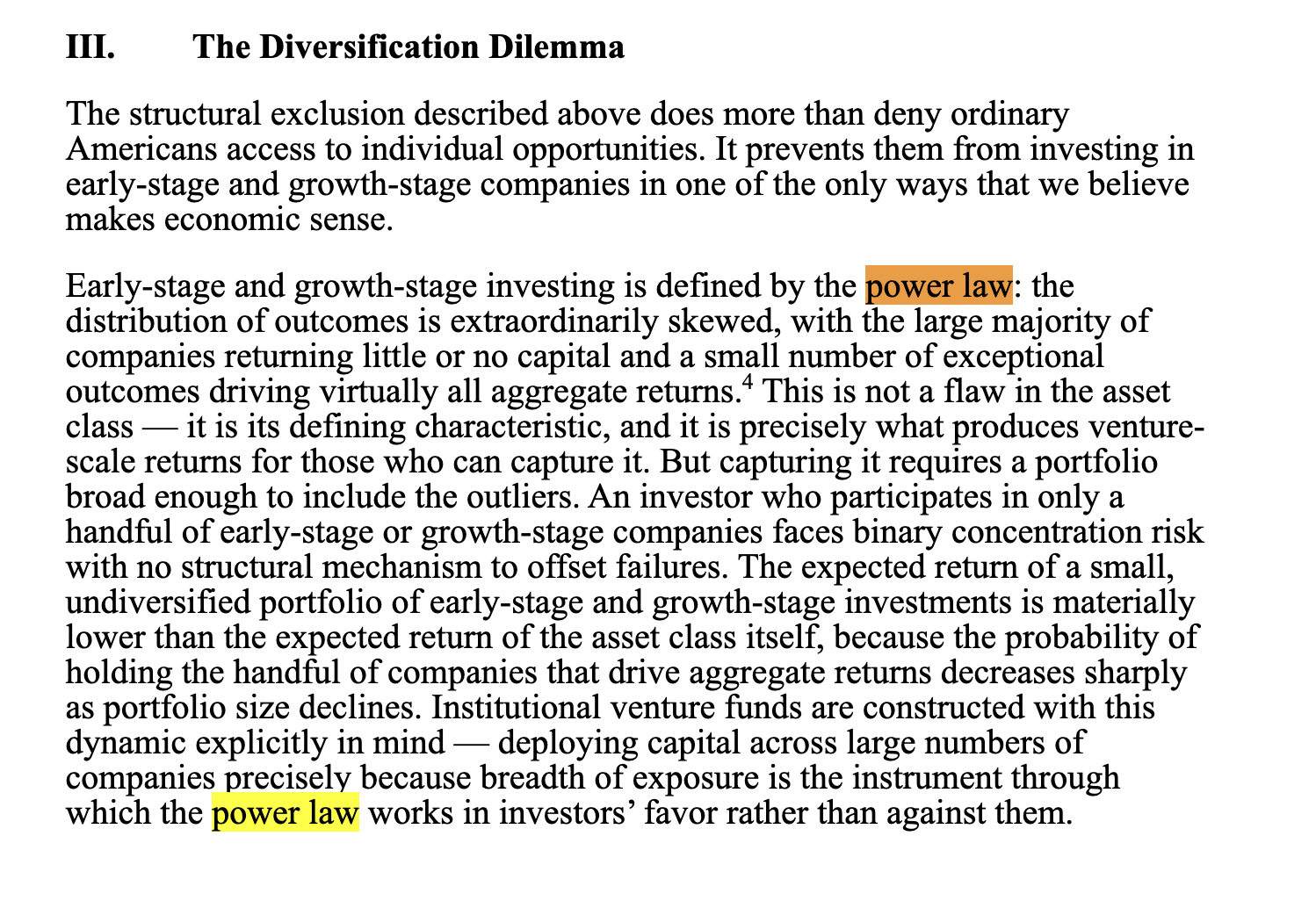
RVII is also a closed-end structure means no redemptions and no forced selling in a panic, which is a real advantage for holding illiquid assets. The fund publishes audited financials quarterly, which actual venture funds never show their LPs. And seed investing has a fat right tail: if one of these 80 companies becomes the next Stripe, the fees stop mattering and I might lose the bet.. but I doubt it.
The part that actually worries me
RVII is one fund. The trend behind it is the real story.
An executive order has the Department of Labor building a safe harbor to put private assets into 401(k)s, reaching over 90 million Americans, mostly through target-date funds nobody actively chose. BlackRock is launching retirement funds with up to 20% in privates.
Private companies file nothing. They disclose nothing. They get valued by the people who collect fees on the valuations. When a public company cooks its books, short sellers, journalists, and quarterly filings eventually blow the whistle. When a private company does it, we find out years later, after the money is gone. Every major private-market blowup you can name followed that pattern.
Now push trillions of retirement dollars into that darkness and tell me how it ends.
Here's what's strange. I agree with Vlad about the disease. His own prospectus cites the data that companies now take 14 years to IPO instead of five, and he's said publicly that being a public company has a branding problem. He's right about all of it.
But the fix for a locked door is not selling tickets to the hallway. The fix is getting companies public earlier, so ordinary people get the growth and the disclosure together.
My solution: let's turn late-stage VC to dust. Tax the ever-loving shit out of any private company that is trying to raise tens of billions of dollars.
I'm not the OG bettor in this regard
In 2006, Warren Buffett stood at the Berkshire annual meeting and offered $500,000 to any professional who could a hedge fund(s) that would beat an S&P 500 index fund over ten years, net of fees.
Nobody took it the bet at first.
Ted Seides of Protégé Partners finally accepted in July 2007. Buffett's written argument on Long Bet #362 is worth reading in full, but the core of it is one sentence: plenty of smart people run hedge funds, their efforts largely cancel each other out, and "their IQ will not overcome the costs they impose on investors."
Carol Loomis did the fee math in Fortune at the time. Because Seides picked funds of funds, the underlying managers took 20% of gains, then the fund of funds took another 5% or more of what was left, so at most 76% of the return reached the investor, who was also paying a management fee on capital no matter what happened. She concluded Protégé's picks would have to do much, much better than the S&P just to tie.
That is the exact structure of RVII's SPV layer. Eighteen years later, same machine, new paint, sold to retail instead of institutions.
Now the part people forget. Buffett lost for four straight years. In 2008 his index fund fell 37% while Protégé's funds lost only 23.9%. Three years in, both sides were underwater, and Fortune noted the only winners so far were the managers collecting fees on losses. Buffett's response was to say he hoped "that Aesop was right" about the tortoise and the hare. He didn't take the lead until year five.
Final result: 7.1% compounded annually for the index, 2.2% for the funds. He preempted the luck argument in his 2017 letter, pointing out there was "nothing aberrational about stock-market behavior over the ten-year stretch." And his conclusion was the line I'd frame on a wall: when trillions are managed by Wall Streeters charging high fees, "it will usually be the managers who reap outsized profits, not the clients."
My (Very Serious) Offer to Mr. Tenev
Vlad, I'll bet you $100,000, winner's charity takes all, structured through Long Bets exactly the way Buffett structured his.
The prediction: over the ten years from RVII's IPO, the fund underperforms a low-cost S&P 500 index (SPY, for example)
We will measure two ways to keep it honest:
net asset value total return as reported in RVII's own audited annual shareholder reports under GAAP, and
NYSE share price total return with distributions reinvested.
NAV so you can't blame the market. Share price so you can't hide behind marks you set yourself. If you accept the offer, we can nail down the terms.
My charity fights the wealth gap, since closing it is supposedly the whole point of your fund.
Every August, win or lose, we publish the scoreboard. Ten years, no hiding.