

General
Warren Buffett’s Greatest Strengths (and how to replicate them)
If you wanted to become great at the game of basketball, you'd want to study Jordan.
If you wanted to become great at guitar, you'd want to study Clapton.
If you want to become great investor, you need to study Buffett.
There's no question he's the GOAT. If he hadn't began giving a ton of money away, he would be the richest person in the world. And his philanthropy is also beyond admirable. When he dies, he will give away 99.99% of his wealth.
There are few things I'd consider myself an "expert" on. Over the past ten years, I have read every word that Buffett has written since 1965 and have watched nearly every piece of content you can find on him.
And it was a worthwhile journey. Let's go into some of my biggest takeaways as to what I believe is the Alchemy of Buffett (it's not his investing genius-- it's the other feats he has to supplicate his decisions).
## His Realistic Optimism
I think this is the one that goes the most unnoticed by people who study Buffett, and I believe it unlocks a lot of his downstream feats like being greed when others are fearful, and how his investment philosophy has basically been the same for over 50 years (with the exception of no longer looking for "cigar butts").
He believe that over the long term, the future is going to be a lot brighter than it is today. But he's not blind in his optimism. He realizes that progress is a rocky road. The best recent example of this is during the dark days of the 2020 market panic, Buffett opened Berkshire’s shareholder meeting by urging everyone to “pause and look at our history.” He spent the first 45 minutes showing how the United States had overcome every past crisis and continued its upward trajectory. Citing examples from World War II, the Cuban Missile Crisis, 9/11, and the 2008 crash, Buffett stated that “nothing can basically stop America… The American miracle, the American magic has always prevailed, and it will do so again.”
It's a long watch, but you can start at minute 15 and hop around. It's worth it.
This realistic optimism allows him to keep his head on straight amidst chaos. The key piece in here the REALISTIC part of optimism. In fact, he and his partner Charlie Munger have openly debated whether the U.S. can sustain even 2% annual GDP growth long-term – showing they weigh the evidence and aren’t blindly rosy. Buffett often points out that when he was born (1930) and growing up in the 1940s, many things in America were far worse – from the economy to healthcare to civil rights – yet tremendous progress has been made over his lifetime. This long historical perspective allows him to keep his head on straight amidst chaos.
But he's always believed that he could find great businesses at fair prices. You just have to look - and you have to enjoy the game. You have to enjoy hunting.
## He understood Compound Interest from an early age
Buffett’s bedrock understanding of compound interest has been the foundation of his wealth-building – and he grasped it remarkably early. This might sound basic (“Investing 101”), but it’s crucial. In fact, the word “compound” appears in every Berkshire Hathaway annual shareholder letter, right in the first paragraph. Here's the 1992 letter as an example.
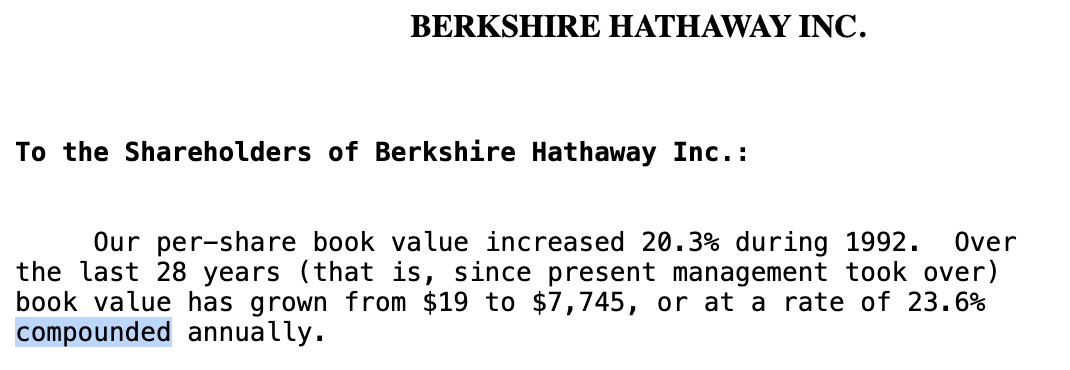
Buffett’s entire approach is to make steady, relatively modest gains that snowball over time. He internalized this as a young man.
He even remarked that he “always knew I was going to be rich [and] never doubted it for a minute.” That wasn’t arrogance – it was quiet confidence born from doing the compound interest math. As a teenager, Buffett realized that if he could compound money at 20% a year, he would become extraordinarily wealthy given enough decades. He didn’t need to swing for the fences or find some 10,000% moonshot; he just needed to sustain solid returns and be patient. This long-term mindset freed him from any rush to “get rich quick.”
Understanding compounding also taught Buffett the value of capital preservation. He famously says the first rule of investing is “Don’t lose money; and the second rule is don’t forget Rule #1.” Small losses or high fees early on can erode the base on which compounding works its magic. Buffett would rather achieve a dependable 15–20% year after year, than chase a risky trade that might triple his money one year and wipe him out the next. Here's a clip where he explains this perfectly, and also warns against leverage.
As investors, we can and should take this onboard: It’s far easier to try compounding steadily at a decent rate than to pray for a once-in-a-lifetime jackpot. Buffett’s trust in compounding fed directly into his next great virtue – his patience.
## His Patience & love for the game
Because he knew that he wasn't in a rush to get rich, it allowed him to be extremely patient in his capital allocation. Buffett and Munger have both said that they could attribute all of Berkshire's success to just 10 decisions they made.
And he's more than happy to wait. The best example of this is his "elephant gun". Berkshire Hathway is currently sitting on $344,000,000,000. That's an insane number. He could buy almost anything with that cash pile. But he's not deploying it. He's got it in short-term government bonds, happily collecting ~5% annually while he waits for the perfect business to buy that is well within his Circle of Competence.
Many investors feel pressure to “do something” with idle cash, but Buffett will only act when it truly makes sense. As he memorably said, “Opportunities come infrequently. When it rains gold, put out the bucket, not the thimble.” Until then, keep your powder dry.
After he finds his buy, Buffett's more than happy to sit back and let his investments grow-- he did the work up front and he knows it's only a matter of time. His favorite holding period is "forever".
But the important thing here is: he found those opportunities, and is still looking for them. He hunted for them. For every one decision he made, he evaluated dozens-- nee hundreds-- of companies. At his peak, Buffett said he read 500 pages of annual reports every day.
While we don't need to go that extreme, we can definitely take a page out of that book. There's value in studying businesses on a regular basis- you got to love the game (and it's fun I promise!). And there are other tangential skills you develop from loving the game of investing.
## His Emotional Makeup
Buffett is a standup guy-- there's no question. He's a good person to do business with (as proven time and time again). And he protects his reputation with ferocity.
In one of the most important moments of his professional life, when he was taking over Salomon Brothers after scandal, he made this testimony to Congress. This was a huge moment for the American capital markets. Faith in our institutions was breaking, but Buffett took a strong stance about reputation and honesty. Now, this was in 1991-- if only Buffett's sentimentality would've persisted through 2008...
If there's one clip you watch from this post, I recommend this one.
Another part of his emotional makeup is that he doesn't try to be a hyper-genius that can predict the markets. In one of his first TV appearances, he tells the interview that the most important quality for an investor is "the temperamental quality, not the IQ". This is why I believe Buffett-style investing should be taken onboard by everday people. You don't have to be a genius.
The last one, and the one I want to wrap this long post with, is Buffett humility.
If you read the Chairman's Letters (which I highly recommend), you'll see time and time again Buffett blaming himself for making bad decisions.
Just in the 2024 Letter, he has a whole section on "Mistakes"... and you can find tons of other examples over the years.
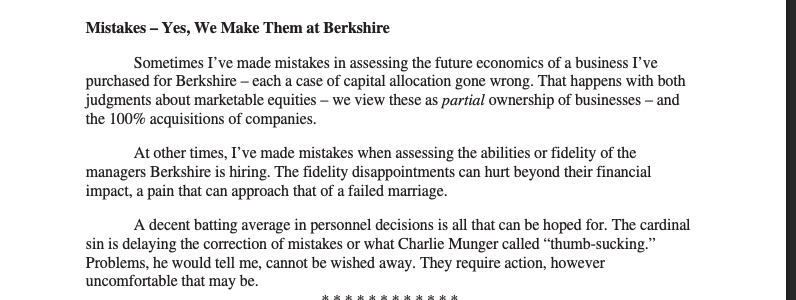
This humility has prevented him from making huge mistakes. It's a beautiful quality.
None of these strengths exist in a vacuum, but combined, they've created the alchemy of Buffett. And the coolest thing is that it's something that everyone can replicate-- and it's wildly underexposed in the financial world today.