

AMZN
Amazon.com Inc
How Amazon actually makes money
How Do They Make Money?Amazon did $716.9 billion in revenue last year - but the revenue breakdown is fascinating. Let's dive into their seven revenue streams:
The seven revenue streams
Amazon breaks its revenue into seven buckets. Here's the last five years:
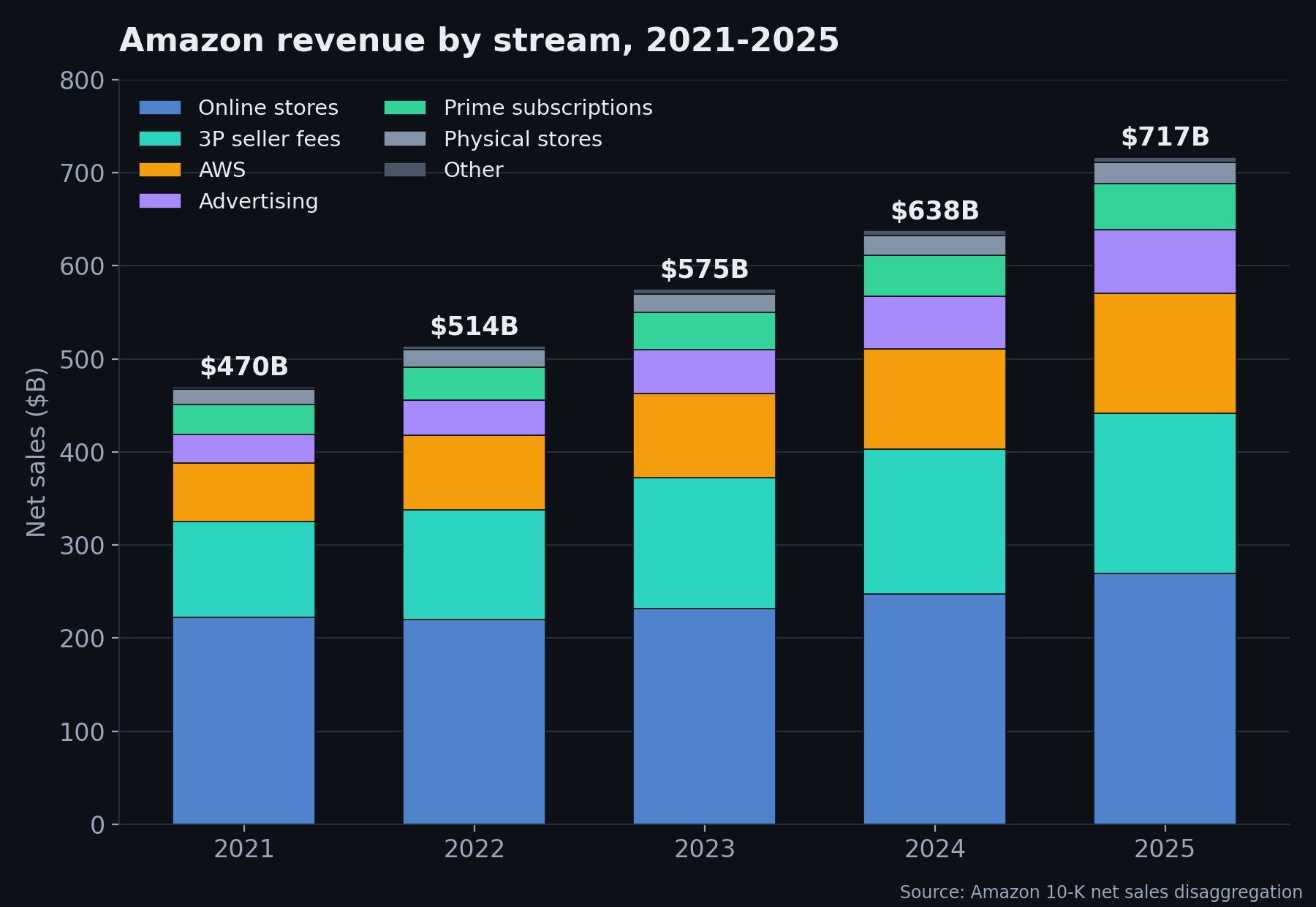
Walking through them, biggest to smallest:
1. Online stores: $269B (38% of revenue). This is Amazon acting like a normal retailer. They buy inventory, they sell it to you, they keep the difference. It's the business everyone pictures, and it's the worst business in the building. Retail margins are razor thin everywhere - intentionally. Bezos has long described Amazon as a purely customer-centric company. That's what they optimize for in their retail units.
2. Third-party seller fees: $172B (24%). This one changes how you should see the company. Independent merchants now sell 62% of everything on Amazon. Amazon takes a referral fee, usually around 15%, plus fulfillment fees if the seller uses Amazon's warehouses. The huge benefit of this is there's no inventory risk for Amazon - they're basically just running the marketplace.
3. AWS: $129B (18%). Amazon rents out computing power, storage, and now AI infrastructure to other companies. Netflix, banks, startups, government agencies, even Flank use AWS! They pay monthly, they rarely leave, and the margins look like software because it is software.
4. Advertising: $69B (10%). When you search "protein powder" and the top results say Sponsored, somebody paid for that placement. Sellers bid for your eyeballs at the exact moment you're holding your wallet. This is the fastest-growing major stream, up 22% last year and 26% last quarter.
5. Prime subscriptions: $50B (7%). Recurring membership fees. Prime is less a profit center and more the glue: it makes you order more boxes, watch more ads, stay in the ecosystem.
6. Physical stores: $23B (3%). Mostly Whole Foods.
7. Other: $6B. Shipping services, healthcare, odds and ends.
Under the Hood of Amazon
Amazon tells you revenue in seven streams but only reports profit in three segments: North America, International, and AWS. Put revenue share next to profit share and the whole company snaps into focus:
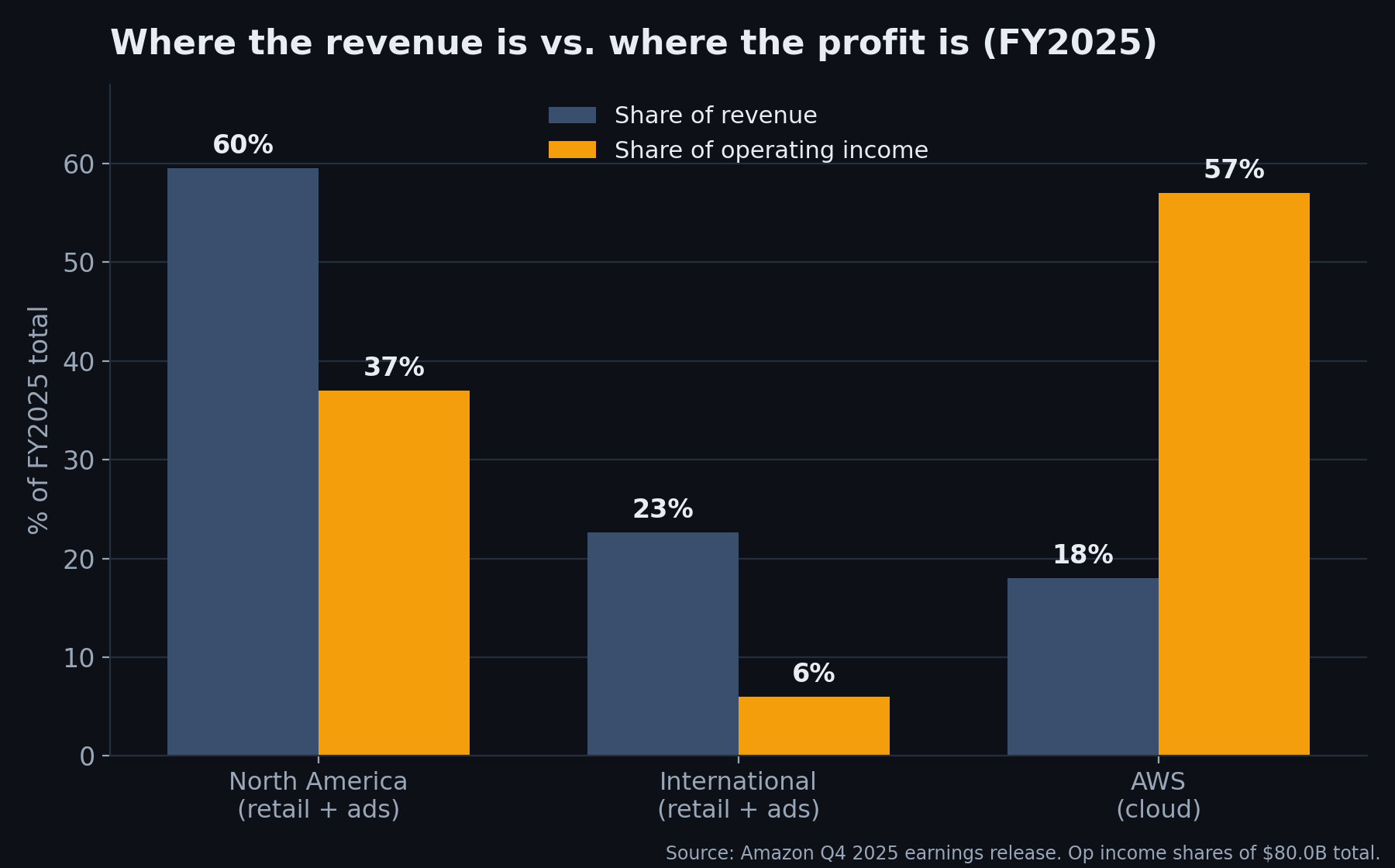
AWS is 18% of revenue and 57% of operating income. Operating income just means profit from actually running the business, before taxes and investment gains. The two retail segments are 82% of revenue and 43% of the profit.
Why? Selling physical stuff is brutal. North America retail earns about 7 cents per dollar of sales. International earns 3. AWS earns 35, and hit 39 cents last quarter.
So here's my mental model: Amazon retail is a thin-margin retail engine, but AWS is an earnings powerhouse.
But will this always be the case?
The turnaround hiding in plain sight
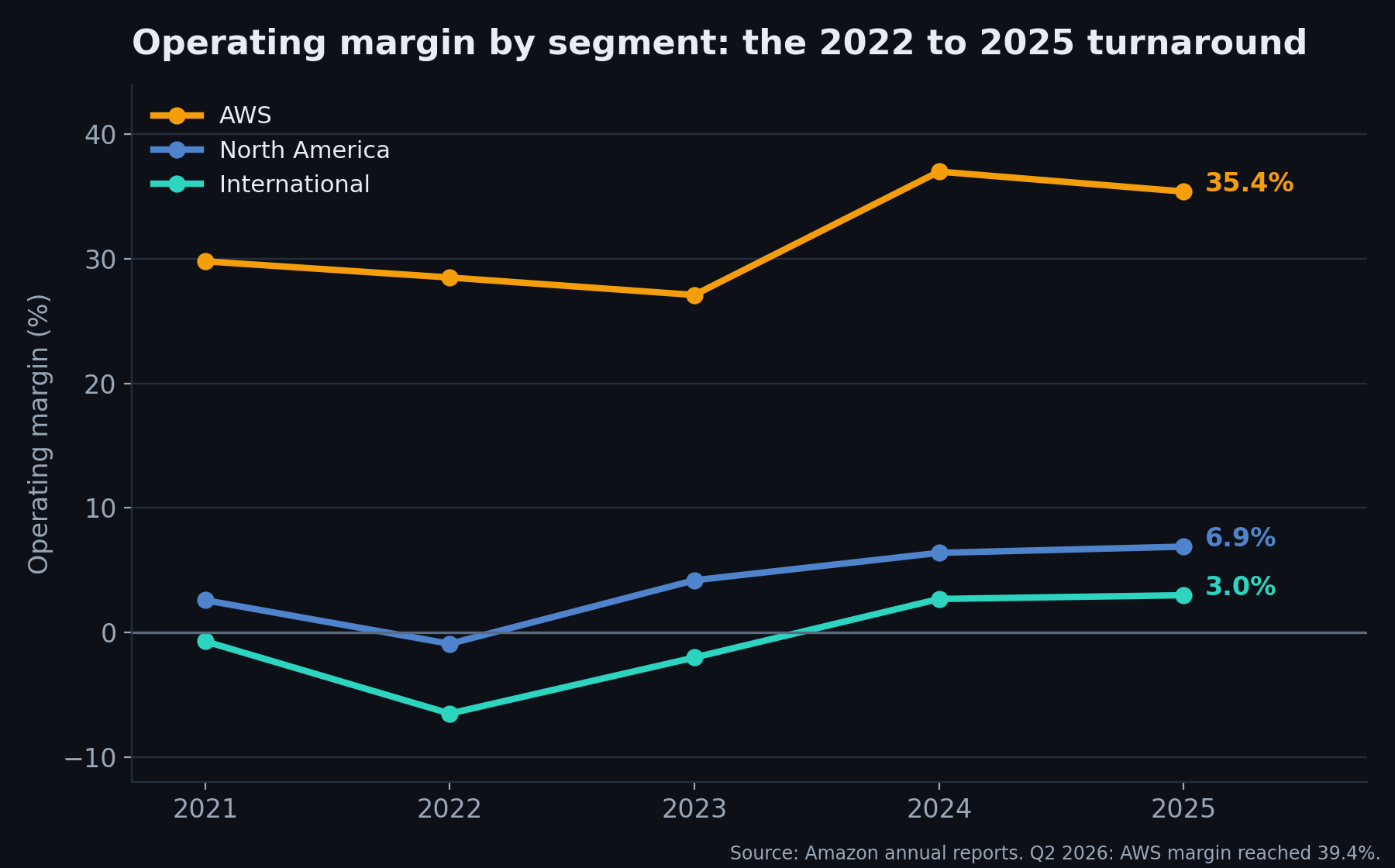
In 2022, both retail segments lost money. Every dollar of stuff sold, Amazon lost a little. Three years later, North America runs a 6.9% margin and International turned positive.
What changed? Mostly advertising. Amazon doesn't disclose ad margins, but ad revenue nearly doubled since 2022 and it lands inside those retail segments. The retail business didn't suddenly get great at selling boxes. It got great at selling access to the people buying them.
Two traps before you quote any headlines
First, Q2 headlines said Amazon's profit tripled to $62.6 billion. Read the fine print. $53.4 billion of that was a paper markup on their investment in Anthropic, the AI company - we covered this in a separate post.
Second, free cash flow went negative. Amazon is spending $220 billion this year building AI data centers, and it's eating every dollar the business throws off. The margin machine and the cash bonfire are both true at the same time.
So that's how Amazon makes money today. If you would follow along with my other Amazon posts. The real reason I'm interested in studying this company more is that they are planning to use robotics and automation to double the output of their retail units while holding headcount steady. I believe this will expand profits a lot. You're talking about the extremely high-volume business that is Amazon retail. Every percentage point of margin means a lot
Sentiment: Bullish