

SPCX
Space Exploration Technologies Corp
Is SpaceX actually cheap?
Over the weekend, Morgan Stanley's Adam Jonas, one of the biggest SpaceX bulls on Wall Street, sent a note to clients titled "SPCX $159: Cheap and Getting Cheaper."
I tried finding the full article, but it is locked down to only his clients, and I was unable to find it.
His price target for Space X, is almost bewildering. He currently has a price target of $300, which would make SpaceX worth about $4 trillion, almost double Friday's price.
His advice: buy in the next few weeks, before Starship Flight 15.
The stock jumped almost 8% on Monday. By Tuesday, the only ticker WallStreetBets talked about more was the S&P 500 fund.
Flight 15 is a big deal. SpaceX already catches its giant booster with the launch tower's arms. On the next Starship flight, it may try to catch the ship on top too. Pull that off and Starship becomes the first fully reusable orbital rocket, which is what makes getting to space cheap. SpaceX hasn't confirmed the date or the catch yet; planning points to no earlier than Oct 19.
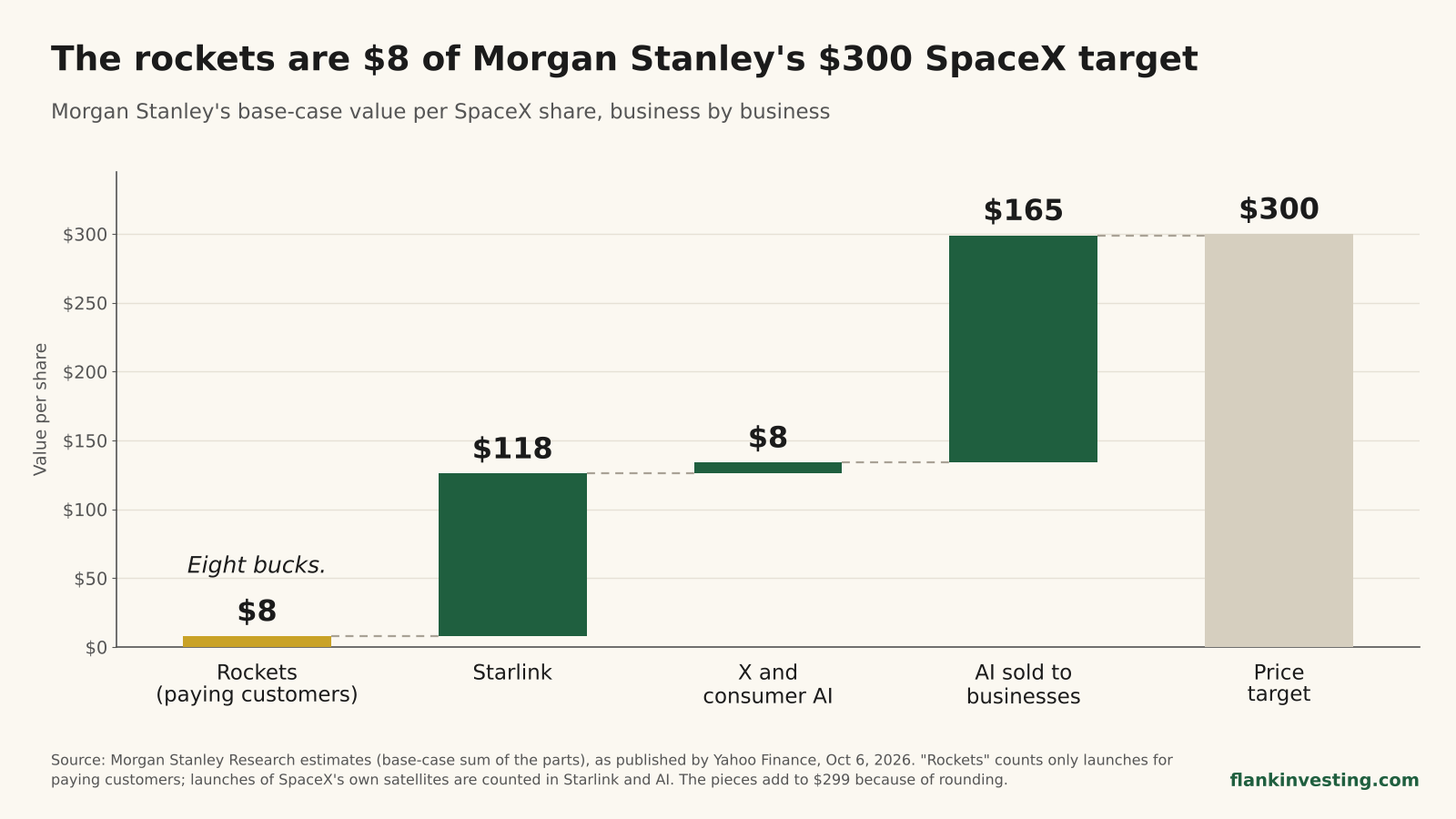
But here's what got me. Break Jonas's $300 down piece by piece, and the rocket business is worth $8 of it. Eight bucks. Starlink is $118. AI is $173.
These rockets are super inspiring, but it's not how the company makes money.
So is SpaceX actually cheap?
Why Jonas says it's cheap
On the usual yardstick, SpaceX is expensive. Jonas says the whole company costs about 30 times the operating profit it's expected to make in 2028. Operating profit is what's left after running the business, before interest and taxes. The other AI giants trade around 16 times.
His argument: you have to factor in growth. (well duh)
Adjust for how fast he expects SpaceX to grow, and it scores 0.3. The AI giants sit around 0.5. Lower means you pay less for each bit of growth. That's the "cheap."
He also says today's price is already covered by the rockets and Starlink, which he values at $127 a share together, so you're getting the AI almost free. (The rockets only get $8 because that piece counts launches for paying customers. Launches of SpaceX's own satellites get counted in Starlink and AI.)
His own downside case: about $100 within a year if AI slows down, Starship hits a wall, or SpaceX has to sell a lot of new stock.
One thing worth knowing: Morgan Stanley was one of the IPO's lead banks and has been paid banking fees by SpaceX. That's normal on Wall Street. Still worth knowing.
Why AI is the whole story
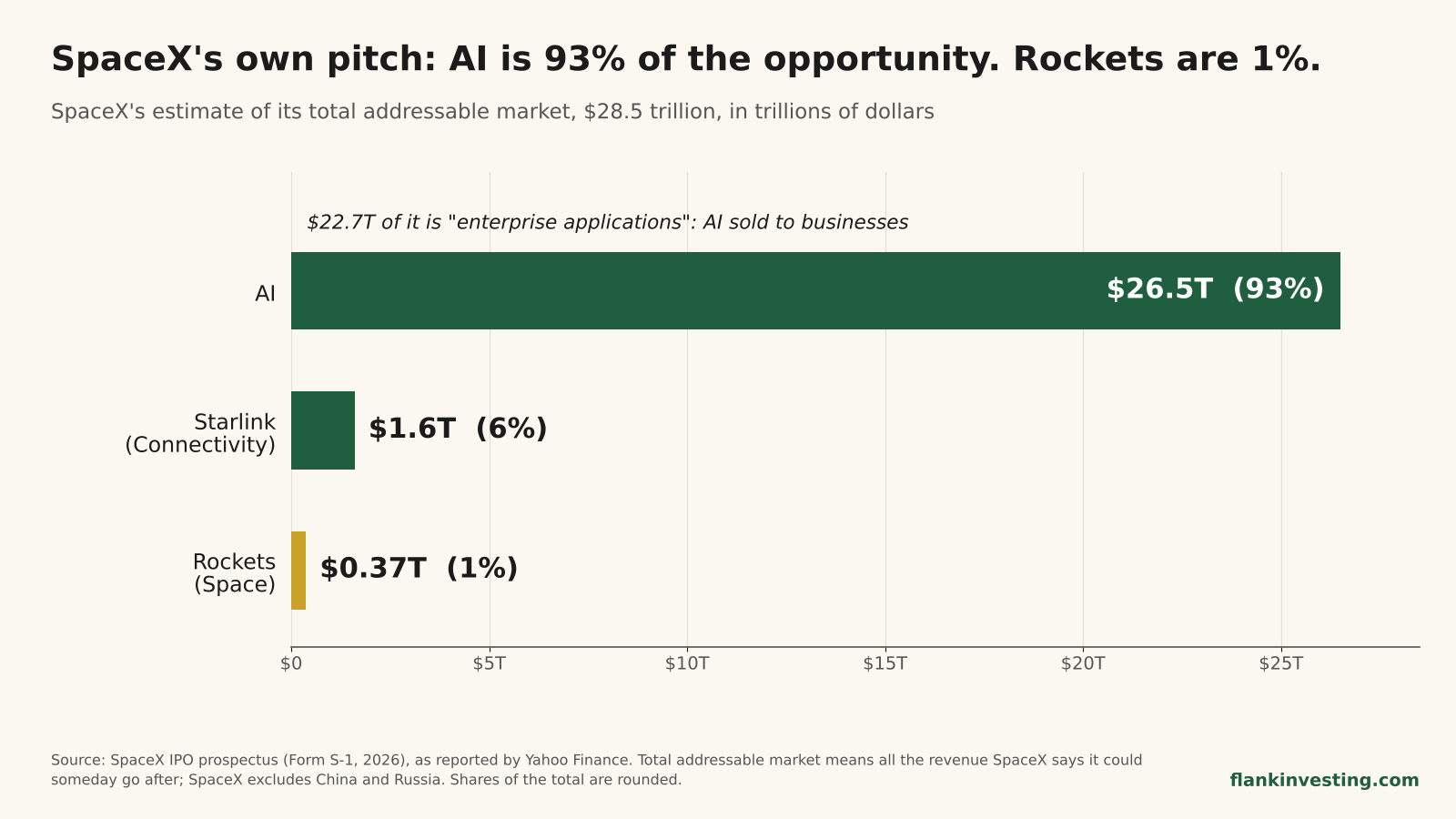
When SpaceX filed to go public, it claimed "the largest actionable total addressable market in human history": $28.5 trillion. You can check out my S-1 piece where I tore it apart. My biggest complaint: almost all of it was from enterprise software TAM (can't make this sh*t up)
Space is $370 billion of it, about 1%. Connectivity, mostly Starlink, is $1.6 trillion. AI is $26.5 trillion, and $22.7 trillion of that, roughly 80% of the whole thing, is AI sold to businesses.
One research firm points out that $22.7 trillion is basically the size of the entire global digital economy.
That's probably why SpaceX bought Cursor, the AI coding tool. Four days after the IPO, it agreed to pay $60 billion in stock, about 389 million new shares (the deal closed Aug 14). At today's price, those shares are worth about $67 billion. Cursor was on pace for about $4 billion a year in revenue in June, and its last private valuation was $29.3 billion. So SpaceX paid about double that, or roughly 15 times revenue.
How's it going? Too early to tell. SpaceX's Q3 report in late October will be the first time Cursor shows up in the numbers.
The bull case
To be fair, the bull case is real. Starlink has 12 million subscribers, double a year ago. On Sept 28, Flight 14 reached orbit and put 26 of the new, bigger Starlink satellites up in one trip, about ten Falcon 9 missions' worth. And Jonas says SpaceX's recent deals renting out AI computing power are priced well above what Wall Street is modeling.
TD Cowen says buy with a $200 target, and Jonas's best case is $600.
Reality check
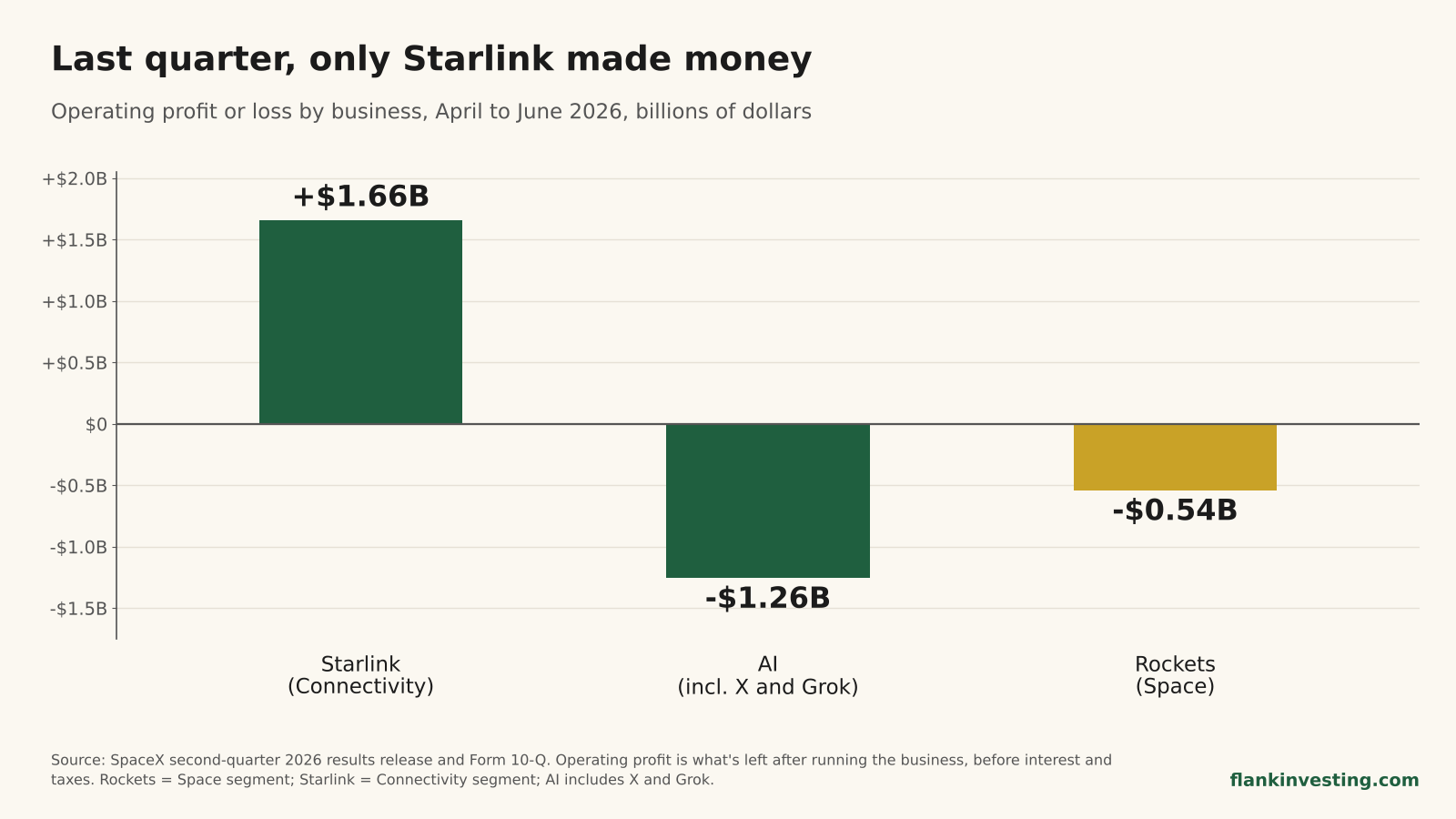
Here's where the money actually comes from. In the second quarter, SpaceX brought in $7.8 billion of revenue, up 92%, and still lost $541 million. Starlink made $1.66 billion of operating profit. AI lost $1.26 billion. The rockets lost $542 million.
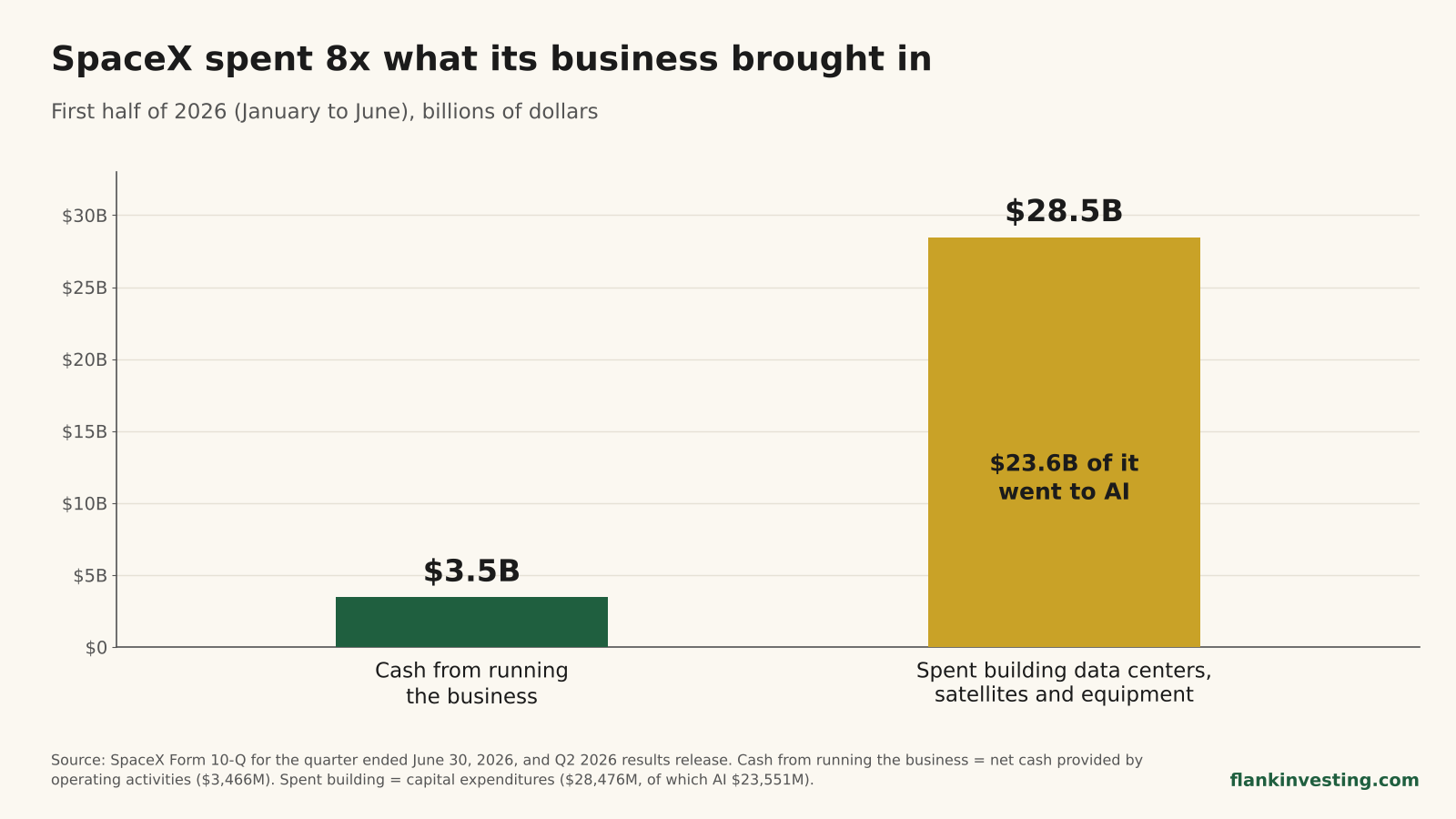
And it's spending like crazy. In the first half of the year, SpaceX made $3.5 billion of cash from running the business and spent $28.5 billion building stuff. $23.6 billion of that went to AI. It covered the gap with borrowed money and new stock, mostly the IPO, which raised $85.7 billion. It ended June with about $100 billion of cash and $39 billion of debt.
One more: a single AI customer was 19.5% of SpaceX's revenue last quarter. SpaceX doesn't say who.
What I believe right now
The rockets are the dream. Starlink is the business. AI is the bet. The rocket business was 12% of revenue last quarter and lost money, and it's still the part everyone falls in love with.
Buffett has a line for this. Airplanes were one of the most amazing inventions ever, and airlines were a money pit for investors for decades. In his 2007 letter, he joked that a smart capitalist at Kitty Hawk would have "done his successors a huge favor by shooting Orville down."
Not everyone on Wall Street is buying the AI story either. DZ Bank says sell with a $100 target, pointing to the spending and all the new shares. Morningstar puts its fair value at $62. And SpaceX's president, Gwynne Shotwell, sold about $52 million of stock in September through a plan she set up in June. She still owns about $830 million.
Final Thoughts
Disclosure: I don't own any SPCX apart from broad-market indices
What I'm watching: Flight 15 and the ship catch, then SpaceX's Q3 report in late October, the first one with Cursor in it.
Want to do the homework with me? SpaceX's research steps are right here on Flank, and Flank is free to get started.
So which one are you actually buying: a rocket company, an internet company, or an AI company?
Sentiment: idk