

NVDA
NVIDIA Corp
Nvidia creates an AI asset class... circular financing continues.
Nvidia announced this week that they have established strategic partnerships to establish independent cmopute financing platforms with Apollo, BlackRock, Blackstone, Brookfield, Goldman Sachs and KKR to mobilize $500B of third-party capital.
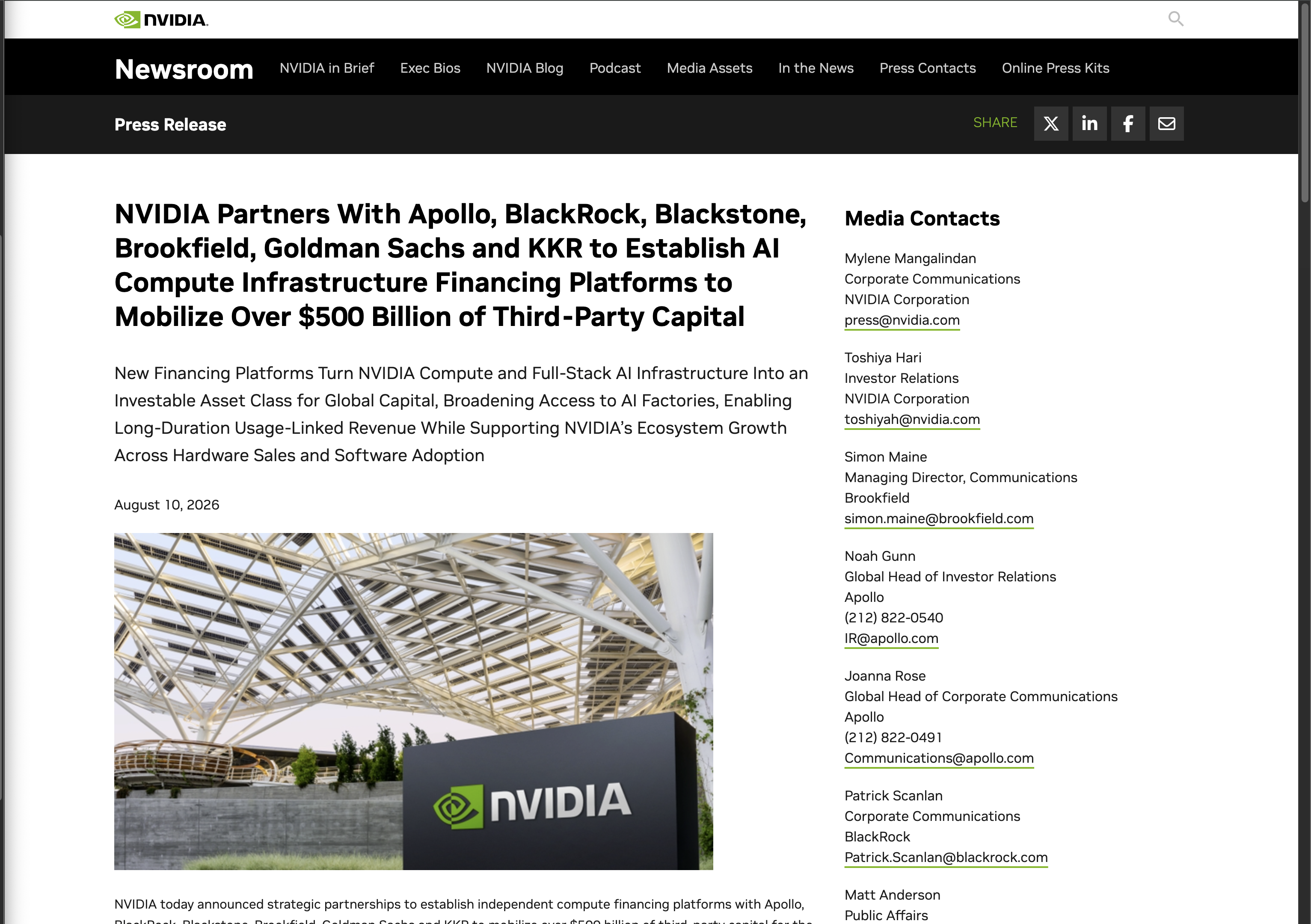
What does this mean in plain english? Wall Street is going to raise half a trillion dollars so Nvidia's customers can rent more Nvidia chips.
The WSJ gave us this chart, which sums it up really well:
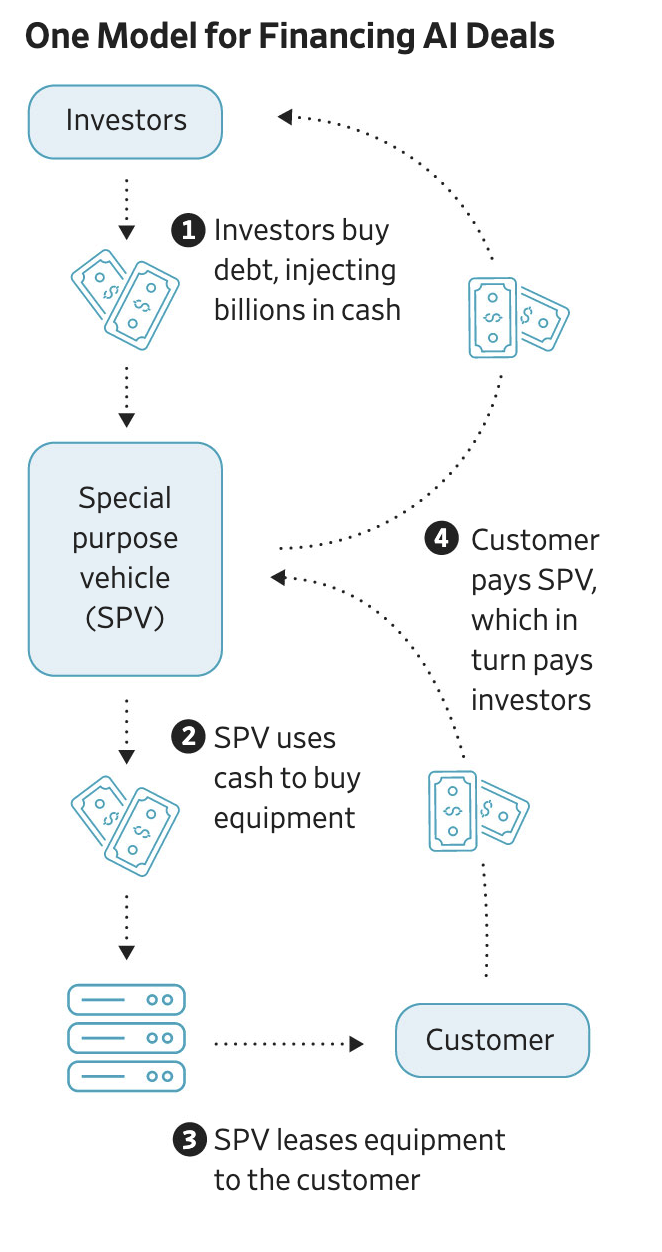
Here's the mechanics of the new offering:
Building AI data centers costs more money than almost anyone has.
Morgan Stanley estimates the big cloud companies will spend $3.5 trillion on AI infrastructure between 2026 and 2028.
Nobody generates that kind of cash, not even Microsoft.
So instead of paying out of pocket, the buyers will borrow, and these six firms will raise the money from the people whose money they manage: pension funds, insurance companies, endowments.
The loans get secured by the chips and data centers themselves, the same way your mortgage is secured by your house. The debt gets packaged into bonds through special purpose vehicles (shell companies built to hold a single project) and sold to investors. Goldman, the only actual bank in the group, runs the bond sales.
One detail before we go further: nothing is final. These are memorandums of understanding, which are agreements to try to reach an agreement. Nvidia's own press release admits the partnerships "remain subject to" execution of the final agreements. The $500 billion is a target, not a commitment.
“NVIDIA has reached an important milestone. We began by building chips; today, we are helping create a new class of productive, investable infrastructure: AI factories,” said Jensen Huang, founder and CEO of NVIDIA
After the announcement though, many skeptics are claiming this is just another example of how AI circular financing is running rampant - resembling the 2000 dot-com bust.
Jensen defended himself on an X post, where he... didn't really answer the question... wonder why?
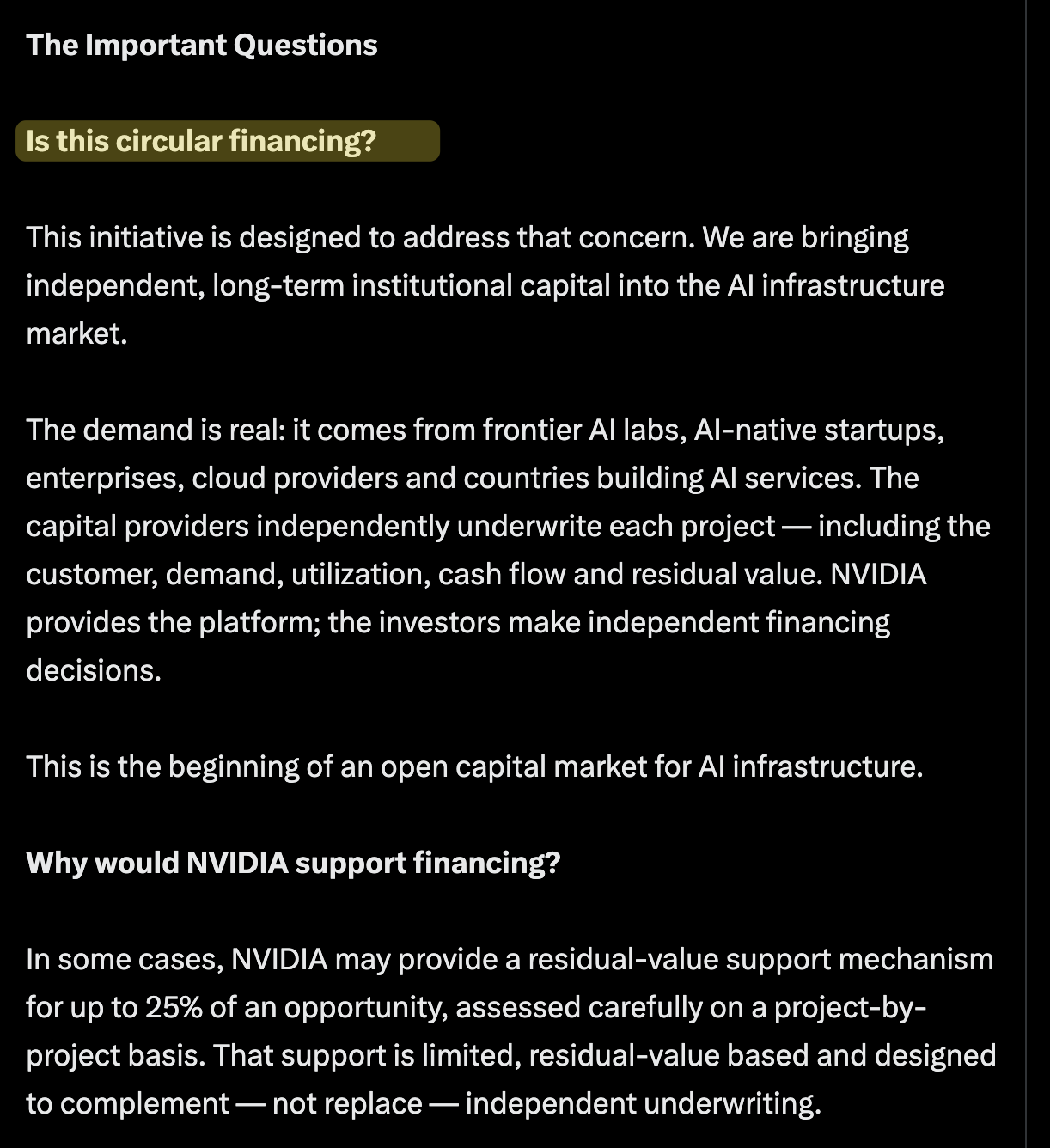
His defense boils down to two claims: the money comes from independent investors who will underwrite each project themselves, and Nvidia just "provides the platform."
Except Nvidia is not just providing the platform. Buried in the announcement, KKR mentions that Nvidia is a founding investor in Helix Digital Infrastructure, KKR's financing vehicle. Nvidia owns a piece of one of the funds that will finance purchases of Nvidia hardware. The circularity critique isn't something the bears invented. This is literally written in Nvidia's own press release.
And the end of that paragraph is also quite telling. He wrote, "In some cases, NVIDIA may provide a residual-value support mechanism for up to 25% of an opportunity, assessed carefully on a project-by-project basis. That support is limited, residual-value based and designed to complement — not replace — independent underwriting."
If these chips are such an obviously "investable asset," why does the manufacturer need to insure their resale value to get lenders comfortable? This, to me, indicates demand is softer than they are letting on. Ben Thompson made the same point this morning: Nvidia wouldn't need to backstop residual value if buyer confidence in GPUs as an asset were truly strong.
The final thing I want to call out is what Jensen's entire thesis lies upon, seen in this quote, where he describes the "Virtuous Cycle" of AI:
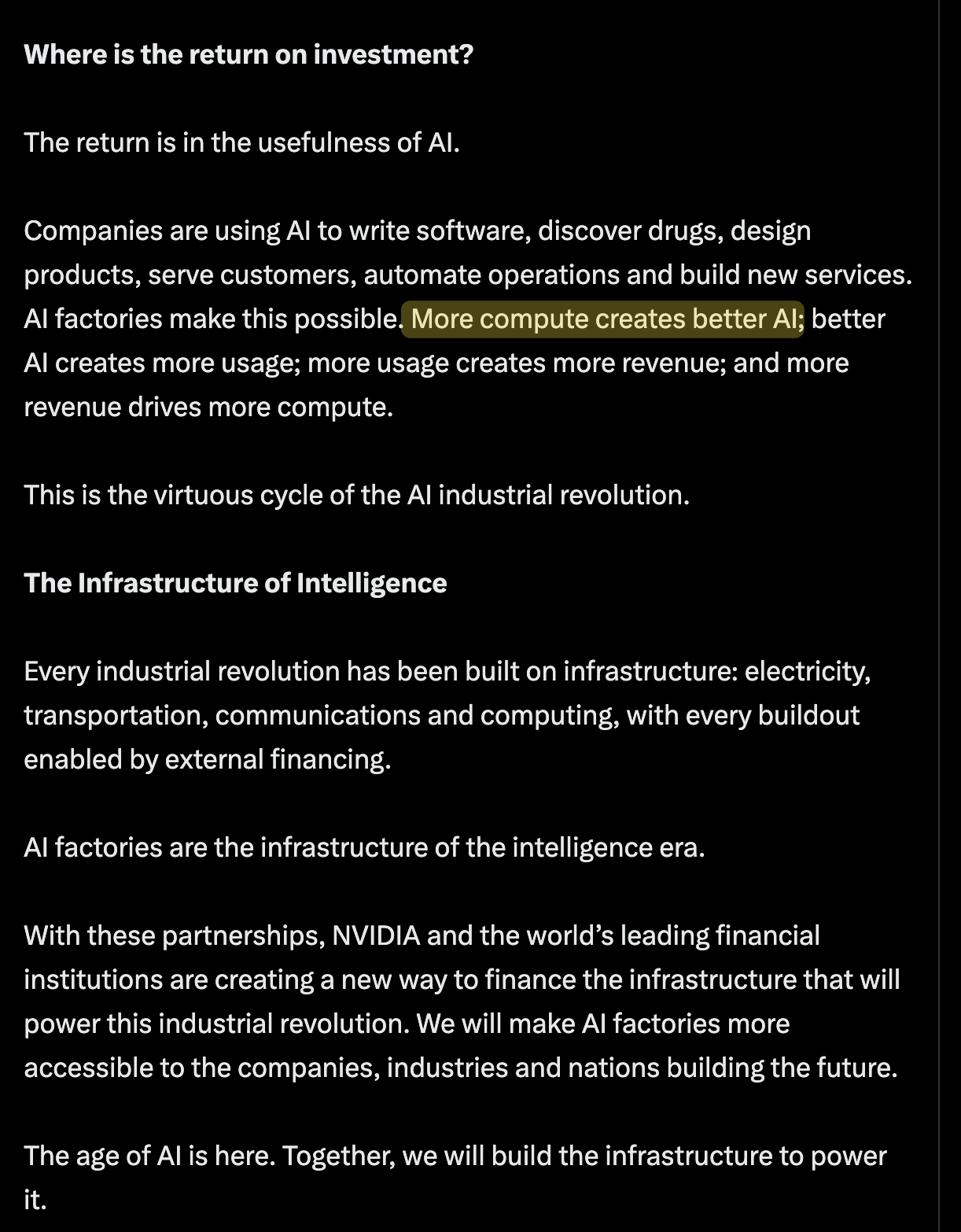
"Companies are using AI to write software, discover drugs, design products, serve customers, automate operations and build new services. AI factories make this possible. More compute creates better AI; better AI creates more usage; more usage creates more revenue; and more revenue drives more compute."
Everything hinges on more compute creating better AI. Will this always be true?
So far, honestly, yes.
Every generation of Nvidia chips has sold out. The rental market for AI compute is sold out too, with one-year H100 contract prices up about 40% since last October. And revenue is following the compute: Anthropic's revenue run rate went from $9 billion in December to $47 billion by late May, one of the fastest revenue ramps ever recorded.
But the market already showed us what happens when this assumption wobbles. In January 2025, a Chinese lab called DeepSeek claimed near-frontier AI performance from a model that cost $5.6 million to train. Nvidia fell 17% and lost $589 billion of market value in one day, at the time the largest single-day loss for any company in history. That's how much weight this single assumption carries.
And here's what bugs me even if the assumption holds. Jensen's cycle has four links, and the weak one isn't "more compute creates better AI." It's "more usage creates more revenue." OpenAI booked $13 billion of revenue in 2025 against a $20.9 billion operating loss, per leaked audited financials. Roughly 95% of ChatGPT users pay nothing. An MIT study found 95% of corporate AI pilots produced no measurable profit impact. Usage is exploding. Revenue is growing. Profit, for most of the ecosystem, still doesn't exist. Bain estimates the industry needs $2 trillion in annual AI revenue by 2030 to justify the buildout, and the current trajectory falls roughly $800 billion short.
From this WSJ article that released later today: “This is great for Nvidia, which needs its customers to have access to capital,” said Jack Ablin, founding partner at the $260 billion family office Cresset, an investor in Nvidia. “But if you’re a debt investor relying on compute power as collateral? I mean, historically, that’s an asset that’s had the shelf life of lettuce.”
Is this circular financing? How bad is it getting?
Since Jensen dodged the question, let's answer it here.
First, what circular financing actually is: a supplier finances its own customers, the customers use that money to buy the supplier's products, and the supplier books it all as revenue. The money moves in a circle, and everyone in the circle reports growth.
Is this deal that? Here's my honest read: this specific deal is Nvidia trying to do the opposite. Recruiting outside money means Nvidia doesn't have to finance customers off its own balance sheet, and if a pension fund genuinely underwrites a project and eats the loss if/when it fails, that purchase is less circular than Nvidia writing the check itself.
But Nvidia couldn't fully let go. It kept three fingers in the loop: it owns a stake in Helix, it's guaranteeing up to 25% of residual value, and it built this entire pipeline for its own customers. Goldman's CEO described the goal as creating "a market for credit backed by NVIDIA compute." The product is the collateral. The vendor is the guarantor.
And this deal doesn't exist in a vacuum. It caps off a year where circular financing went from a finance-Twitter theory to the dominant structure of the AI economy. Analysts tracking the interlocking deals put the total north of $800 billion
Here is a WONDERFUL site to see the current state of play on AI circular financing
We've been here before
In the late 1990s, telecom equipment makers ran this exact play. Lucent, Nortel, and Cisco lent money to cash-strapped telecom startups so those startups could buy their equipment. Lucent committed $8.1 billion. Nortel, $3.1 billion. Cisco, $2.4 billion.
McKinsey later tallied about $25.6 billion of vendor financing across nine suppliers. At the peak, the financing Cisco and Nortel extended to customers exceeded 10% of their annual revenues.
It worked beautifully until it didn't. Between 2000 and 2003, 47 of those telecom customers went bankrupt. The vendors wrote off the loans. The SEC charged Lucent with manipulating $1.1 billion of revenue through channel stuffing and hidden side deals.
Cisco fell 89% from its peak and only recently returned to its 2000 high, even though it earns roughly seven times more today. The FCC chairman told Congress the industry owed a trillion dollars, much of it never repaid. Telecom bond investors recovered about 20 cents on the dollar.
Now the scale comparison. The entire dot-com vendor financing pool was about $25.6 billion. Today's circular AI arrangements are north of $800 billion. Thirty times bigger. This one Nvidia platform alone is twenty times bigger than everything Lucent, Nortel, Cisco and six other suppliers did combined.
Two things are genuinely different this time, and I want to be fair. First, only about 7% of the fiber laid in the dot-com era was ever lit, while today's AI data centers run at roughly 80% utilization. The demand is real, if slightly exaggerated. Second, Lucent lent to startups with no revenue, while Nvidia's biggest customers are the most profitable companies in human history, funding much of this from operating cash flow.
But watch where the marginal dollar is coming from now. CoreWeave plans $31 to $35 billion of capital spending this year against $6.2 billion of trailing revenue, funded by GPU-backed debt. OpenAI loses billions. Safe Superintelligence has no revenue at all. The buyers are migrating from the profitable to the leveraged, and a $500 billion financing platform is exactly the machine that accelerates that migration.
Seriously, we've been here before: this comparison is uncanny
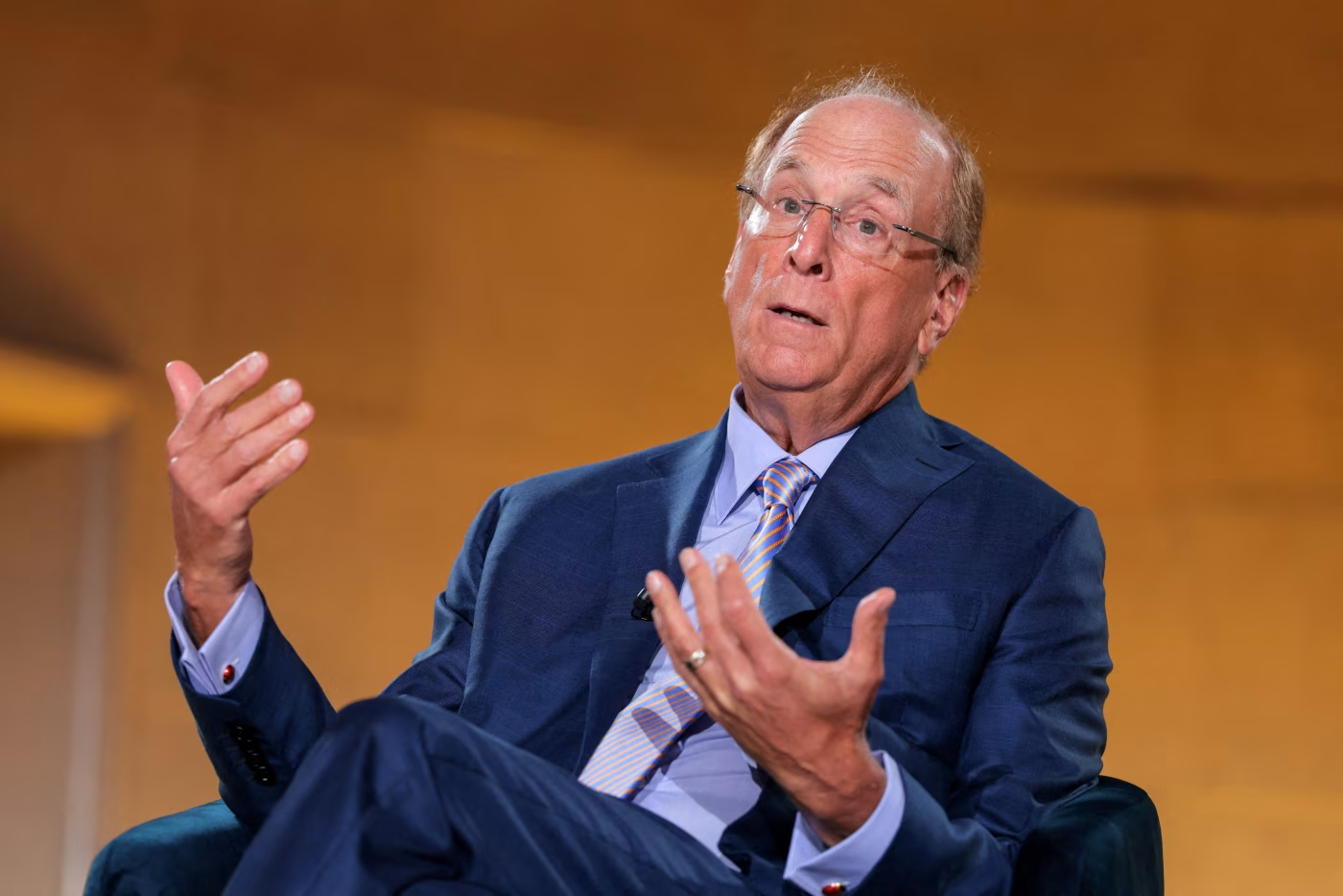

Larry Fink, CEO of Blackrock, now vs then
There's one more detail from the WSJ's coverage of this deal that I can't stop thinking about. BlackRock CEO Larry Fink compared this moment to the beginning of his career in the 1970s, when Wall Street pioneered the mortgage-backed securities market. He would know. Fink helped invent that market.
Mr. Fink means the comparison as a compliment: mortgages went from one-off loans sitting on bank balance sheets to a standardized, tradable, multi-trillion dollar asset class. That is exactly the plan for AI compute.
Michael Burry literally became famous for betting against mortgage-backed securities. Burry's reaction to this announcement, posted on his Substack: "Structuring credit is a natural part of the system. Structuring unnatural credits to prolong momentum late in the bull phase is where the worry comes in."
So the man who built the mortgage bond and the man who broke it are finally staring at the same trade. One sees 1978. The other sees 2006. And the difference between those two years is the difference between an asset class being born and an asset class being rated AAA right before it detonates.


Michael Burry, famously shorted MBS back in 2006, now vs then
Final Thoughts
This deal, by itself, is not the smoking gun. Bringing real outside underwriters into the loop is arguably the least circular thing Nvidia has done all year. If the pension funds do genuine due diligence and bad projects get rejected, this becomes boring infrastructure finance, like aircraft leasing.
But follow the risk. Meta's data center bonds run to 2049. Nvidia just issued its own notes maturing in 2056. CoreWeave's loan documents assume a six-year useful life for the GPUs inside. Nvidia ships a new chip architecture every single year. And Michael Burry, who shut down his hedge fund and now spends his days shorting this trade, argues the true economic life of these chips is two to three years, and that the industry is understating depreciation by $176 billion through 2028. Somebody owns the gap between a 2049 bond and a chip that's obsolete by 2029. Increasingly, that somebody is a pension fund or an insurer holding an investment-grade rated bond.
When a CEO has to publish a blog post explaining why his announcement is NOT circular financing (but then dodges it), that tells you what the market heard. And the market did hear it. The stock fell 2.9% on the news before bouncing back the next day, but the bond market's verdict stuck: the cost of insuring Nvidia's debt against default jumped the most in two weeks.
Sentiment: Neutral, but will be excited when this (inevitably) all crashes down