

ORCL
Oracle Corp
I said watch two things on Oracle's recent earnings. Both happened.
Disclosure: I am a former Oracle employee and held the stock in the past.
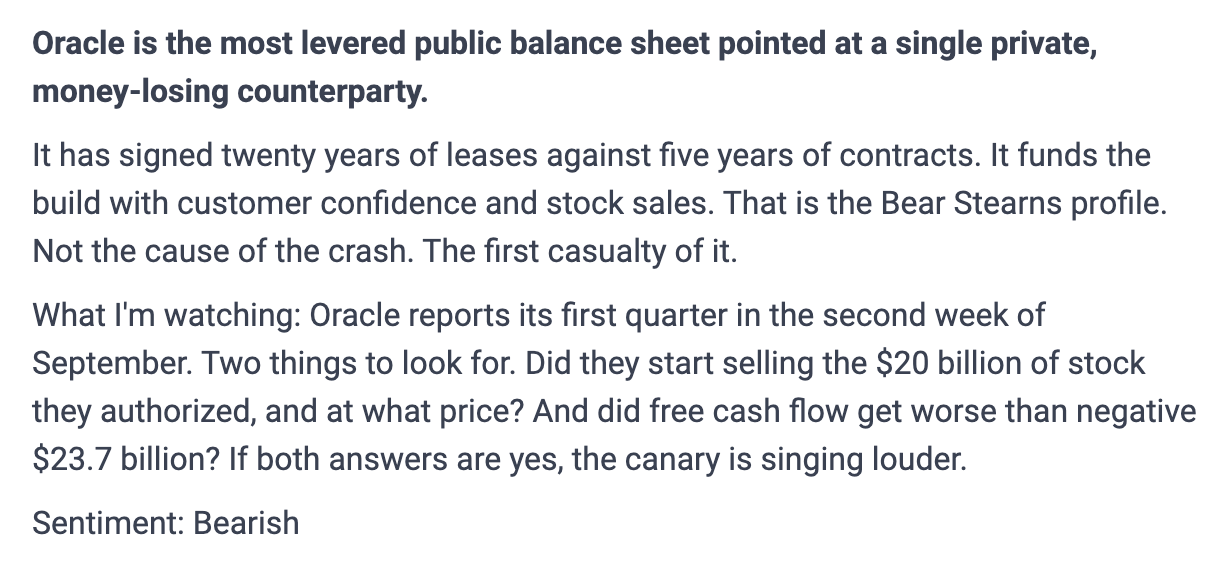
Two weeks ago I made this post on Oracle asking whether it could be ground zero for an AI crash. I ended it with two things to watch in the September print. Did they start selling the $20 billion of stock they authorized, and at what price? And did free cash flow get worse?
Both answers are yes.
They sold the entire $20 billion stock program in one quarter. Not started selling. Sold all of it. That's 141 million new shares at about $141 apiece, $19.9 billion net, straight out of the 10-Q.
Free cash flow came in at negative $5.4 billion for the quarter. Operating cash flow was $23.1 billion, capex was $28.5 billion, and I'll get into why that first number is not what it looks like in a minute (Q1 release).
The stock was $154 when I hit publish on the first post. It closed today at $140, down 9% since that post and 56% off its high. Oracle sold $20 billion of stock at almost exactly today's price.
Dave, stop being so negative.
Now the quarter itself, because the headline numbers were great. Revenue was $19.3 billion, up 30%, and almost all of that growth came from one place: cloud infrastructure, the business where Oracle rents out data centers full of Nvidia chips, went from $3.3 billion to $7.4 billion in a year.
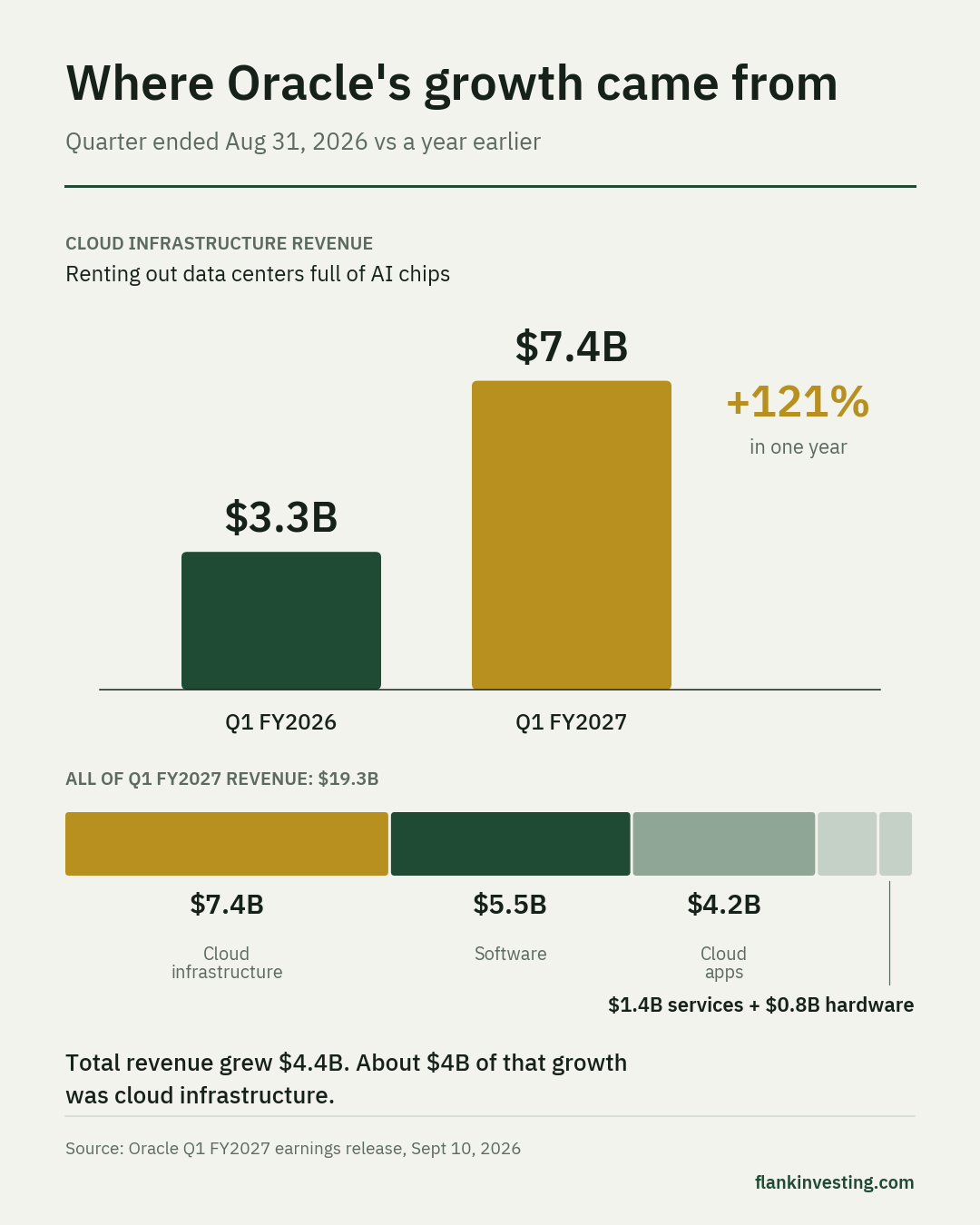
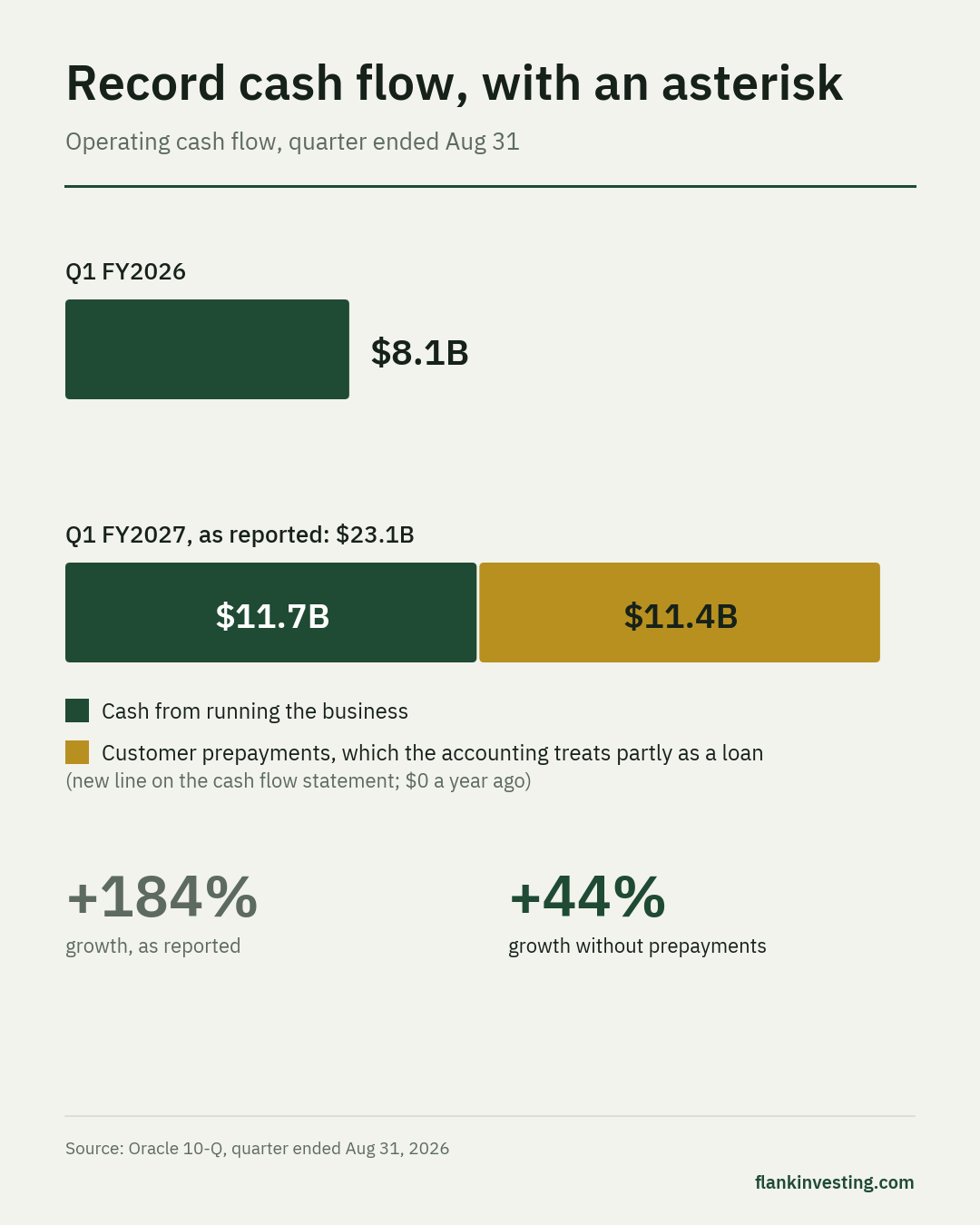
Net income was $4.8 billion, up 60%, and operating income grew faster than revenue, which is what you want to see from a company spending this much. The backlog, meaning signed contracts Oracle hasn't delivered on yet, hit $664 billion. And the number every headline ran with: operating cash flow of $23 billion, up 184%, which the CFO called a record. That last one is the number I want to talk about.
The CFO, Hilary Maxson: "We drove record cash flow from operations of $23 billion in Q1" (Q1 call transcript). That is the number that made the debt story go quiet... at first.
But I think Wall St found out (after human review lol) that there's a bit of financial engineering fuckery happening. The stock popped 8% the morning after earnings and closed down on the day. The 10-Q hit that night. Two trading days later the stock was down almost another 7%.
The smoking gun: a new line item.
Wait, wat? A new line item?
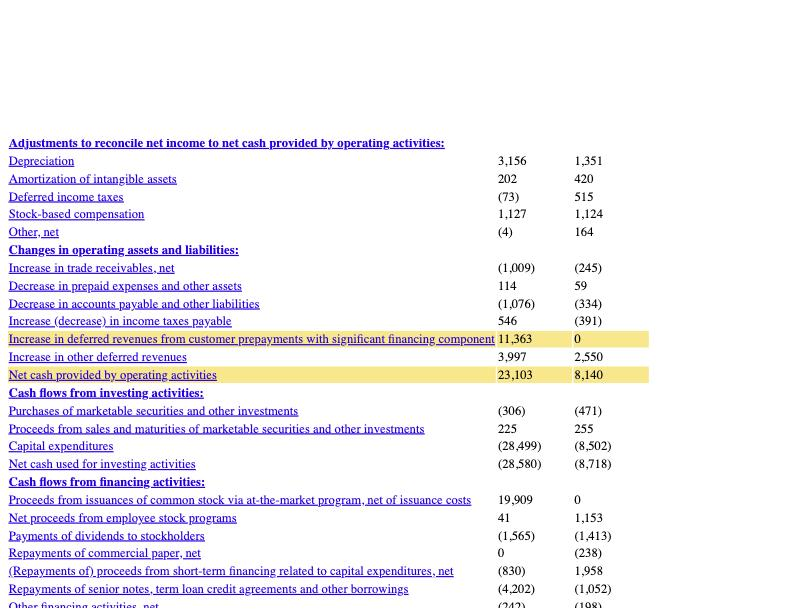
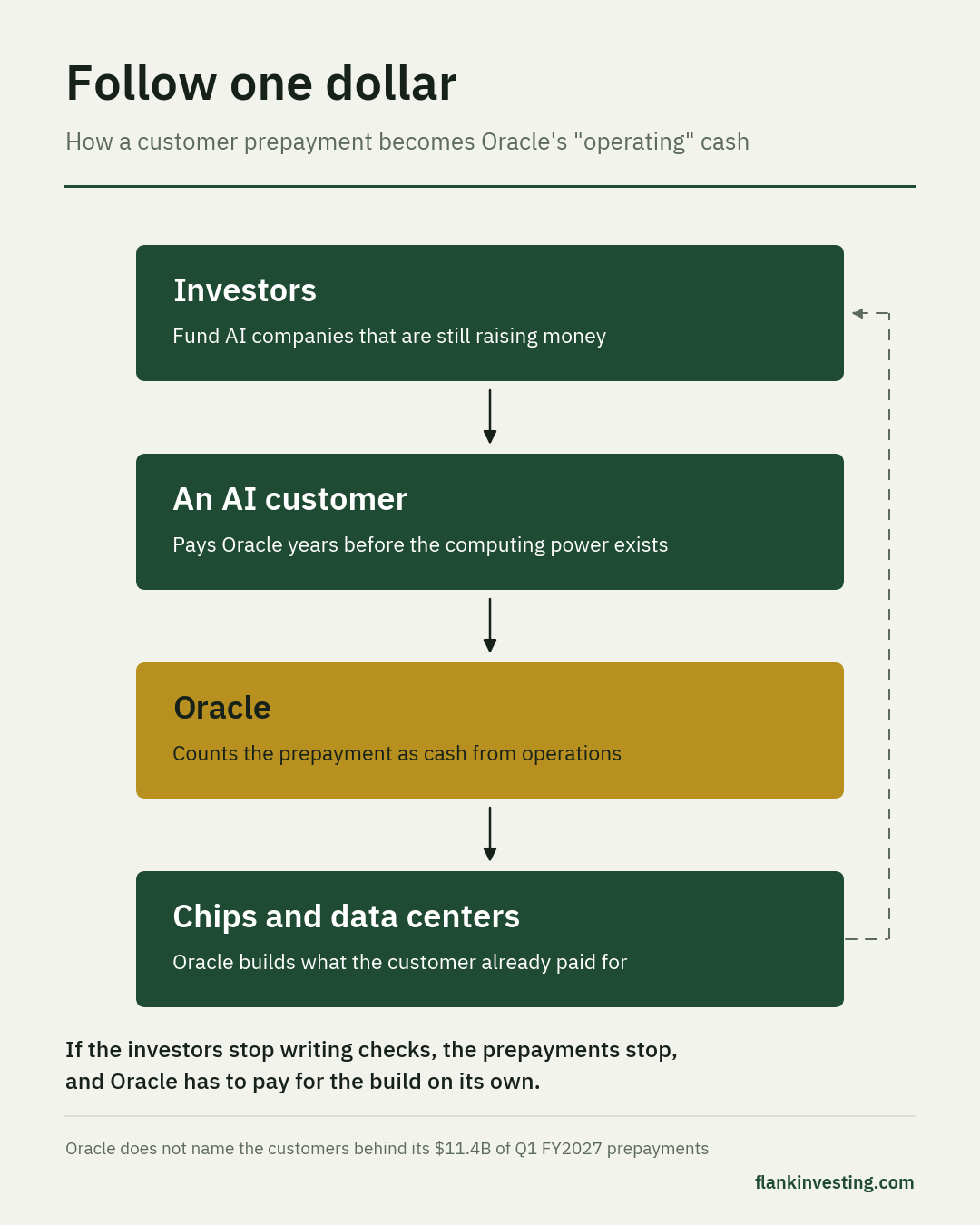
There's a new line on Oracle's cash flow statement: "Increase in deferred revenues from customer prepayments with significant financing component." $11.4 billion. A year ago it was zero.
In plain English: customers paid Oracle years in advance for computing power that doesn't exist yet. How far in advance? The CFO said those prepaid contracts "will not impact our CapEx or revenues until fiscal 28 or beyond." Oracle's fiscal 2028 starts in June 2027. When a payment comes that early, the accounting rules treat part of it as a loan from the customer. Oracle books interest on it and pays it back in GPU hours.
So half of Oracle's record cash flow is customers lending Oracle the money to build the data centers they'll rent. The IOU pile, deferred revenue, doubled in one quarter to $30.8 billion, and $11.4 billion of that $15.4 billion jump was these prepayments.
The math without the loan
Take out the $11.4 billion and operating cash flow is $11.7 billion. Up 44%. Good, not record.
Subtract capex and free cash flow is negative $16.8 billion. Last year's full-year number was negative $23.7 billion. They nearly matched it in three months... ruh roh.
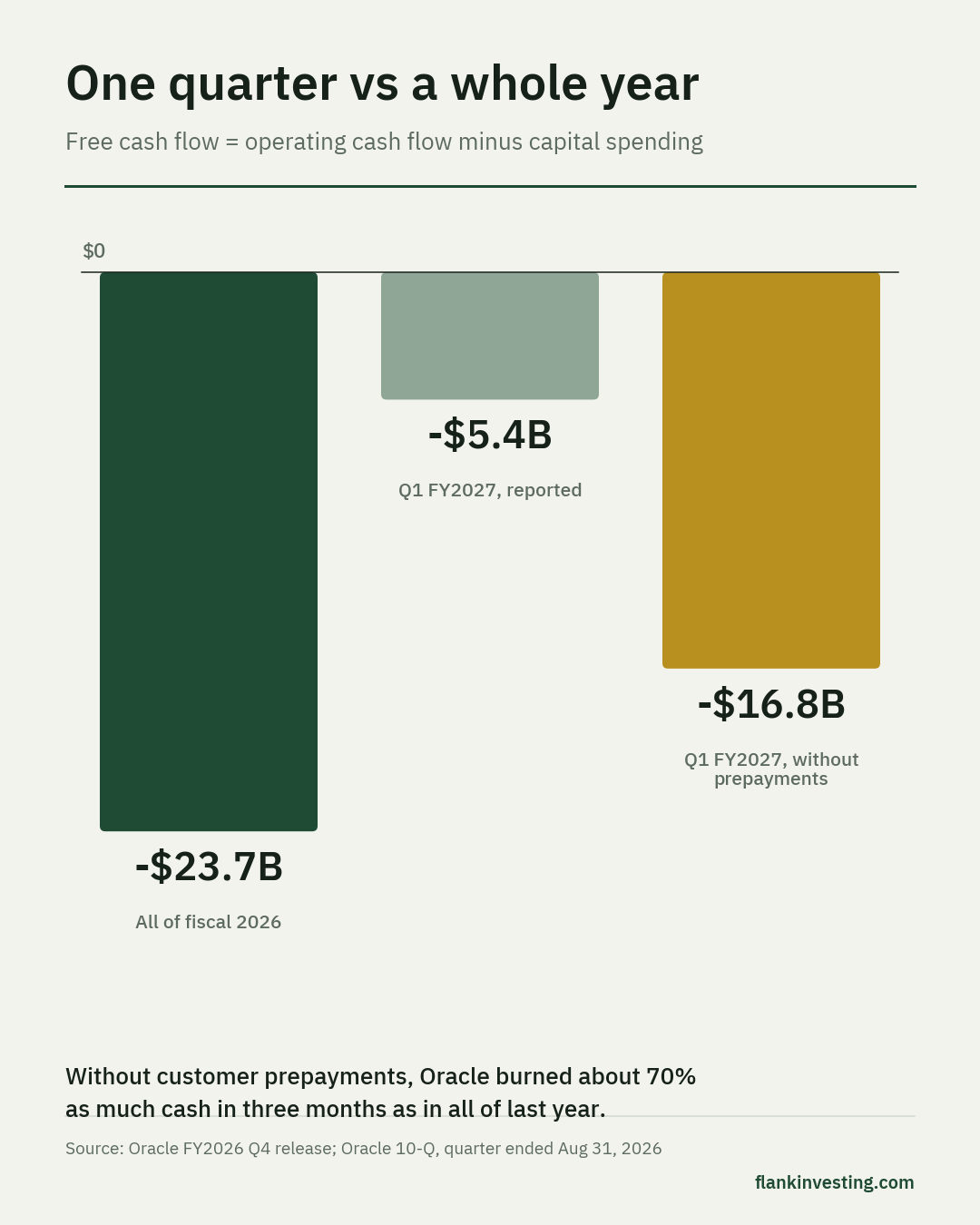
This is the plan, not an accident. Oracle expects to spend $90 to $95 billion building data centers this year. The CFO said on the earnings call that "not more than $70 billion" of that will be Oracle's own cash. The rest, at least $20 to $25 billion, is supposed to come from customers paying up front. They already covered $11 billion of it in the first quarter.
Who prepays $11 billion?
Oracle won't say. But when S&P downgraded Oracle in July, it estimated about half of Oracle's backlog is tied to OpenAI, a private company that burns cash and pays its bills by raising money from investors.
Here's why that matters. A normal company's cash flow comes from customers paying for things they've already received. Oracle's record came partly from customers paying years early for data centers that aren't built yet. If that customer is OpenAI, the money didn't come from OpenAI's profits. It came from OpenAI's investors. So follow one dollar: an investor gives it to OpenAI, OpenAI prepays Oracle, Oracle spends it on chips and buildings, and Oracle's cash flow statement counts it as cash from operations. If those investors ever stop writing checks, the prepayments stop, and Oracle has to fund the build on its own.
The rent is due either way
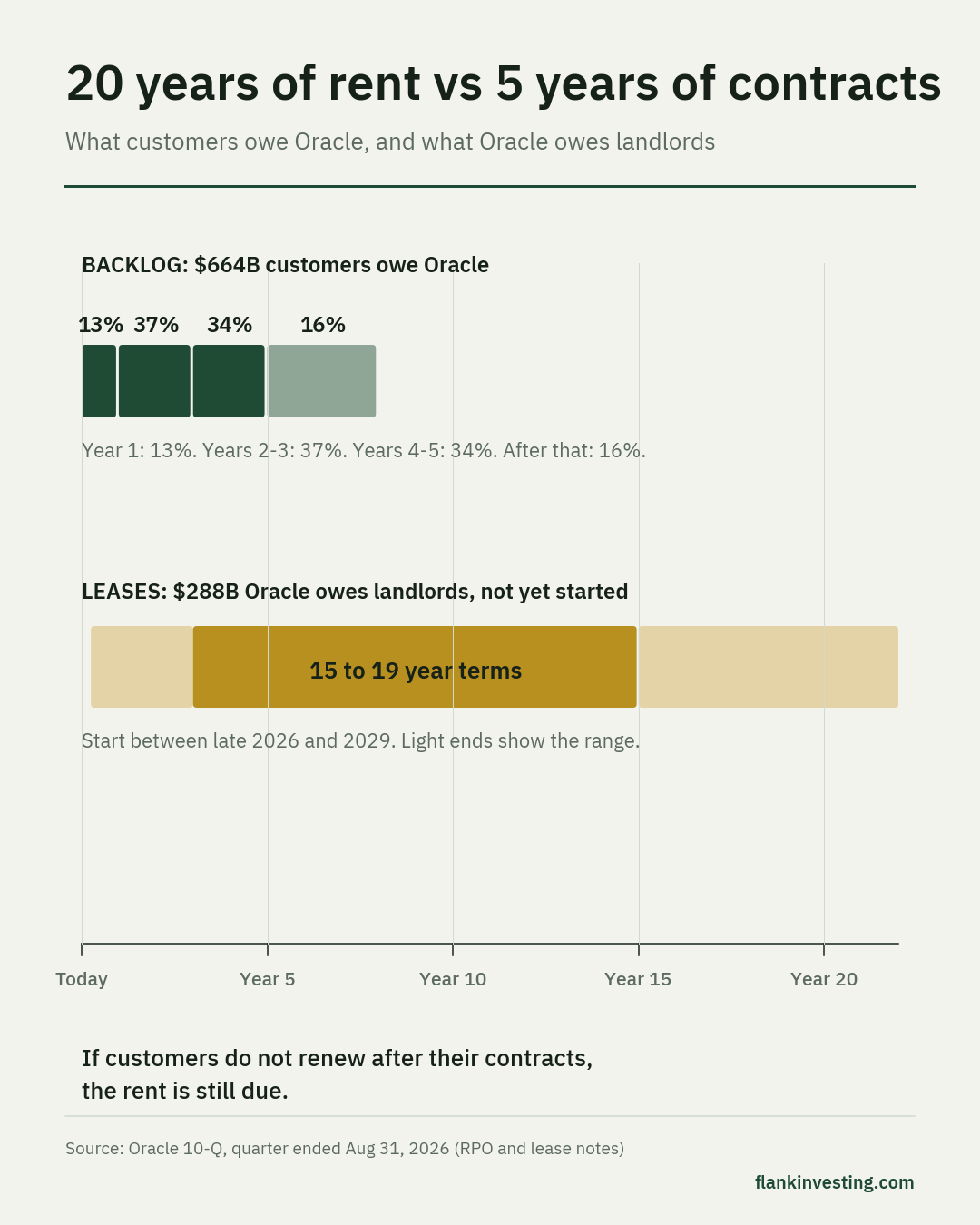
There's one more number that didn't make the headlines. The backlog is what customers owe Oracle. Leases are what Oracle owes landlords for the data center buildings. Oracle has signed $288 billion of data center leases that haven't started yet, up from $261 billion in February, and none of it is on the balance sheet yet. Those leases run 15 to 19 years. Meanwhile, Oracle expects to collect 84% of its $664 billion backlog within five years (10-Q). That's the mismatch from my first post: almost twenty years of rent against five years of contracts. If the customers don't renew, the rent is still due.
The best case for Oracle
Customers don't prepay $11 billion for something they don't want, and cloud infrastructure more than doubling says the demand is real. Prepaid cash is in Oracle's bank account, not a promise, and it means the customer shares the risk of the build. Interest expense rose 55% to $1.4 billion, but operating income still covers it about 4.7 times over.
Oracle used some of the stock money to pay down $4.2 billion of debt. And Larry Ellison scrapped his plan to sell up to 50 million shares, saying he has no other plans to sell. If the customers are good for it and the margins hold, this might be the cheapest money Oracle has ever raised.
That's a lot of ifs pointed at one customer.
Final thoughts
Oracle didn't break this quarter. But! It did exactly what I was worried about. It sold $20 billion of stock, burned more cash, filled the gap with money borrowed from its customers, and called it a record.
What I'm watching next quarter:
does the prepayment line keep growing,
does that $30.8 billion turn into profitable revenue, and
do they come back for more stock.
Sentiment: Bearish